

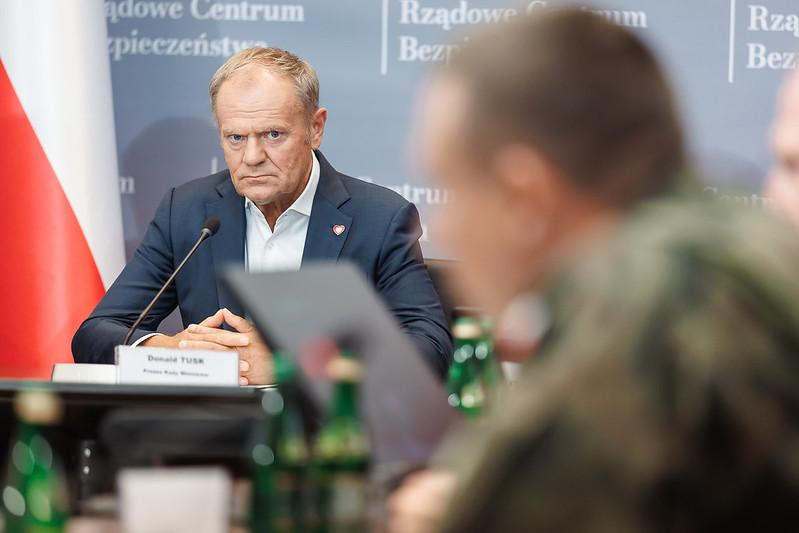
Prime Minister Donald Tusk said Sunday that Russian escalation “is becoming a fact” and that Poland cannot rule out the campaign reaching its own territory, after jet-powered drones struck Ukrainian targets within one to two kilometres of the Polish border.
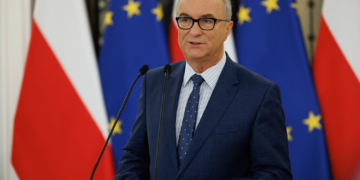
Tusk spoke after a 17:00 briefing at the Government Security Centre with the interior and defence ministers and the heads of the security services. The meeting was called after overnight and early-morning strikes on the Ukrainian side of the Dorohusk–Yahodyn corridor — one of the main road and rail links between Poland and Ukraine.
- Find more news from Poland on our Homepage .
“What we know, and what can be expected, is that the coming weeks and months will be a period of very intensified activity by Russia,” Tusk said. “Unfortunately, we cannot rule out that this escalation will also affect our territory.”
He added that Polish authorities had for months received assessments from their own services and from allies pointing to a further rise in Russian pressure. “I hope the worst-case scenario doesn’t come true, but events so far confirm the information we’ve been receiving for several months — that the worst variants are also possible.”
Tusk said Poland would now operate in a “significantly heightened mode.” He asked the public not to slip into panic, but said Warsaw and its allies must be ready for a joint response “if the need arises.”
Polish defence systems detected more than a dozen jet-powered Geran-5 drones operating over western Ukraine before dawn. Defence Minister Władysław Kosiniak-Kamysz said one struck about one kilometre from the Polish border and another about five kilometres away. F-16 fighters, helicopters and a Saab airborne early-warning aircraft operated in Polish airspace. The Operational Command said Polish airspace was not violated.
On the ground the picture was closer. Polish Border Guard officers said a drone destroyed a truck about 800 metres from the Dorohusk–Yahodyn crossing. Interior Ministry spokeswoman Karolina Gałecka said a petrol station on the Ukrainian side was hit and two trucks caught fire. Processing at the crossing was halted; more than 280 travellers plus Border Guard and customs staff were briefly evacuated. Traffic later resumed. No one was injured on the Polish side.
Ukrainian Railways said a separate drone struck the locomotive of a Kyiv–Warsaw passenger train about two kilometres from the frontier in Volyn region. The crew had been warned; no passengers were hurt. PKP Intercity said the incident occurred on Ukrainian territory before the Polish operator took over the train, that 206 people were aboard, that none were Polish citizens, and that the service was accepted with a delay of about 370 minutes. Later Polish official comments distinguished confirmed hits — a fuel site near the crossing and rolling stock on a spur — from some of the first social-media claims. Russia’s defence ministry said it had targeted infrastructure used to move military cargo from Europe into western Ukraine.
BREKAING:
— Poland 24 🇵🇱 (@poland24com) September 13, 2026
A Russian drone struck a passenger train on the Kyiv–Warsaw route just 2 km from Poland’s border in Volhynia, Ukraine’s rail operator says. pic.twitter.com/siF511BI7K
Residents of Dorohusk described a flash and a blast that shook windows around 04:00, followed by the sound of Polish aircraft. The Government Security Centre sent air-threat alerts to districts in Lublin province, including Chełm, Włodawa and Krasnystaw. Sirens sounded. Alerts were later stood down.
Interior Minister Marcin Kierwiński called the strikes “terrorist attacks” and said they were being treated with “the utmost seriousness.” Operational Command spokesman Lt Col Jacek Goryszewski said the threat to Poland was “real” because drones were striking targets only a few kilometres from the frontier.
Tusk placed the night in a longer pattern. Attempts to paralyse border crossings are “not the first such incident,” he said, pointing to earlier Russian pressure on the Moldova–Ukraine frontier. Polish and Ukrainian services had already averted what he described last week as a “direct threat” to a Poland–Ukraine crossing. He said Moscow’s plan included disruption, paralysis and possibly the destruction of Ukrainian border infrastructure — which, by definition, also touches Poland.


Kosiniak-Kamysz said Russia is changing tactics: jet-powered drones launched in small groups to soak up Ukrainian air defences. Their range and accuracy, Tusk said, are a cause for concern even when the impact points remain on the Ukrainian side of the line.
The political message from Warsaw was the same as the operational one. Foreign Minister Radosław Sikorski, in Kyiv, called the strikes an escalation and argued that Polish and Ukrainian security are “inseparably linked.” Ukrainian Foreign Minister Andrii Sybiha said the hits near Yahodyn were “Putin’s terror knocking directly on the doors of the EU and NATO.”
Nothing in Sunday’s official record shows a Russian munition landing on Polish soil. That is the line Tusk and the General Staff held all day. The change is the distance, the munition type, and the prime minister’s willingness to say out loud that the next phase may not stop at the Bug.
Poland has spent the past two years expanding air defence, hosting a growing U.S. presence and treating the eastern crossings as strategic infrastructure rather than ordinary customs posts. Sunday’s meeting was the first public signal that the government now expects a sustained, not episodic, Russian campaign against the logistics that keep Ukraine supplied from NATO territory.
Crossing traffic at Dorohusk was back to normal by afternoon. The Kyiv–Warsaw train continued west after checks. The warning from the RCB building is what remains.