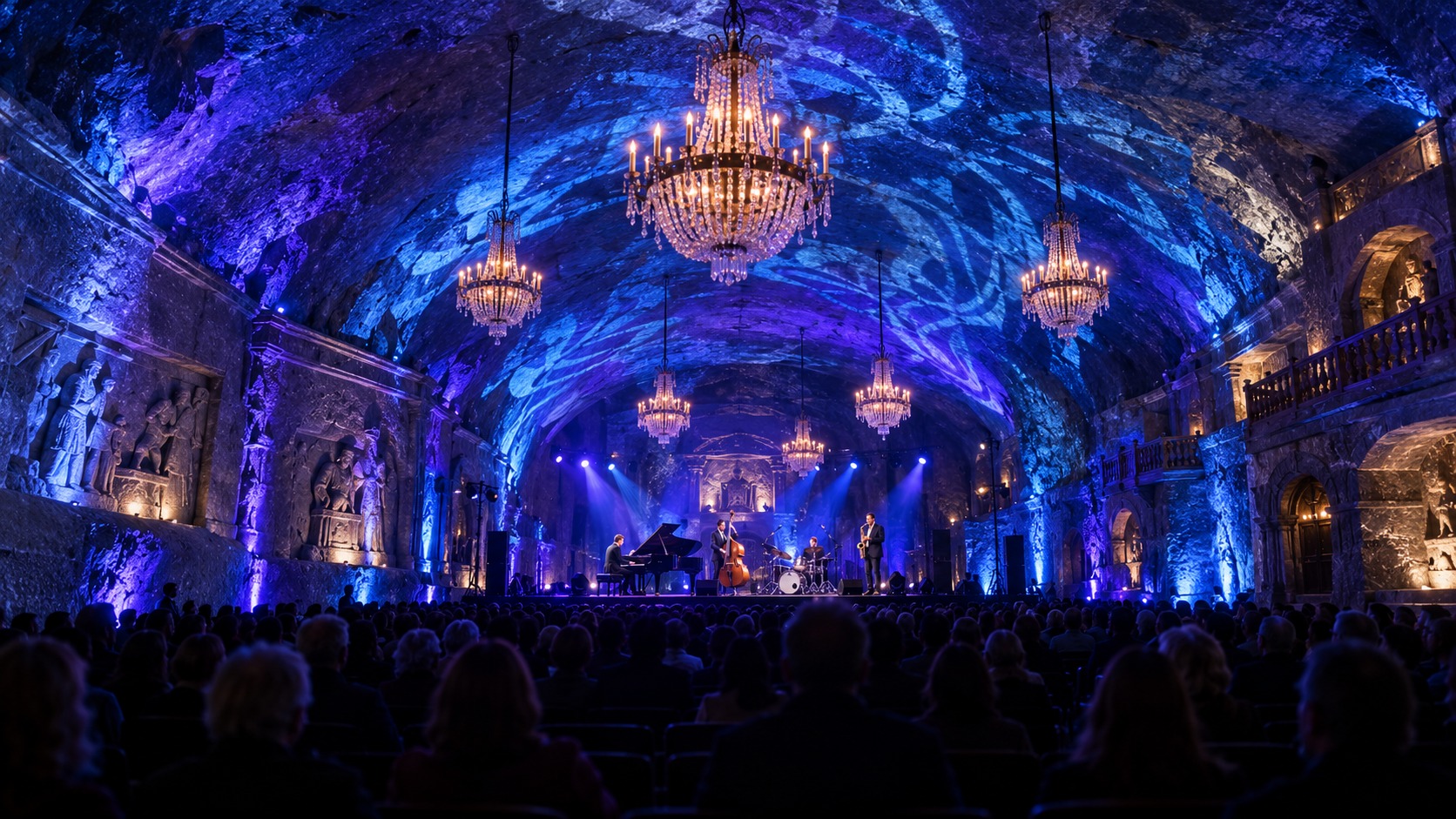
More than 100 metres beneath the streets of southern Poland, an extraordinary concert is being prepared to mark the opening of one of Europe’s longest-established jazz festivals.
On Saturday, 31 October 2026, musicians will descend into the historic Wieliczka Salt Mine for a performance combining jazz, visual art and orchestral music inside a vast underground chamber carved from salt.
The event, called Magnum Sal 2026, will serve as the prologue to the 71st Krakowskie Zaduszki Jazzowe, or Kraków All Souls’ Jazz Festival.
- Find more news from Poland on our Homepage .
The main festival will then take place across Kraków from 3 to 7 November, bringing together emerging Polish musicians, international performers and established figures from the country’s jazz scene.
With roots stretching back to 1954, Krakowskie Zaduszki Jazzowe has become one of Poland’s most enduring musical traditions.
The organisers describe it as Europe’s oldest jazz festival, although that international distinction has not been independently established.
Jazz in a chamber carved from salt
The opening concert will take place in the Warszawa Chamber, an underground performance hall approximately 125 metres below the surface of the Wieliczka Salt Mine.
The chamber’s carved walls, high ceiling and elaborate chandeliers provide a striking setting far removed from a conventional jazz club.
Wieliczka itself is one of Poland’s best-known historic sites.
Salt has been extracted in the area since the Middle Ages, and the mine’s vast underground network contains chapels, sculptures, tunnels and chambers created through centuries of mining.
The site was inscribed on the UNESCO World Heritage List in 1978 and is now part of the wider Wieliczka and Bochnia Royal Salt Mines World Heritage property.
For the 2026 festival, the underground concert will feature two musical projects.
The first, Witkacy MultiArt, is led by Polish composer and pianist Leszek Kułakowski. It combines jazz with visual projections inspired by the artistic legacy of Stanisław Ignacy Witkiewicz, the Polish writer and artist widely known as Witkacy.
Kułakowski will perform alongside bassist Piotr Kułakowski and drummer Tomasz Sowiński, with visualisations created by Andrzej Wąsik.
The second project, Ananke, will be led by saxophonist and vocalist Marek Stryszowski.
Its expanded ensemble includes trumpeter Tomasz Kudyk, vocalist Rasm Almashan, guitarist and bassist Krzysztof Ścierański, accordionist Oleg Dyyak and percussionist Sławomir Berny.
The performance will also feature the Wieliczka Salt Mine’s Representative Brass Orchestra, conducted by Antoni Majerski, alongside visual work by Adam Drzewiecki.
According to the festival’s official programme, the concert begins at 18:00 local time.
It is a special accompanying event ahead of the five-day main programme.
A festival born in a school gymnasium in 1954
The origins of Krakowskie Zaduszki Jazzowe are considerably more modest than its latest underground concert.

In 1954, Polish jazz musicians gathered in the gymnasium of a primary school on Królowej Jadwigi Street in Kraków.
What took place was not a conventional ticketed concert but a nationwide jam session, bringing together musicians who rarely had opportunities to perform in the same place.
The gathering became recognised as the beginning of Krakowskie Zaduszki Jazzowe.
The festival’s unusual name comes from Zaduszki, the Polish term associated with All Souls’ Day and the remembrance of the dead in early November.
In Polish tradition, this period is strongly associated with visiting cemeteries, lighting candles and remembering relatives and friends who have died.
The jazz festival developed its own musical connection to remembrance, honouring performers from earlier generations while providing opportunities for contemporary musicians.
Its early history also reflects the complicated position of jazz in communist-era Poland.
Jazz was sometimes viewed with suspicion by the authorities because of its associations with Western culture and artistic independence.
The festival’s official historical account describes interruptions in 1968 and 1969, when official editions did not take place amid political restrictions.
The event resumed in 1970 under the less religiously suggestive name Krakowski Festiwal Jazzowy, although musicians and audiences continued to associate it with Zaduszki.
Over subsequent decades, the festival attracted major international performers, including American saxophonist Stan Getz and jazz figures associated with Duke Ellington’s orchestra.
Its survival helped establish Kraków as an important centre of Polish jazz culture.
Celebrating 100 years of jazz in Kraków
The 2026 edition will also commemorate a century of jazz history in the city.
A special concert titled 100 Years of Jazz in Kraków is scheduled for Thursday, 5 November, at the Karol Szymanowski Philharmonic.
The programme will feature Halina Mlynkova, Renata Świerczyńska, Marek Stryszowski and Jacek Królik, alongside the Silesian Chamber Orchestra and the ensemble TakSieNieGra under conductor Piotr Zaufal.
The anniversary reflects the city’s documented jazz heritage reaching back to the 1920s, before the festival itself was established.
Other performances will highlight both emerging talent and music associated with earlier generations.
The main programme opens on 3 November with the Marcin Małek Trio, followed by the Szymon Wojnarowicz Trio on 4 November.
Both performances are connected with the festival’s Hope of Polish Jazz scholarship programme, which supports promising young musicians.
On 6 November, Czech ensemble Ondřej Havelka and his Melody Makers will perform at Nowohuckie Centrum Kultury.
The group specialises in recreating the sound and theatrical atmosphere of swing orchestras from the 1920s and 1930s.
Together, the performances illustrate the festival’s continuing interest in connecting historical music with new generations of performers.
A closing tribute to Stanisław Soyka
The festival will conclude on Saturday, 7 November, with a gala at the Kraków Opera dedicated to Stanisław Soyka.
Soyka, who died on 21 August 2025 aged 66, was one of Poland’s most recognisable musical voices.
Over several decades, he moved between jazz, soul, popular music and interpretations of poetry, developing a distinctive style that reached audiences beyond traditional jazz circles.
The closing concert, titled Wielka Rzeka — W Hołdzie Stanisławowi Soyce, meaning Great River — A Tribute to Stanisław Soyka, will feature Anna Maria Jopek, Natalia Grosiak, Skubas and Łukasz Lach.
This year’s festival carries the motto Play It Again, a reference to one of Soyka’s songs as well as the enduring practice of revisiting and reinterpreting music.
For the organisers, the theme links remembrance with creativity: returning to familiar compositions without simply repeating the past.
An unusual beginning for a lasting Polish tradition
The Wieliczka Salt Mine has confirmed that the underground concert will take place on 31 October, with visitors transported to the performance chamber by lift.
The mine’s ticketing information advises attendees to arrive between 16:30 and 17:45 for the descent, ahead of the 18:00 performance.
With the main festival continuing in Kraków over the following week, the 2026 programme will connect several generations of Polish jazz musicians with one of the country’s most unusual performance venues.
It is a considerable transformation from the original gathering in a school gymnasium more than seven decades ago.
Yet the central idea remains recognisable: bringing musicians together around the time of All Souls’ Day to celebrate music, remember those who shaped it and allow new performers to add their own voices.
This year, that tradition will begin deep beneath the ground, surrounded by the salt-carved walls of Wieliczka.