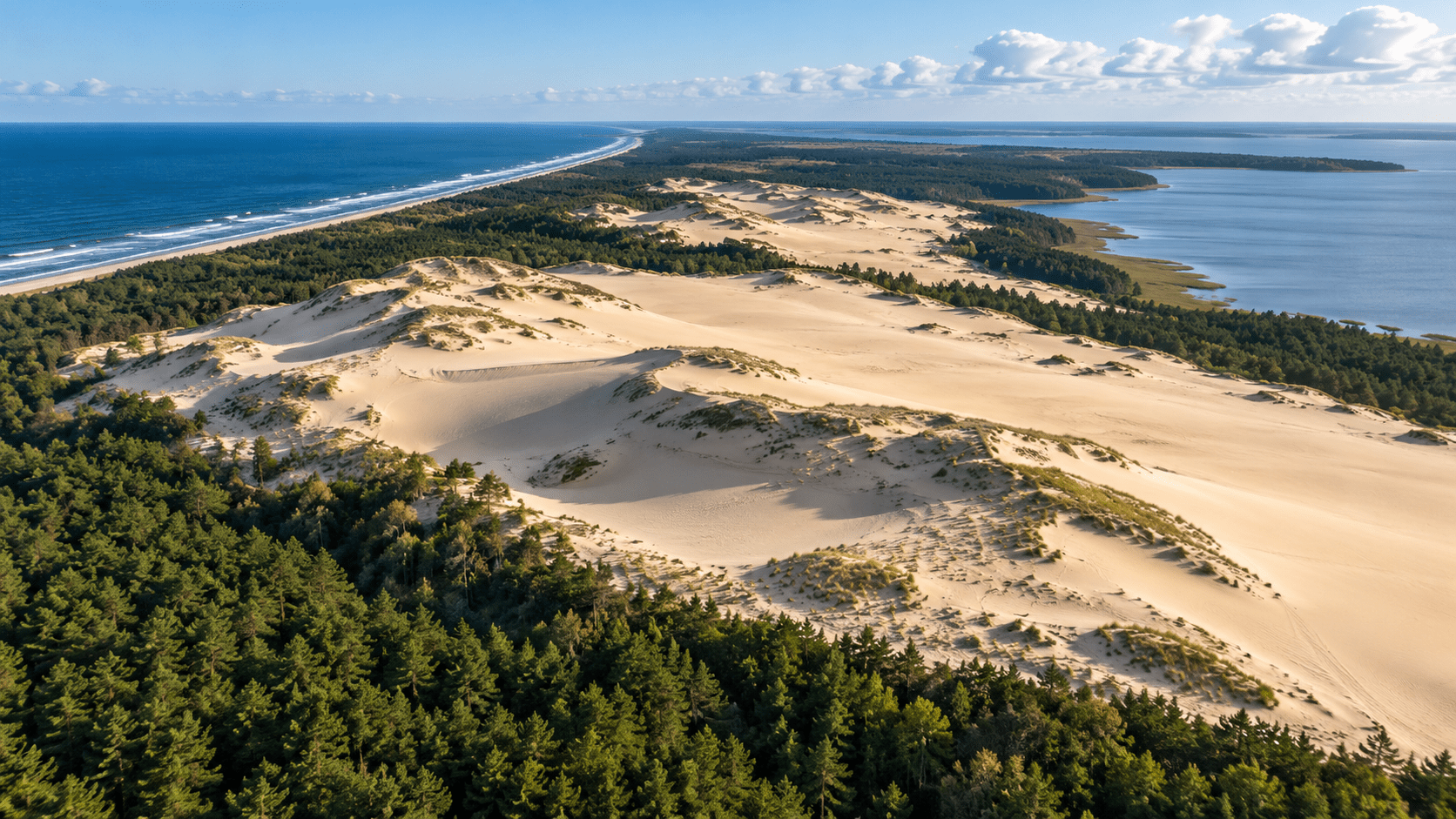
At first glance, parts of Poland’s Baltic coast look as though a desert has somehow reached central Europe.
Pale sand rises into sweeping ridges. Forest ends abruptly at the edge of the dunes. In places, dead trunks emerge from the sand — traces of woodland overtaken as the landscape slowly moved around it.
This is Słowiński National Park, between Łeba and Rowy on Poland’s northern coast, and its moving dunes are among the most active and extensive dune systems around the Baltic Sea.
- Find more news from Poland on our Homepage .
They are not a true climatic desert. They are something more unusual: a constantly changing coastal landscape created by sand, vegetation and powerful Baltic winds.
How a dune starts to move
The process is deceptively simple.
When wind becomes strong enough, loose grains of sand begin travelling up the gentler windward slope of a dune. Once they reach the crest, they fall down the steeper side.
Grain by grain, the whole dune gradually shifts.
Official material from Słowiński National Park says sand movement begins when wind speeds reach roughly five metres per second. The dominant western and north-western winds generally push the most active dunes towards the east and south-east.
The rate is not the same everywhere.
Much of the spit contains more stable parabolic dunes, many of which have been covered by vegetation. But in the central zone of the Gardno-Łeba spit, the genuinely mobile dunes can move at average rates of around three to ten metres a year, according to the park.
That is fast enough for change to become visible within a human lifetime.
When sand meets forest
The most dramatic consequences appear where the moving sand encounters vegetation.
A dune can advance over grasses and shrubs and eventually reach woodland. Trees are gradually surrounded and buried as sand accumulates around their trunks.
Elsewhere, later movement can expose remnants of vegetation that had disappeared beneath the dunes years before.
The Polish Tourism Organisation describes ancient tree stumps and remnants of former forest being uncovered as the dunes migrate across the Łeba Spit.
The park’s own educational material goes further into the history of that movement. It records that wandering dunes once covered natural forests, meadows, pastures and even settlements. Wydma Czołpińska is associated with the disappearance of the old settlement of Stara Chusta, while Wydma Łącka advanced over the settlement of Łączka.
Attempts were eventually made to stop some of that movement by planting forests on the dunes during the late 19th and early 20th centuries.
Large parts of the landscape were successfully stabilised.
But the remaining mobile dunes became one of the defining natural features of the park.
More than a sea of sand
Seen in isolation, photographs of Słowiński can create the impression that the park is dominated by sand.


In reality, the dunes form only part of a much richer coastal system.
The park encompasses beaches, pine forests, peatlands, marshes, meadows and major coastal lakes including Łebsko and Gardno.
That mixture of water and land is particularly important for wildlife.
UNESCO describes the Słowiński wetlands as significant breeding and stopover habitat for numerous bird species. The wider area has been part of UNESCO’s World Network of Biosphere Reserves since 1976 and was also designated a Ramsar wetland site in 1995.
The UNESCO designation is a Biosphere Reserve, not a World Heritage listing — an important distinction.
What UNESCO highlights most strongly is not simply the appearance of the dunes, but the natural processes still taking place there: moving sand, changing shorelines, developing vegetation zones and wetlands shaped by the Baltic Sea.
A landscape that refuses to stay still
Słowiński National Park was established in 1967, and its best-known dunes are now among Poland’s most recognisable natural landscapes.
Wydma Łącka and Wydma Czołpińska draw visitors precisely because they provide something rarely associated with the country: immense open expanses of pale sand framed by forest, lakes and the Baltic.
Yet their real fascination comes from movement.
The forest edge seen today may not be the forest edge seen decades from now. Sand can bury one surface and reveal another. Plants can begin colonising a dune while wind reactivates a different section nearby.
What appears from a distance to be a frozen landscape is, in geological terms, remarkably restless.
On this part of the Polish coast, the scenery is still being rewritten by the wind.