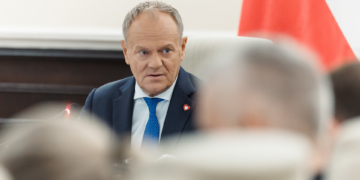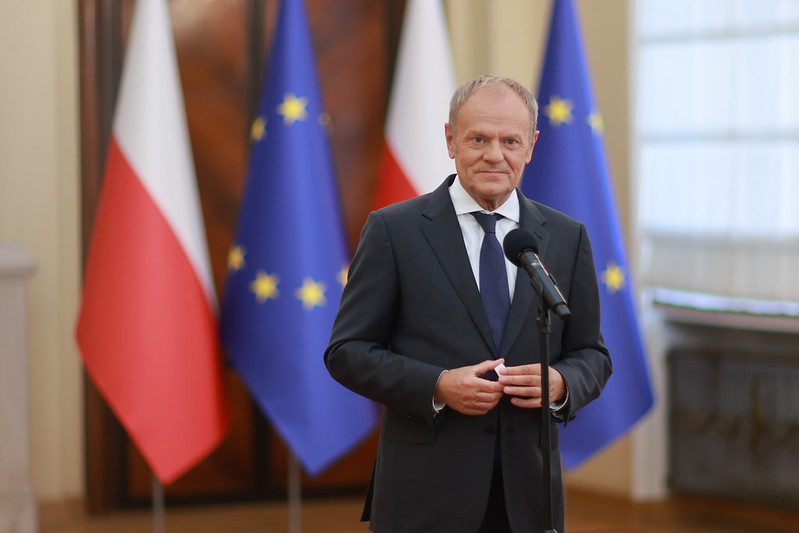
Polish Prime Minister Donald Tusk has accused the opposition Law and Justice party and Presidents Andrzej Duda and Karol Nawrocki of undermining the rule of law, using a nationally televised address on Saturday evening to defend the government’s handling of the escalating Constitutional Tribunal crisis.
Speaking on 31 October, Tusk rejected accusations that his government had forcibly seized control of Poland’s constitutional court. Instead, he argued that judges elected by parliament had been prevented from taking up their duties and that police had intervened to protect them.
He defended the authorities’ response to confrontations outside the tribunal’s Warsaw headquarters and criticised politicians who, he said, were attempting to intimidate judges.
- Find more news from Poland on our Homepage .
The address followed an extraordinary 24 hours in Polish politics, during which the tribunal’s leadership was challenged, President Nawrocki interrupted a foreign trip and returned to Warsaw, and opposition politicians called for a new approach to resolving the country’s constitutional dispute.
Tusk did not announce specific new legislation or a new constitutional procedure. His speech was principally a defence of the government’s position and a pledge to ensure the tribunal’s security and ability to function.
A full Polish transcript of the address was published by the Polish Press Agency (PAP). The quotations below are translated from Polish.
‘A democratic state must be strong’
Tusk opened his address by condemning the confrontations outside the Constitutional Tribunal on Friday evening.
He said the scenes had been distressing and expressed the hope that Poland would not experience similar events again.
However, he rejected the argument that restoring calm required the authorities to retreat from measures they considered necessary to enforce the law.
As reported in Wirtualna Polska’s coverage of the address, the prime minister insisted that “a democratic state must be strong” and capable of ensuring justice.
He also said that maintaining peace could not mean “giving way to lawlessness and violence.”
Tusk criticised politicians and activists associated with PiS and Confederation who had gathered near the tribunal, mentioning figures including Grzegorz Braun and Robert Bąkiewicz.
In his account, police officers had responded calmly but firmly to aggressive behaviour.
The prime minister’s description contrasts with that of President Nawrocki and opposition politicians, who have accused the authorities of using police to facilitate an unlawful takeover of a constitutional institution.
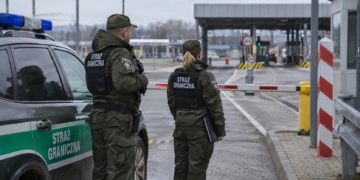
Police have said their intervention followed concerns about threats to judges, staff and public order. Independent reporting confirmed clashes at security barriers and the detention of three protesters.
The legal justification for the wider institutional changes remains contested.
Tusk blames PiS and successive presidents for constitutional crisis
The prime minister placed responsibility for the present confrontation on PiS, which governed Poland between 2015 and 2023, and on former President Andrzej Duda and current President Karol Nawrocki.
In one of the address’s central accusations, he argued that the confrontation at the tribunal represented another stage in the deterioration of constitutional safeguards that he attributes to those political figures.
Tusk said his parliamentary majority had previously attempted to resolve the tribunal crisis through legislative and parliamentary measures.
He argued that international institutions and Polish legal authorities had raised serious concerns about the tribunal’s independence under arrangements introduced during PiS rule.
Those concerns have a documented history, including judgments by European courts concerning elements of Poland’s judicial system. They do not, however, automatically establish the legality of every subsequent action taken by Tusk’s government.
The prime minister said the proposed remedies had ultimately been obstructed by PiS and the presidency.
He portrayed the latest confrontation as the consequence of unsuccessful earlier attempts to restore the tribunal’s normal functioning.
‘We waited calmly’ — Tusk defends the appointment of new judges
A substantial part of Tusk’s speech concerned the appointment of judges elected by the current parliament.
He said the governing majority had initially allowed the terms of previous tribunal members to expire before proceeding with new appointments.
“We waited calmly,” he said, according to Onet’s reporting of the address.
Tusk explained that the Sejm had elected new members of the tribunal, but President Nawrocki had declined to receive their judicial oaths.
The prime minister maintained that the judges had nevertheless taken their oaths through an alternative procedure and were entitled to begin exercising their responsibilities.
He accused tribunal president Bogdan Święczkowski of preventing them from doing so.
Święczkowski and his supporters dispute the legitimacy of the appointments and the procedures used to enable the judges to take office.
The disagreement is therefore not simply about political preferences. It involves competing interpretations of the constitutional requirements for appointing tribunal judges and the authority of the institution’s existing leadership.
Tusk’s statement set out the government’s legal and political position. It did not resolve those competing interpretations.
‘The judges were attacked’ — prime minister defends police intervention
Tusk then turned to Friday’s confrontation at the tribunal itself.
After weeks of unsuccessful efforts to begin working, he said, the newly elected judges had attempted to exercise their responsibilities despite the resistance of the institution’s existing management.
According to the prime minister’s account, “the judges were attacked” when they attempted to do so.
He maintained that police had been protecting the court and its personnel rather than conducting a politically directed takeover.
The remarks followed Friday’s announcement by judge Anna Korwin-Piotrowska of measures intended to suspend the duties of tribunal president Święczkowski and vice-president Bartłomiej Sochański.
Korwin-Piotrowska subsequently assumed responsibility for directing the institution’s work.
Święczkowski, Nawrocki and opposition politicians have challenged the validity of those decisions.
The president returned early from an overseas journey, visited the tribunal and convened emergency consultations with parliamentary parties.
In an official statement, Nawrocki accused the government of an unlawful seizure of a constitutional institution and called for the restoration of what he regards as the legitimate leadership.
His allegations remain disputed rather than established judicial findings.
The two sides therefore offer fundamentally different accounts of the same events: the government describes an attempt to allow properly elected judges to work, while the president and opposition describe an unlawful intervention against the court’s leadership.
‘There can be no compromise’ — Tusk uses theft analogy
One of the most striking passages in the speech was Tusk’s rejection of attempts to treat the opposing sides’ legal claims as equivalent.
He used an analogy involving a thief who steals a handbag from an elderly woman.
In the hypothetical situation, the thief protests when confronted and accuses those trying to recover the bag of wrongdoing.
Tusk then imagined observers suggesting that the contents of the stolen handbag should be divided equally between the thief and the victim as a compromise.
The analogy was intended to argue that, in some circumstances, an apparently balanced settlement would reward behaviour that the prime minister considers unlawful.
“There can be no compromise,” he argued in relation to such situations.
This was a political analogy, not a determination that the individuals involved in the tribunal dispute had committed theft or another criminal offence.
Tusk went on to reject intimidation and physical confrontation as ways of deciding questions of law.
He said “shouting, lies and fighting” could not become a source of legal authority in Poland.
The remarks also appeared to challenge politicians who have suggested a negotiated constitutional settlement.
Several parliamentary figures have called for discussions on a broader reset of the tribunal, while some opposition groups have raised the possibility of early elections.
Whether a political agreement can be reached remains uncertain, particularly because those involved disagree over which judges and institutional authorities should be recognised as legitimate.
Prime minister criticises presidential intervention
Tusk also addressed the conduct of politicians entering courts and tribunals.
He argued that public officials should not attempt to direct judicial proceedings, instruct judges or intimidate them.
His remarks were particularly relevant to Nawrocki’s visit to the Constitutional Tribunal during the confrontation.
The prime minister maintained that constitutional principles should apply regardless of whether a politician holds the presidency or another senior office.
He also argued that the rule of law requires protection for people who may be physically or politically weaker than those challenging them.
These comments formed part of his broader criticism of the president’s response.
Nawrocki, meanwhile, has said he intervened to defend the constitutional order and the authority of the tribunal’s existing leadership.
The disagreement raises important questions about presidential powers, the autonomy of constitutional institutions and the lawful enforcement of decisions concerning judicial appointments.
None was conclusively settled by Saturday’s address.
Tusk alleges pro-Russian support for opponents of judicial changes
The prime minister introduced a further international dimension when he accused certain political organisations and individuals of deliberately seeking to undermine Polish democracy.
He questioned their motives and claimed that forces opposed to democratic institutions in Poland had received support from pro-Russian circles.
He also alleged that an organised network of Russian-controlled social-media accounts had been supporting one side of the current constitutional confrontation.
Tusk did not present publicly verifiable evidence for that specific allegation during the address.
The claim should therefore be understood as an accusation made by the prime minister, not as an independently established finding about the online activity surrounding the tribunal crisis.
Poland has previously documented and warned about Russian information operations, but that broader context does not by itself verify Tusk’s claim about the specific events of 30–31 October.
Tusk promises an independent Constitutional Tribunal
Towards the end of his address, Tusk returned to the future of the court.
Despite the confrontation, he expressed confidence that the tribunal would eventually resume what he considers its proper constitutional role.
Crucially, he argued that the institution should operate “independent, even of me” — an acknowledgement that the court’s autonomy must extend to the government as well as the president and opposition.
He said the executive branch’s responsibility was to provide the court with security and the conditions necessary for its work.
He pledged to fulfil that responsibility.
Tusk ended by describing Poland as “strong, democratic and determined”, presenting his government’s position as part of a wider commitment to preserving the democratic institutions established after the fall of communism.
The speech did not specify a new legal mechanism for resolving the tribunal’s leadership dispute or establish when the competing claims to institutional authority would be settled.
Those questions remain unresolved.
What happens next in Poland’s constitutional crisis?
Saturday’s address followed an escalation that has moved beyond the Constitutional Tribunal itself.
Nawrocki has convened political consultations, while former Prime Minister Mateusz Morawiecki has separately proposed a constructive vote of no confidence against Tusk’s government.
That proposal would require significant additional parliamentary support and has not been established as a viable replacement administration.
For Tusk’s government, the immediate issue is whether the judges it regards as properly appointed can exercise their responsibilities and whether the tribunal can resume normal operations.
For the president and opposition, the central issue is the legitimacy of the attempted change to the tribunal’s leadership.
Both questions sit within a constitutional dispute dating back to 2015.
Poland-24 has published a detailed explainer of the Constitutional Tribunal crisis and its origins, covering the disputed appointments, European court rulings and successive attempts to reform the institution.
The latest speech clarified the prime minister’s position but did not remove the underlying legal disagreements.
Tusk has pledged that the state will protect the tribunal and ensure it can operate independently. Whether the government, presidency and competing judicial authorities can agree on how that independence should be restored remains the central unresolved question.