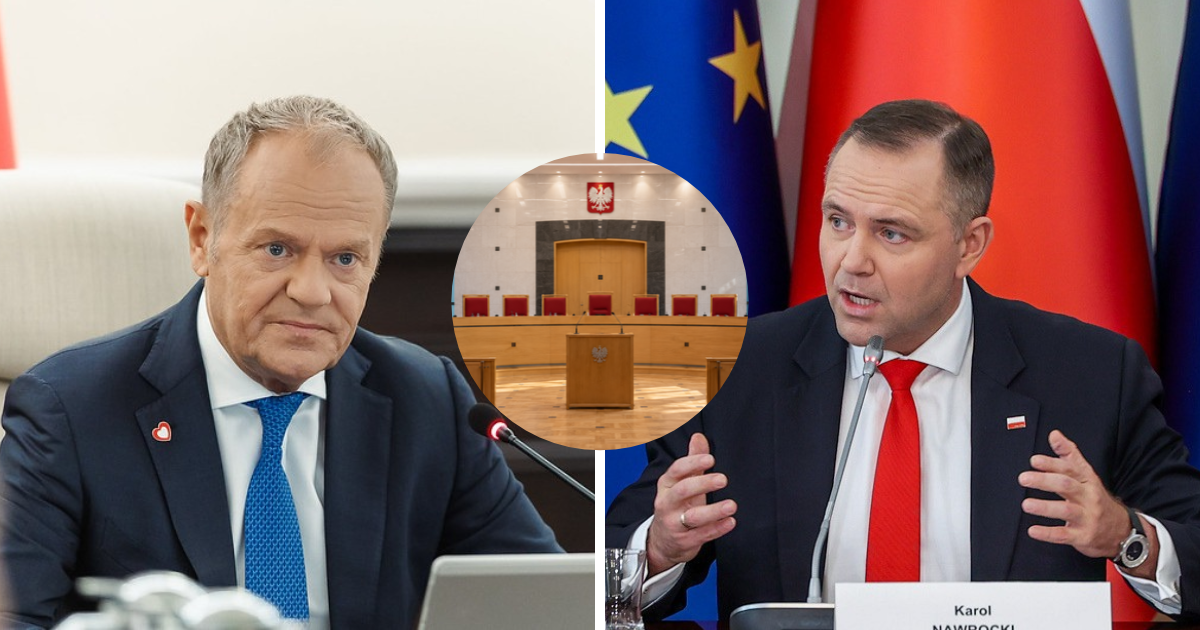
Poland is facing one of its most serious constitutional confrontations in years, following an extraordinary dispute over who has the legal authority to lead the country’s Constitutional Tribunal. The conflict has brought Prime Minister Donald Tusk’s government into direct confrontation with President Karol Nawrocki and the opposition Law and Justice party, raising fundamental questions about judicial independence, the separation of powers and the rule of law.
On Friday, 30 October 2026, judges elected by Poland’s current parliamentary majority moved to suspend the Tribunal’s president, Bogdan Święczkowski, and his deputy, Bartłomiej Sochański. Their actions were supported by the government but rejected by the existing leadership and the president.
Nawrocki cut short a foreign trip and returned to Warsaw, where he visited the Tribunal amid protests and a substantial police presence. He subsequently accused his opponents of unlawfully taking control of a constitutional institution and called for urgent political consultations.
- Find more news from Poland on our Homepage .
Prime Minister Tusk defended efforts to restore the rule of law, arguing that the process was necessary after years of constitutional violations under the previous government.
Yet the dispute extends far beyond the events of one evening.
Its origins can be traced to judicial appointments made in 2015, disagreements over the constitutional powers of successive governments and presidents, and conflicting interpretations of judgments delivered by Polish and European courts.
To understand the present crisis, it is necessary to examine not only what happened this week, but why Poland’s most important constitutional court has become the focus of such a prolonged political and legal struggle.
What is Poland’s Constitutional Tribunal?
The Constitutional Tribunal, known in Polish as the Trybunał Konstytucyjny (TK), is responsible for determining whether legislation and certain other legal acts comply with Poland’s Constitution.
Its role is different from that of an ordinary court.
While ordinary courts deal with criminal cases, civil disputes and other legal proceedings, the Constitutional Tribunal examines whether the rules governing those proceedings are themselves compatible with the country’s highest law.
For example, if parliament adopts legislation restricting a constitutional right, the Tribunal may be asked to determine whether that restriction is permitted by the Constitution.
Its judgments can affect important areas of public life, including individual rights, social policy, taxation and the powers of state institutions.
The Tribunal therefore acts as a constitutional check on parliament, the government and other public authorities.
Under Article 194 of Poland’s Constitution, the Tribunal consists of 15 judges elected individually by the Sejm, the lower house of parliament.
Each judge serves a single nine-year term.
Unlike judges of Poland’s ordinary courts, Constitutional Tribunal judges are elected directly by parliament, rather than appointed by the president following recommendations from the National Council of the Judiciary.
This distinction is central to the current dispute.
Poland’s Constitution gives the Sejm the power to elect Tribunal judges. Separate legislation requires those elected to take an oath before the president.
The disagreement is over the legal relationship between these two steps and whether a president can prevent a parliamentary nominee from assuming judicial duties by refusing to receive the oath.
How does Poland’s political system work?
Understanding the conflict also requires some familiarity with Poland’s constitutional arrangements.
You May Also Be Interested In

Poland is a parliamentary republic with a directly elected president.
The prime minister and government exercise most executive powers and normally depend on the support of a parliamentary majority.
The president serves as head of state and has important constitutional responsibilities, including the ability to veto legislation or refer it to the Constitutional Tribunal for review.
The president and prime minister can belong to opposing political camps, as they do today.
Donald Tusk leads a coalition government formed in December 2023 after the parliamentary elections that year.
His Civic Coalition (KO) is the largest component of a governing alliance that includes politicians from the centre, centre-right and left.
The principal opposition party is Law and Justice (PiS), which governed Poland from 2015 until 2023.
President Karol Nawrocki, who took office in August 2025, was backed by PiS in the presidential election. He is politically opposed to Tusk’s government, although the presidency is formally a separate constitutional institution.
This division matters because the government can pass legislation through parliament but does not automatically have the support of the president.
Meanwhile, the Constitutional Tribunal is supposed to exercise judicial authority independently of both.
Where did the crisis begin? The disputed appointments of 2015
The immediate origins of the present crisis lie in the final months of 2015, when Poland experienced a change of government.
Before that year’s parliamentary election, the outgoing parliament, controlled by Civic Platform (PO) and its coalition partner, the Polish People’s Party (PSL), elected five judges to the Constitutional Tribunal.
Three seats were becoming vacant during the outgoing parliament’s term. The other two were due to become vacant after the newly elected parliament had taken office.
Following the election, Law and Justice secured a parliamentary majority and formed a new government.
The incoming PiS-controlled Sejm challenged the outgoing parliament’s appointments and elected five different people.
President Andrzej Duda, who was politically associated with PiS, declined to receive the oaths of the five candidates elected by the outgoing parliament. Instead, he accepted the oaths of the replacement candidates chosen by the new majority.
The question was whether the outgoing parliament had been entitled to fill all five seats.
On 3 December 2015, the Constitutional Tribunal delivered a judgment that made an important distinction.
It found that the outgoing parliament had acted lawfully in electing three judges whose predecessors’ terms expired during its own term.
However, it also found that the outgoing parliament had exceeded its authority by selecting two judges for vacancies arising during the next parliamentary term.
In other words, the court did not validate all five appointments made by the outgoing majority.
It found that three appointments were lawful and two were not.
This distinction is essential to understanding the dispute and is documented in the Venice Commission’s October 2026 legal opinion, which revisits the original 2015 proceedings.
The 2015 judgment also found that the president was obliged to receive the oaths of the three lawfully elected judges.
Nevertheless, the competing appointments were not resolved in a manner accepted by all institutions.
Three seats that the Tribunal had already regarded as lawfully filled became occupied by individuals appointed through the subsequent PiS-controlled parliamentary process.
Critics began referring to these appointees, and later their successors, as dublerzy, or replacement judges occupying already-filled seats.
Supporters of PiS maintained that the incoming parliament was entitled to correct irregularities associated with the outgoing majority’s attempt to appoint judges beyond its term.
The critical legal distinction, however, was that the Tribunal’s own December 2015 judgment had identified three valid appointments.
The authorities’ failure to implement that finding became the foundation of the constitutional conflict that followed.
How the dispute developed under Law and Justice
During its eight years in government, PiS introduced a series of changes affecting Poland’s judiciary.
The Constitutional Tribunal was among the first institutions involved.
Changes to its operating rules, appointment procedures and leadership became the subject of repeated disputes between the government, judges, legal organisations and European institutions.
PiS argued that its reforms were needed to make the judiciary more accountable, remove entrenched institutional arrangements and correct what it considered an imbalance in the relationship between elected politicians and judges.
Its opponents argued that the reforms weakened institutional independence by increasing political influence over bodies that were supposed to scrutinise the government.
The Tribunal’s leadership also changed.
In December 2016, Julia Przyłębska became president of the Constitutional Tribunal. Her appointment and aspects of the procedure surrounding it were subsequently challenged by critics.
Over time, the court’s composition increasingly reflected appointments made during PiS’s period in government.
For the opposition, this raised the concern that the Tribunal was no longer acting as an effective independent check on political power.
PiS rejected allegations that its judicial appointments were inherently illegitimate and maintained that the reforms were compatible with the Polish Constitution.
The conflict was not limited to domestic politics. It increasingly involved the European Union and the Council of Europe’s human rights system.
What did European courts actually decide?
One of the most important aspects of the dispute is that some questions about the Tribunal’s composition have already been examined in international judicial proceedings.
These decisions are separate from the competing claims now being made by politicians.
The European Court of Human Rights
In May 2021, the European Court of Human Rights (ECtHR) delivered its judgment in Xero Flor w Polsce sp. z o.o. v. Poland.
The case concerned a company whose proceedings had involved the Constitutional Tribunal.
The Strasbourg court concluded that the participation of a person appointed to a seat already lawfully filled was incompatible with the applicant’s right to have its case determined by a tribunal established by law.
The European Court of Human Rights’ judgment and accompanying explanation established an important principle: the legality of the process used to appoint judges can affect whether a judicial body meets the requirements of the European Convention on Human Rights.
This was not a general political opinion about PiS.
It was a judicial finding concerning the composition of a specific Tribunal bench and the applicant’s rights under the Convention.
The Court of Justice of the European Union
A further significant judgment followed on 18 December 2025.
In Case C-448/23, European Commission v Poland, the Court of Justice of the European Union ruled against Poland over issues involving the Constitutional Tribunal.
The court found that serious irregularities affecting appointments to the Tribunal, including the appointment of three judges in December 2015 and its president in December 2016, meant that Poland had failed to meet relevant EU requirements concerning an independent and impartial tribunal established by law.
The judgment also addressed Constitutional Tribunal rulings that had rejected aspects of the authority and binding effect of EU law and European Court of Justice decisions.
This introduced a wider constitutional question: how national constitutional authority relates to obligations that Poland accepted through its membership of the European Union.
The Polish Constitutional Tribunal has disputed the authority of European courts to make certain determinations concerning its own composition and the Polish Constitution.
Its position reflects the argument that the Polish Constitution occupies the highest position in the domestic legal system and that EU institutions cannot exercise powers beyond those granted under European treaties.
The European Court of Justice, however, maintains that EU law must be applied consistently throughout member states and that national institutions exercising functions within the scope of EU law must satisfy its judicial independence requirements.
These positions have produced a conflict extending beyond the appointment of individual judges.
Importantly, the Strasbourg court and the EU court are separate institutions.
The European Court of Human Rights belongs to the Council of Europe system. The Court of Justice of the European Union interprets EU law.
Their judgments do not serve identical legal purposes, but both have played a significant role in the Polish dispute.
Why does the Constitutional Tribunal matter to ordinary people?
The significance of the Tribunal is not limited to debates between politicians and legal professionals.
Its decisions can produce direct consequences for individuals.
One of the most prominent examples was the Tribunal’s ruling of 22 October 2020, which found that the legal provision permitting abortion on grounds of severe foetal abnormalities was unconstitutional.
The ruling, published in January 2021, significantly restricted access to lawful abortion in Poland and prompted widespread public protests.
The legal composition of the Tribunal panel that delivered the judgment was subsequently examined in proceedings before the European Court of Human Rights.
In its 2023 judgment in M.L. v. Poland, the Strasbourg court found that the applicant’s rights had been violated. The court identified serious issues involving the composition of the Tribunal and the foreseeability of the law affecting her case.
The ECtHR’s judgment in the case illustrates how concerns about judicial appointments can have practical consequences for individuals whose rights are affected by constitutional decisions.
More generally, when institutions disagree over whether Tribunal judgments are legally authoritative, uncertainty can arise over how particular laws should be interpreted or applied.
For businesses, this can affect regulatory certainty.
For individuals, it can affect the protection of constitutional rights.
For public institutions, it can create difficulties when they receive conflicting interpretations from different state authorities.
A functioning constitutional court is therefore not simply a requirement of constitutional theory. It helps establish which rules apply and whether citizens can rely on predictable legal protections.
What changed when Donald Tusk returned to power?
The 2023 parliamentary election brought a change of government but did not automatically change the membership of the Constitutional Tribunal.
Judges hold fixed nine-year terms that are not normally ended simply because a new government takes office.
This meant that when Tusk’s coalition entered office in December 2023, it inherited a Tribunal whose composition remained largely the result of appointments made under PiS.
The new government announced that restoring the rule of law and rebuilding the independence of judicial institutions would be major priorities.
It argued that the problems identified by European courts required institutional changes rather than simply waiting for disputed arrangements to continue.
In March 2024, the Sejm adopted a resolution questioning the legitimacy of the Tribunal in its existing composition and calling for measures to restore its independence.
The government subsequently stopped publishing the Tribunal’s judgments in the official legal journals, arguing that rulings issued by an improperly constituted body should not be treated as valid constitutional judgments.
This decision created a separate constitutional controversy.
Under Article 190 of the Polish Constitution, Constitutional Tribunal judgments are final and universally binding, and judgments subject to official publication are to be published without delay.
The government maintains that those requirements apply to judgments delivered by a legally constituted tribunal, not to acts issued by a body whose composition fails constitutional and European judicial standards.
Opponents argue that the executive has no constitutional power to decide which Tribunal judgments deserve publication.
From their perspective, refusing publication allows the government to disregard constitutional decisions it finds inconvenient and undermines the authority of the judiciary.
The Tribunal’s existing leadership has repeatedly challenged the government’s refusal to publish its rulings.
Consequently, the dispute has developed into a question not only of who may sit on the court, but also who has the authority to determine whether its decisions count as binding judgments.
Why did attempts to reform the Tribunal fail?
The governing coalition sought to address the crisis through legislation.
In September 2024, parliament passed two bills intended to reform the Constitutional Tribunal and establish transitional arrangements for restoring its operation.
The measures included changes affecting the selection of judges, the Tribunal’s leadership and the legal consequences of disputed appointments.
However, President Andrzej Duda did not sign the legislation into law.
Instead, he referred the bills to the Constitutional Tribunal for constitutional review.
In July 2025, the Tribunal issued a judgment in case Kp 3/24, finding provisions of the legislation unconstitutional and concluding that the bills could not stand in their existing form.
In its published explanation of the judgment, the Tribunal criticised measures that would retrospectively invalidate judicial appointments, affect earlier rulings and terminate the term of its president.
The government, meanwhile, continued to question the Tribunal’s legitimacy.
The result was a constitutional deadlock.
The government argued that the existing Tribunal required reform because of defects in its composition.
The Tribunal, whose composition the government disputed, rejected the reform legislation as unconstitutional.
Meanwhile, the president’s constitutional powers prevented the legislation from taking effect.
The failure of this process helps explain why attention subsequently shifted towards filling judicial vacancies as existing terms expired.
The new confrontation over judicial appointments in 2026
By the beginning of 2026, six seats on the Constitutional Tribunal were vacant.
On 13 March, the Sejm elected six new judges.
President Nawrocki received the oaths of two of them in April but declined to receive the oaths of the remaining four.
The president’s office raised concerns about the appointment procedures and the legality of certain aspects of the elections.
The Sejm’s leadership rejected those objections.
In an official statement issued on 3 April 2026, the parliamentary administration argued that all six judges had been elected in accordance with the Constitution and that the president had no authority to reconsider the Sejm’s decisions.
The four judges whose oaths had not been received subsequently participated in a parliamentary oath-taking ceremony.
They maintained that they had fulfilled the legal requirement by making their oaths formally addressed to the president, despite his absence.
Nawrocki rejected the argument that such a ceremony could replace an oath received by the head of state.
The Tribunal’s president, Bogdan Święczkowski, also refused to allow them to begin adjudicating.
Another judicial appointment, Sławomir Patyra, proceeded during the summer, with Nawrocki receiving his oath in July.
A further dispute developed after parliament elected Maciej Berek, a former minister and close associate of Tusk, to the Tribunal in September.
The president raised additional objections concerning Berek’s qualifications and political background.
Berek maintained that he fulfilled the statutory requirements and took an oath during a parliamentary ceremony in October without the president’s participation.
By late October, the central problem had become increasingly clear.
Parliament regarded its elected candidates as legitimate judges. The president and the Tribunal’s existing leadership did not accept that those whose oaths he had not received could exercise judicial duties.
The resulting disagreement left the institution struggling to operate normally.
What does the Venice Commission say about the president’s powers?
In October 2026, the Venice Commission, an expert advisory body of the Council of Europe, published a new opinion examining the president’s role in the oath-taking procedure.
The opinion adopted on 9–10 October concluded that the constitutional power to elect Tribunal judges belongs to the Sejm.
The Commission noted that the requirement to take an oath before the president comes from ordinary legislation rather than from the constitutional provision governing the election of Tribunal judges.
It concluded that this statutory requirement could not give the president a discretionary power to approve, reject or reconsider parliament’s choices.
It recommended that the president receive the oaths of elected judges without undue delay.
The Commission also addressed what should happen if a president refuses to participate.
In those circumstances, it considered that an oath could be completed without the president’s physical presence, provided the required formal elements were preserved and the oath was properly addressed and transmitted to the president.
The opinion supports the central legal argument advanced by the Sejm and governing coalition.
However, Venice Commission opinions are advisory rather than judicial decisions that automatically resolve every domestic legal dispute.
The European Court of Human Rights also issued interim measures in May 2026 concerning four judges elected by parliament who had been unable to begin their duties.
Those measures required Poland not to obstruct the applicants’ assumption of judicial functions while the proceedings continued.
The Tribunal’s existing leadership rejected the European court’s authority to intervene in that manner.
The international legal developments strengthened the governing coalition’s position on the oath-taking dispute, but they did not bring the domestic institutional disagreement to an end.
Nor did they directly decide whether the Tribunal’s leadership could be suspended using the legal procedure invoked on 30 October.
What happened at the Constitutional Tribunal on 30 October?
The conflict escalated dramatically on Friday evening when seven people elected by parliament during 2026 entered the Tribunal’s headquarters in Warsaw.
Among them were judges whose oaths had been received by the president and others whose status remained disputed.
Anna Korwin-Piotrowska, one of the judges whose oath Nawrocki had refused to receive, announced that she was assuming responsibility for directing the Tribunal’s work.
She also announced orders imposing a temporary interruption of the judicial duties of the Tribunal’s president, Bogdan Święczkowski, and vice-president, Bartłomiej Sochański.
The measures were described as lasting up to one month.
The existing leadership immediately challenged the validity of the orders.
A dispute also developed over control of the Tribunal’s website and official communications.
Police were deployed around the building as demonstrations developed outside. Opposition politicians and supporters protested against the leadership change, with some alleging that the government was attempting to seize the institution.
During the evening, Justice Minister and Prosecutor General Waldemar Żurek announced that he had submitted five requests concerning the lifting of judicial immunity from Święczkowski and Sochański.
Four related to Święczkowski and one to Sochański.
The requests sought permission for further criminal proceedings. They did not constitute convictions or establish criminal responsibility.
President Nawrocki, who had been travelling to Senegal, cut short his journey and returned to Warsaw.
He met senior judicial figures before visiting the Constitutional Tribunal overnight.
Confrontations occurred around the building’s entrance, with video footage and opposing accusations emerging from representatives of the two sides.
The presidency and government-backed judges offered conflicting accounts of the behaviour of those involved.
There has been no final judicial determination establishing responsibility for the alleged physical incidents.
In an official statement issued on 31 October, Nawrocki described the events as a violation of Poland’s constitutional order and accused his opponents of taking control of a state institution by force.
He said that he had enabled Sochański to enter the Tribunal and called for urgent talks with parliamentary political groups.
The government maintained that its actions were necessary to overcome an institutional blockage that had prevented lawfully elected judges from exercising their responsibilities.
By Saturday morning, the competing claims over the Tribunal’s leadership remained unresolved.
Was the decision to suspend the Tribunal’s leadership legal?
This is now one of the most important questions in the crisis.
Korwin-Piotrowska’s intervention relied on provisions concerning judicial duties and the temporary interruption of those duties, including Article 130 of the legislation governing ordinary courts.
That provision allows an immediate temporary interruption of a judge’s duties in specified circumstances, subject to further legal safeguards.
The legal dispute concerns whether those provisions can be applied to the president and vice-president of the Constitutional Tribunal in the way attempted, and whether Korwin-Piotrowska possessed the authority to invoke them.
Supporters of the intervention argue that the existing leadership had unlawfully prevented properly elected judges from carrying out their responsibilities, threatening the normal functioning of a constitutional institution.
They maintain that urgent action was necessary to restore the Tribunal’s ability to operate.
Opponents argue that the procedure has no proper legal basis in this situation and that the Tribunal’s leadership cannot be displaced by an order issued by someone whose judicial status they do not recognise.
Crucially, criticism of the suspension is not confined to the political opposition.
Marcin Matczak, a legal scholar who has been a prominent critic of PiS-era judicial reforms, questioned the legal basis for suspending Święczkowski.
Speaking publicly on 30 October, Matczak argued that the legal provisions cited did not authorise the action, despite his longstanding objections to the existing Tribunal leadership.
His position illustrates an important distinction: a legal expert can regard the Tribunal’s earlier composition as defective while also questioning whether the methods now being used to change its leadership are lawful.
The broader legal argument therefore cannot be reduced to a simple choice between supporting or opposing the government.
The validity and consequences of the suspension orders require separate legal assessment from the earlier findings concerning judicial appointments.
What does Donald Tusk’s government argue?
The government’s position begins with the claim that Poland’s constitutional judiciary was compromised during the PiS administration and that the defects identified by Polish and European courts have not been adequately remedied.
Tusk’s coalition maintains that its actions are intended to restore an independent Constitutional Tribunal capable of scrutinising government legislation and protecting constitutional rights.
It argues that judicial vacancies have been filled through the procedures provided by the Constitution and that the president has no authority to indefinitely prevent those elected from assuming office.
The government also accuses the Tribunal’s existing leadership of obstructing the work of judges elected by parliament and contributing to the institution’s paralysis.
In an official statement on 14 October, Tusk said that state institutions were obliged to respect the Constitution and that the government would protect the ability of elected judges to begin their work.
Following the events of 30 October, he reiterated that restoring the rule of law was his government’s responsibility, describing the process as difficult and requiring decisive action.
Supporters of the coalition’s approach also refer to the Venice Commission’s findings and decisions of European courts as evidence that the original institutional defects were substantial rather than merely political disagreements.
However, the government faces a further question: whether correcting unlawful institutional arrangements can justify exceptional measures whose legal basis is itself disputed.
That question has become particularly significant following Friday’s confrontation.
What do Law and Justice and President Nawrocki argue?
Law and Justice and the president reject the government’s claim that it is entitled to disregard the existing Tribunal’s authority or replace its leadership through contested procedures.
PiS argues that the Constitutional Tribunal remains a constitutional institution whose judges and leadership cannot simply be displaced because the parliamentary majority disagrees with them.
It emphasises the need to respect fixed judicial terms, established legal procedures and the separation of powers.
The party also maintains that the governing coalition is seeking to establish political control over an institution that may review or invalidate its legislation.
In this interpretation, actions taken in the name of restoring the rule of law risk undermining it by concentrating power in the hands of the executive and its parliamentary supporters.
The presidency has similarly argued that an oath taken without the president cannot satisfy the statutory requirements governing the assumption of Tribunal duties.
Nawrocki’s office has raised procedural and qualification objections concerning particular parliamentary nominees.
Following the events of 30 October, the president went further, describing what had happened as the forcible takeover of a constitutional institution.
PiS leader Jarosław Kaczyński and other opposition figures have used similarly severe language, including allegations of a coup against the Tribunal.
Those descriptions are political and legal accusations. They should not be confused with a finding by a court that a criminal coup has occurred.
The opposition’s position also raises a question arising from the earlier judicial findings: how should Poland address the appointment irregularities established by the European Court of Human Rights and the Court of Justice of the European Union?
Rejecting the government’s proposed remedies does not, by itself, resolve those documented problems.
That tension remains central to the debate.
Are there concerns about the current government’s own appointments?
Yes.
Even among organisations that have supported efforts to restore judicial independence, there have been objections to some of the governing coalition’s decisions.
The appointment of Maciej Berek is a particularly important example.
Berek had served in Tusk’s government and was regarded as a close political associate of the prime minister before his election to the Tribunal in September 2026.
Nine civil society organisations, including the Helsinki Foundation for Human Rights, argued that choosing someone with such recent political ties could undermine confidence in the court’s independence.
In a joint statement published in August, the organisations called for Berek to withdraw his candidacy and urged parliament to choose a politically independent candidate.
Their concern was not simply whether an individual satisfied the minimum legal qualifications.
It was whether appointments could help rebuild public confidence in a court that had become deeply entangled in political conflict.
Berek defended his qualifications and the broader effort to restore the institution.
The controversy illustrates the difficulty facing the governing coalition.
A government seeking to reverse what it regards as excessive political influence over the judiciary must also demonstrate that its own appointments and procedures satisfy the standards of independence it advocates.
Why is the crisis so difficult to resolve?
The underlying problem is that Poland’s major institutions do not agree on the legal starting point from which the dispute should be resolved.
The government and parliamentary majority regard certain historical appointments as defective and seek to restore the Tribunal’s authority through new appointments and institutional reforms.
The opposition and president maintain that the current leadership’s legal status must be respected and that the government cannot simply declare constitutional institutions illegitimate.
Meanwhile, the Tribunal’s existing leadership disputes the authority of European rulings that challenge its composition.
The president and government also possess different constitutional powers, making unilateral solutions difficult.
For the government, an ordinary legislative reform may face a presidential veto or referral to the Tribunal.
For the president, attempts to block parliamentary judicial elections face objections based on Article 194 of the Constitution and the Venice Commission’s interpretation of the oath-taking process.
For the Tribunal, the appointment disputes undermine confidence in its capacity to resolve questions about its own membership and leadership.
The most recent events have added a further difficulty: the legal authority of the measures used to replace the Tribunal’s leadership is now contested independently of the original appointment crisis.
Consequently, the conflict is no longer simply over which judges should sit on the court.
It also concerns which institutions and procedures can legitimately settle the disagreement.
What happens next?
The immediate challenge is to determine who can lawfully direct the Constitutional Tribunal and whether the judges elected during 2026 can exercise their duties.
Korwin-Piotrowska has announced plans for a General Assembly of Tribunal judges on 3 November, including consideration of the institution’s budget.
The existing leadership disputes her authority to convene and direct the Tribunal.
President Nawrocki has called for urgent political consultations following Friday’s confrontation.
Further developments may also arise from the prosecutor general’s requests concerning judicial immunity.
Yet none of those steps automatically resolves the broader constitutional conflict.
Any lasting settlement will need to address the composition of the court, the legal status of disputed appointments, the treatment of earlier judgments and the relationship between the Tribunal and Poland’s European legal obligations.
It must also provide a credible basis for restoring public confidence in the institution’s independence.
The fundamental purpose of a constitutional court is to determine whether public authorities are acting within the law, regardless of which political party holds office.
Poland’s prolonged dispute illustrates what happens when the institution entrusted with answering that question becomes the subject of competing claims over its own legitimacy.
The challenge is not simply to decide who controls the Constitutional Tribunal today, but to establish a framework in which its independence and authority can be accepted regardless of who governs Poland tomorrow.