


President Karol Nawrocki has signed Poland’s new windfall tax on extraordinary fuel-sector profits, allowing the law to take effect despite his continuing constitutional objections. At the same time, he has announced that he will ask the Constitutional Tribunal to examine the legislation after enactment.
The President’s Chancellery confirmed that Nawrocki signed the 18 September act on 1 October and would refer it to the Constitutional Tribunal through post-enactment review, known in Polish as kontrola następcza.
That means the constitutional challenge does not itself stop the legislation from operating.
- Find more news from Poland on our Homepage .
The law was published in the Journal of Laws on 1 October as item 1287, completing the promulgation stage. Its formal title covers extraordinary profits earned from liquid-fuel sales between 1 March 2026 and 31 March 2027.
That is materially different from the president’s handling of the government’s first version of the tax earlier this year.
In July, Nawrocki sent the previous act to the Constitutional Tribunal before signing it, using preventive constitutional review. That prevented the legislation from entering into force while the case remained unresolved. The government estimated at the time that around PLN 4 billion in expected revenue had consequently been delayed.
This time, Nawrocki has signed first and challenged afterwards.
How Poland’s president fits into the legislative process
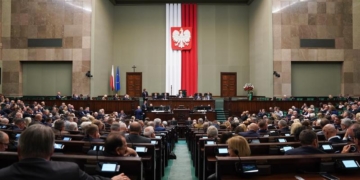
In Poland, ordinary legislation is passed first by the Sejm, the lower house of parliament, and then considered by the Senate, which may approve it, propose amendments or reject it. Once the parliamentary stage is complete, the Marshal of the Sejm sends the act to the president. Only after the president signs it and orders its publication in the Journal of Laws can it become universally binding law.
At that final stage, the president has several constitutional options. He can sign the act, normally within 21 days; he can send it to the Constitutional Tribunal before signing for preventive review; or, if he has not chosen that route, he can veto it and send it back to the Sejm for reconsideration. The Sejm can override a presidential veto with a three-fifths majority in the presence of at least half of all MPs, after which the president must sign the act within seven days.
The president can also challenge legislation after it has entered into force. Article 191 of the Constitution gives the president standing to ask the Constitutional Tribunal to review the constitutionality of a law. That is what Nawrocki is doing here: unlike a preventive referral made before signature, a post-enactment challenge does not itself stop the law from operating while the tribunal considers the case.
Why Nawrocki still objects
Nawrocki used a televised address on Thursday evening to say that signing the act did not mean he had withdrawn his constitutional concerns.
He has objected in particular to the retroactive character of the tax, because it applies to extraordinary profits generated from March 2026 even though the legislation was enacted months later.
The president has argued that this raises questions under the constitutional principle that legislation should generally not operate retrospectively.
The government rejects that interpretation. During parliamentary consideration, government representatives argued that constitutional case law allows exceptions to the prohibition on retroactive taxation in exceptional circumstances and that the fuel-market shock created such circumstances. Senate debate records show that the government defended the retrospective element on those grounds.
Nawrocki nevertheless said he would allow the law to proceed while asking the tribunal to rule on those objections later.
How the windfall tax works
The legislation is designed to capture part of what the government defines as extraordinary fuel-sector profits rather than taxing companies’ entire earnings.
During the Senate debate, the measure was described as applying principally to companies producing liquid fuels in Poland and businesses selling imported or intra-EU fuels under the relevant foreign-fuel trading licences.
The tax base is calculated by comparing current fuel-sale margins with a reference margin based on a company’s average 2025 margin, increased by 20%.
Only the excess above that threshold is treated as extraordinary profit.
The tax rate is 60% of that extraordinary-profit tax base, not 60% of total company profit or revenue. The Senate’s rapporteur explicitly stressed that distinction during parliamentary consideration.


The government estimates that the measure could raise around PLN 4 billion. The Finance Ministry says the proceeds are intended to help finance measures cushioning consumers from unusually high fuel prices, including reductions in indirect taxation.
The government’s adopted version provided for the new regime to begin operating from 1 November 2026, with the first advance tax payment covering earlier months due in November. The Senate subsequently accepted the Sejm act without amendments.
Fuel prices could fall this weekend
The most immediate question for drivers is what the president’s signature means at filling stations.
Finance and Economy Minister Andrzej Domański told RMF24 after the announcement that prices could fall by around PLN 1.20–1.30 per litre this weekend as the government restores elements of its “Ceny Paliwa Niżej” programme.
That figure is a government forecast, not a guaranteed nationwide price reduction.
The windfall tax itself does not mechanically reduce the price displayed at petrol stations. Its role is primarily fiscal: it gives the government a source of revenue that it says can help offset the budgetary cost of lower fuel taxation and other price-support measures.
Earlier versions of the CPN programme combined reduced VAT and excise duties with maximum retail prices. The government says those interventions previously reduced pump prices by around PLN 1.20 per litre in some categories.
Domański said the government was prepared to move quickly following the president’s signature.
Political dispute is not over
The decision resolves the immediate question of whether the president would allow the windfall-tax legislation to proceed, but it does not end the political argument over fuel prices.
Nawrocki said in his address that the government now bore responsibility for delivering reductions at filling stations and called for prices to move towards the PLN 5.19 per litre figure associated with Donald Tusk’s earlier political pledge.
He also demanded that revenue raised through the new tax be used to lower fuel costs and renewed calls for parliament to consider his own competing fuel bill. Those are presidential policy demands rather than requirements contained in the newly signed windfall-tax act.
Government figures, meanwhile, have accused Nawrocki of delaying relief by refusing to sign the previous legislation.
The dispute therefore shifts from whether the law will take effect to two new questions: how quickly the government can translate the signature into lower pump prices, and whether the Constitutional Tribunal ultimately accepts Nawrocki’s objections to the tax’s retrospective design.
For drivers, the first answer may begin to emerge this weekend.
For the law itself, the constitutional argument is only beginning.