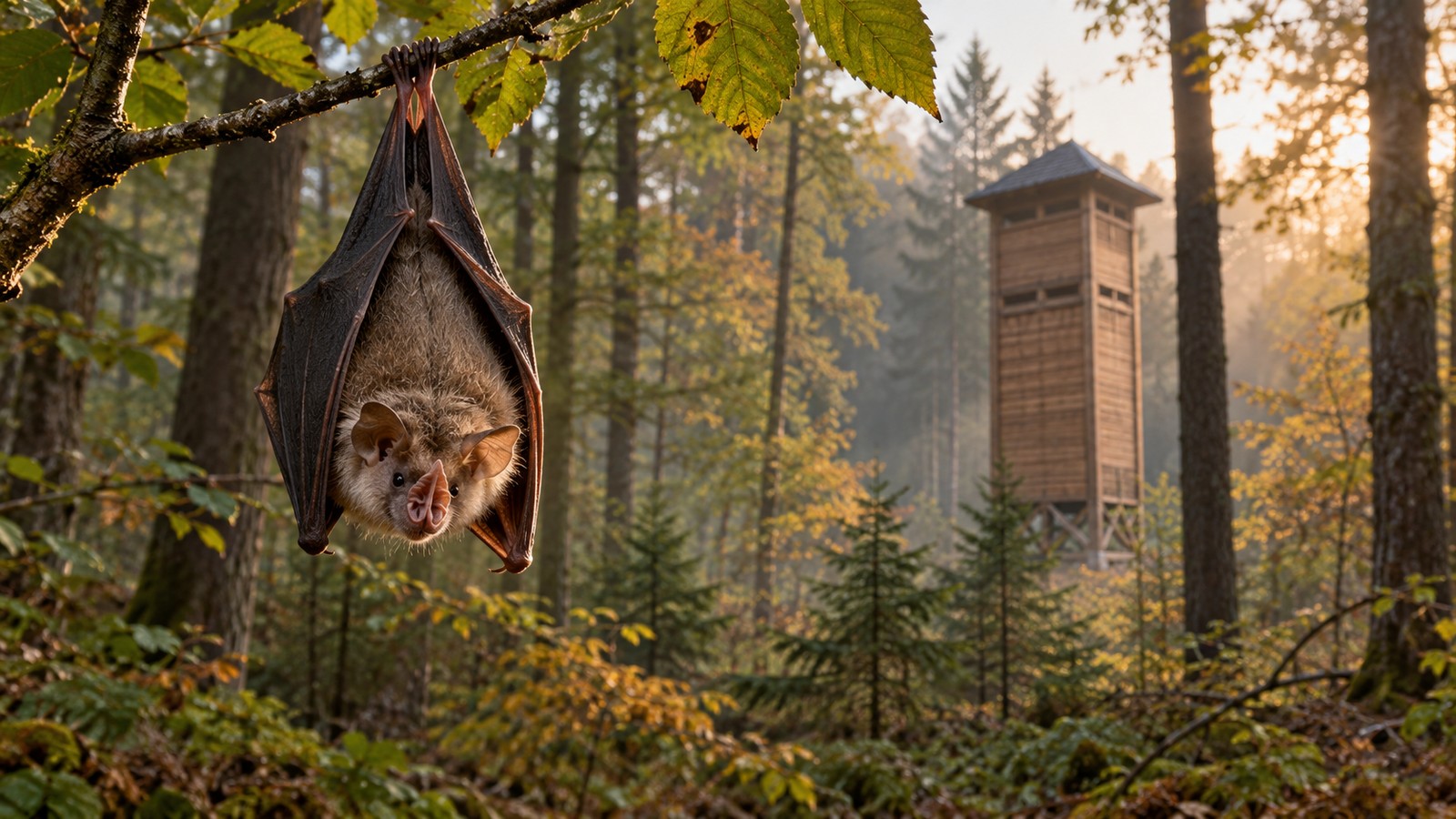
Deep in the forests of southern Poland, unusual wooden towers and miniature houses are being built for some very particular residents: bats. The specially designed structures are part of an international conservation programme intended to provide safe places for protected species to rest, breed and survive the winter. And the experiment is already producing encouraging results, with researchers documenting bats using the smaller shelters and exploring the larger towers.
The initiative, known as LIFE+ Podkowiec Towers, is coordinated by the Polish Society of Friends of Nature pro Natura in cooperation with Poland’s State Forests and conservation organisations in the Czech Republic, Slovakia and Romania.
Recent reporting by Polsat News and Interia has highlighted the distinctive structures and the recovery of one of Poland’s most vulnerable bat populations.
- Find more news from Poland on our Homepage .
The project represents a change in conservation strategy. Rather than concentrating exclusively on protecting places where bats already live, researchers are creating new habitats designed around the animals’ needs.
Why Poland is building houses for bats
The programme particularly benefits the lesser horseshoe bat (Rhinolophus hipposideros), a small, strictly protected species found mainly in southern Poland.
In the country’s cooler climate, these bats frequently use the attics of historic churches, monasteries and other buildings as summer breeding roosts. They typically spend the winter in underground sites such as caves and cellars.
However, suitable shelter is becoming harder to find.
Modern building renovations can seal entrances that bats previously used, while the conversion of unused attics into living spaces reduces potential roosting sites.
Changes to the surrounding landscape create further problems.
Roads, artificial lighting and the loss of trees or vegetation can interrupt the sheltered routes bats use to travel between their roosts and feeding grounds.
The conservation programme therefore aims to provide alternative accommodation within forests, where bats can find insects and move through relatively undisturbed habitats.
Unlike conventional bird boxes, the new structures are designed to meet the needs of several bat species.
Towers with underground winter homes
The most striking structures are wooden towers built in forest clearings.
Some are several storeys high and include compartments offering different temperatures and places to roost.
The first completed tower in the programme was constructed in the Rymanów Forest District, in south-eastern Poland, in 2025.
According to the project organisers, the building stands approximately 15 metres tall and is connected to an artificial underground hibernation site.
Its subterranean section consists of a winding corridor designed to maintain suitable humidity and temperature conditions during winter.
Monitoring equipment allows researchers to measure the conditions inside the shelter and record visits by bats.
Other towers have been developed in different parts of southern Poland.
At Limanowa, near the Beskid Wyspowy mountains, a tower has been linked to underground winter accommodation, with a restored pond nearby.


The water provides a drinking source and can attract insects that bats feed on.
In September 2026, Poland’s State Forests reported that a tower had been completed in the Zdroje Forest District, while further construction was taking place in Prudnik and Bardo Śląskie.
The programme has plans for ten large towers across participating Polish forest districts. However, the latest independently verified project updates do not establish that every planned tower is fully operational.
Smaller shelters are already attracting residents
The programme also includes much smaller structures that resemble miniature wooden forest houses.
These are designed primarily as summer or temporary shelters, rather than replacements for the underground sites bats need for hibernation.
Their construction includes deliberately created crevices, rough wooden surfaces and protected spaces where bats can cling, rest and avoid predators.
The project’s August 2025 monitoring report recorded particularly encouraging results.
Researchers found bats using every monitored shelter in the Prudnik and Krościenko forest districts, just two or three months after construction had been completed.
In the Limanowa Forest District, one shelter contained a group of at least 19 western barbastelle bats.
Other recorded visitors included lesser horseshoe bats, Brandt’s bats, whiskered bats and pipistrelles.
These findings provide direct evidence that the artificial shelters are being used by wildlife.
The results are especially important because some of these species normally depend on natural tree cavities, loose bark or other sheltered spaces that can be lost through habitat change.
At Zdroje, foresters confirmed in July 2026 that ten smaller bat shelters had been established, alongside work on a larger tower.
Visits have also been recorded in the bigger structures. At Rymanów and Limanowa, monitoring equipment detected lesser horseshoe bats entering tower or underground areas while construction was still under way.
However, those observations should not be confused with confirmed successful breeding or overwintering in the completed towers. Establishing their long-term effectiveness requires further monitoring.
From near disappearance to around 16,000 bats
The wider background to the project is a remarkable recovery in Poland’s lesser horseshoe bat population.
During the 1990s, the species had declined to extremely low recorded numbers, and conservationists feared for its future in the country.
Rafał Szkudlarek of pro Natura, who has been involved in efforts to protect the species for almost three decades, told Polsat News that the population is now estimated at approximately 16,000 individuals.
The figure is also cited in a 2025 State Forests account of the conservation programme.
That recovery followed years of practical measures, including protecting roosts, adapting buildings, improving access to attics and working with property owners.
The earliest population estimates and current figures are not necessarily based on identical counting methods, so the figures should be understood as evidence of a major long-term recovery rather than a precise measure of growth.
Crucially, the recovery predates the new forest towers.
It cannot be attributed to buildings constructed only within the past few years.
Instead, the towers represent the next stage in an established conservation programme: creating additional habitats to help preserve and potentially expand the recovering population.
A Polish conservation idea with European ambitions
The LIFE+ Podkowiec Towers initiative runs from 2021 to 2026 and receives support from the European Union’s LIFE environmental programme.
It brings together conservation specialists from Poland, the Czech Republic, Slovakia and Romania, where several bat species face similar threats.
According to the State Forests’ official project description, the programme aims to improve breeding and wintering habitats, protect feeding areas and reduce conflicts between human activity and bat conservation.
Its broader objective is to move from responding to habitat destruction after it occurs towards creating suitable habitats in advance.
That approach could become increasingly valuable as changes in construction, forestry and land use alter the places bats have traditionally occupied.
Bats are also an important part of forest ecosystems. Many European species feed on insects, helping maintain ecological balance.
The success of the new shelters will ultimately depend on whether bats continue using them, establish breeding colonies and return over successive seasons.
For now, the early monitoring evidence offers grounds for cautious optimism.
And the unusual wooden structures appearing in Poland’s forests show how protecting wildlife sometimes requires an unexpectedly architectural solution: building houses for creatures that cannot build their own.