In a peaceful corner of western Poland, three extraordinary oak trees stand as monuments to centuries of history, their enormous trunks and twisting branches recalling a famous legend about the origins of the Slavic peoples.
Named Lech, Czech and Rus, the trees grow near Rogalin Palace, a historic aristocratic residence south of Poznań.
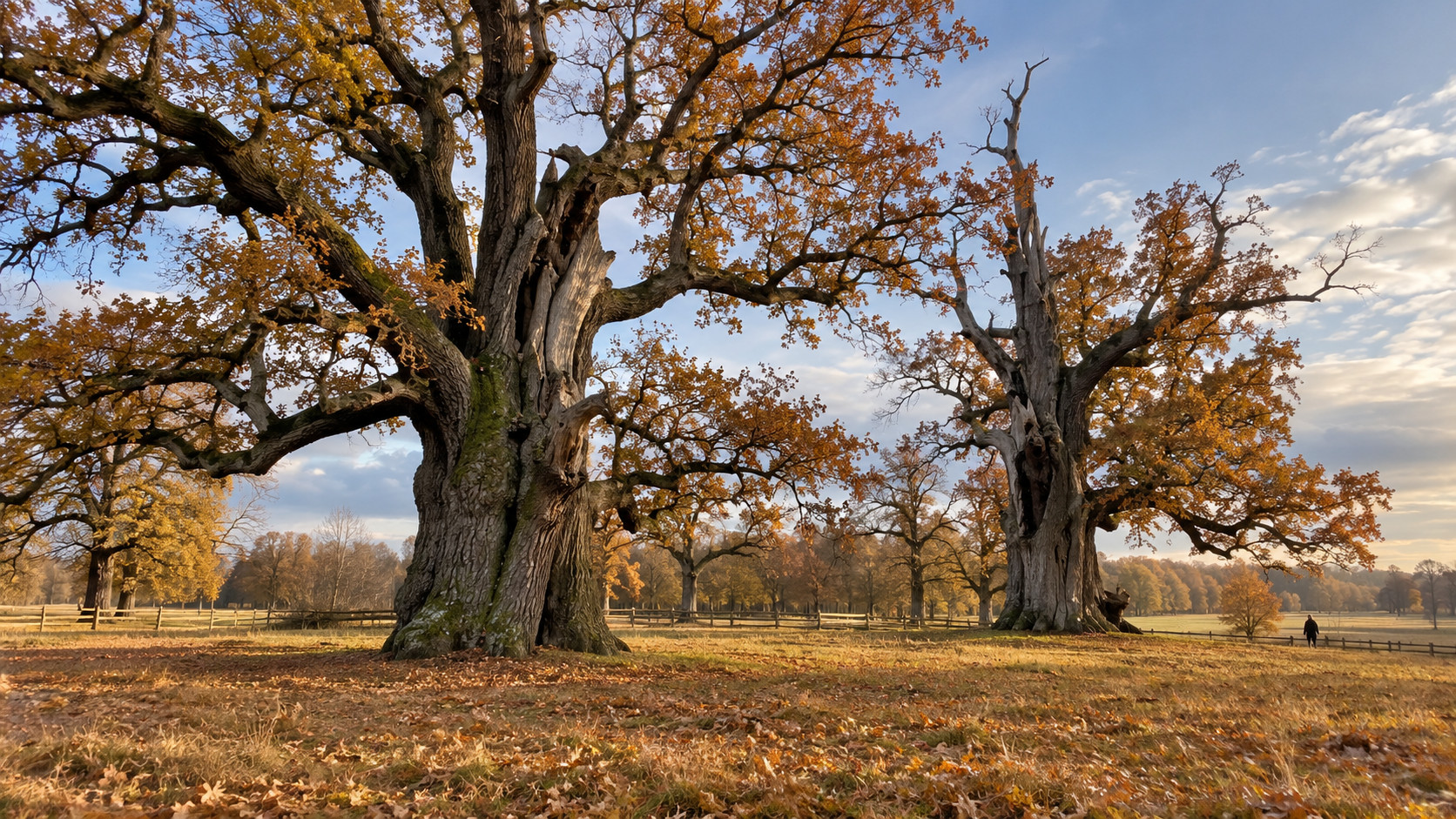
The largest, Rus, has a trunk measuring more than nine metres in circumference. Lech is almost as remarkable, while Czech, which died in 1992, remains part of the celebrated group.
- Find more news from Poland on our Homepage .
Together, they have become among the most recognisable natural landmarks in Poland’s Greater Poland region.
But the three famous oaks are only a small part of something much larger.
The surrounding Warta River valley contains an extraordinary concentration of veteran trees. An inventory carried out in 1992 recorded 1,435 oak trees with trunk circumferences exceeding two metres, making the area one of Europe’s notable surviving landscapes of ancient oaks.
Their story combines natural history, Polish folklore, aristocratic heritage and an ongoing effort to protect an ecosystem that has developed over centuries.
Three trees named after the legendary founders of Slavic nations
The trees take their names from Lech, Czech and Rus, three brothers who appear in traditional stories about the origins of neighbouring Slavic peoples.
In one familiar version of the legend, the brothers travelled together before eventually going their separate ways.
Lech became associated with the origins of Poland, Czech with the Czech lands, and Rus with the peoples of the lands further east.
One of the best-known episodes describes Lech discovering a white eagle nesting in a tree and deciding to establish a settlement nearby. The story is associated with Gniezno, one of the most important centres of early Polish statehood.
The Rogalin oaks have their own local version of the tale.
According to an account published by Poznań County, the three brothers were hunting in the area when they encountered an impressive elk.
They put down their weapons after discovering that they had entered a sacred grove.
The story continues with an encounter with a priest and the establishment of a place of worship, before the brothers supposedly planted the trees that would later bear their names.
It is a colourful piece of regional folklore, not a documented historical event.
There is no evidence that the legendary brothers planted the Rogalin oaks, or even that the brothers existed as historical individuals.
What the legend demonstrates is the cultural importance of ancient trees.
For many pre-Christian European communities, particularly impressive oaks were associated with sacred places, strength and continuity.
The enormous trees of Rogalin became natural settings for stories connecting the landscape with a much older imagined past.
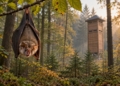

The giant called Rus
Of the three famous trees, Rus is the largest.
The Rogalin Palace Museum, a branch of the National Museum in Poznań, lists its trunk circumference at 9.15 metres.
That makes it the thickest oak recorded in the museum’s description of the Rogalin oak landscape.
Lech has a listed circumference of 6.33 metres, while Czech, although no longer alive, was recorded at 7.35 metres.
The measurements illustrate the extraordinary scale of the trees.
An adult standing beside Rus appears small against its deeply furrowed trunk, which has developed hollows and other features associated with great age.
The exact ages of the Rogalin oaks are harder to establish.
Various sources place some of them at several hundred years old, with Rus sometimes estimated at around 800 years.
Such estimates should be treated with caution. Ancient trees are difficult to date precisely, particularly when their oldest central wood has decayed.
What is clear is that these trees were already mature long before the modern Polish state emerged.
Their survival spans generations of changing borders, governments and communities.
A palace surrounded by centuries of nature
The celebrated oaks grow within the landscape surrounding Rogalin Palace, one of Greater Poland’s most important historic residences.
The present palace complex developed during the eighteenth century under the Raczyński family, one of the region’s influential aristocratic families.
Its formal gardens and naturalistic landscape park were designed to complement the surrounding countryside rather than completely transform it.
This approach helped preserve many of the veteran oaks already growing across the estate.
The museum’s historical account explains that the landscape park once covered approximately 300 hectares, while the area under its management is now around 27 hectares.
The wider oak landscape extends far beyond the palace grounds, reaching into fields, meadows and wooded areas along the Warta River.
Many trees are remnants of the old deciduous forests that once covered large parts of the river valley.
The landscape itself contains old river channels, floodplain meadows and small bodies of water, creating a mosaic of habitats around the surviving oaks.
Rogalin’s historic palace, gardens and park also form a nationally recognised Monument of History, reflecting their cultural and landscape significance.
The remarkable wildlife living inside ancient oaks
The trees are important for more than their size or the legends attached to them.
Veteran oaks provide habitats for species that depend on old, damaged or decaying wood.
Among the rare insects associated with Rogalin are the hermit beetle (Osmoderma eremita), the great capricorn beetle (Cerambyx cerdo) and the stag beetle (Lucanus cervus).
These insects form part of a complex ecosystem that develops as trees age.
Hollows, dead branches and decomposing wood provide breeding sites and shelter unavailable in many younger forests.
The great capricorn beetle is particularly interesting because its larvae tunnel through the wood of old oaks.
This creates a conservation dilemma.
The very insects that make the trees ecologically important can also contribute to the deterioration of already weakened trunks.
According to the National Museum in Poznań’s account of Rogalin’s natural heritage, conservation work has sought to protect both the ancient trees and the rare organisms that depend on them.
That means caring for weakened oaks while avoiding unnecessary destruction of valuable habitats.
The wider landscape is also protected through Rogalin Landscape Park and European Natura 2000 designations, which recognise the ecological importance of the Warta River valley.
When part of Lech broke away
The challenges of preserving such old trees became particularly apparent in 2014.
A large dead section of Lech’s trunk, weighing approximately six tonnes, broke away from the living portion of the tree.
The fragment had been dead for decades and was weakened by natural decay and the activity of organisms living within the wood.
Rather than falling immediately to the ground, it became caught among the remaining branches.
On 30 November 2014, firefighters carried out an operation to remove the dangerous section.
The work was intended to protect visitors and prevent further damage to the living tree.
The detached wood was placed nearby rather than simply destroyed.
As the Rogalin Palace Museum explained, the dead fragment remained a valuable habitat for rare organisms.
The incident illustrates the delicate balance involved in preserving ancient trees.
Their survival cannot be guaranteed indefinitely, but careful intervention can sometimes extend their lives while protecting the wildlife they support.
Other long-term threats identified by the museum include drought, changing groundwater conditions, strong winds, lightning and human damage.
A new generation of Rogalin’s famous trees
Efforts to preserve the oaks are not limited to caring for the existing giants.
Researchers have also worked to protect their genetic heritage.
On 12 April 2019, the museum celebrated the planting of a young oak known as Rus Junior.
The tree was produced through research by the Institute of Dendrology of the Polish Academy of Sciences, which successfully cloned the original Rus.
Its planting provided a particularly symbolic moment.
The ancient oak whose name recalls one of the legendary Slavic brothers now has a much younger genetic counterpart growing in the Rogalin landscape.
The museum also describes efforts to produce seedlings from selected veteran oaks to help restore the original woodland environment.
These initiatives cannot reproduce the centuries of ecological history contained within an ancient trunk.
But they provide a way to maintain the region’s oak heritage for future generations.
Where Polish legend and nature meet
Today, Rogalin’s ancient oaks remain an important attraction for visitors exploring the countryside around Poznań.
Their appeal is not simply that they are exceptionally large.
They belong to a landscape where natural history and human imagination have been intertwined for generations.
The trees inspired local legends and artists, while their ageing trunks have become habitats for species that depend on the survival of ancient woodland.
The original Czech has already died. Lech and Rus have endured centuries of environmental change, but they too remain vulnerable to the natural processes affecting very old trees.
Their preservation requires continuing attention rather than an assumption that such giants will last forever.
For visitors, however, the experience remains extraordinary.
Three enormous trunks stand together beneath the canopy of the Rogalin park, bearing the names of brothers from a story passed down through generations.
And nearby, a younger oak offers a reminder that the most important part of this heritage may be what survives into the future.