Before Christmas trees became the centrepiece of festive celebrations in many Polish rural homes, another extraordinary decoration could be found hanging from the ceiling.
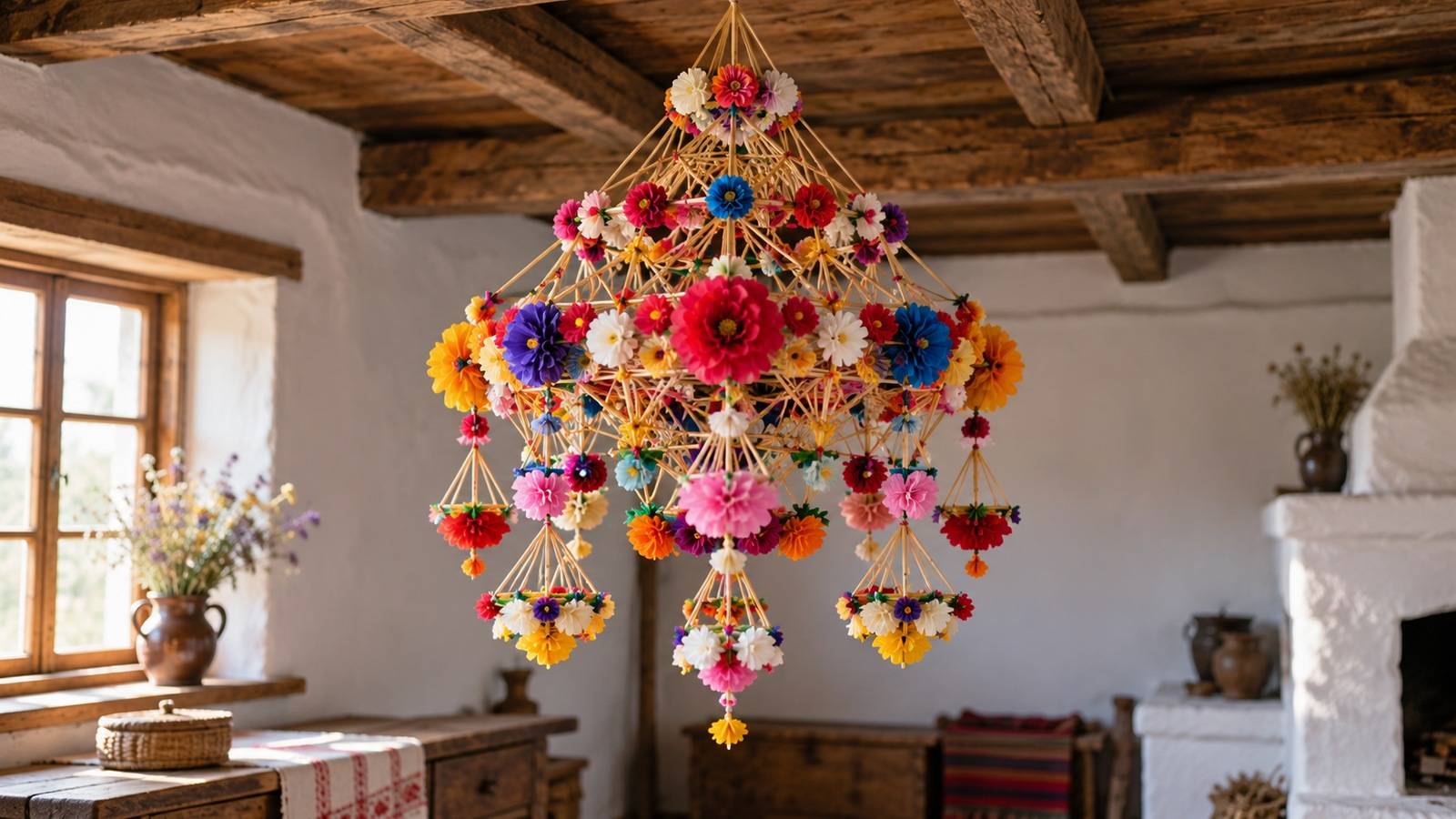
Made from ordinary straw, colourful paper and delicate tissue-paper flowers, these intricate suspended creations were known as pająki — the Polish word for spiders.
Some resembled geometric sculptures, with dozens of precisely arranged straw segments forming cubes, pyramids and other elaborate shapes. Others looked like colourful chandeliers, decorated with paper flowers, chains and hanging ornaments.
- Find more news from Poland on our Homepage .
For generations, they brought colour to rural households during Christmas. Today, the traditional craft of making them in Poland’s Lublin region has received official recognition as part of the country’s intangible cultural heritage.
The skill of making straw, paper and tissue-paper pająki in Lubelszczyzna, the region around Lublin in eastern Poland, was entered on Poland’s National List of Intangible Cultural Heritage on 17 December 2024. The Ministry of Culture publicly announced the recognition on 22 January 2025.
The listing acknowledges a tradition that has survived despite enormous changes in how Polish families decorate their homes.
A chandelier made from the simplest materials
The craftsmanship behind pająki begins with one of the most familiar materials in the Polish countryside: straw.
In the Lublin region, rye straw was traditionally preferred. Craftspeople carefully cleaned it, cut it into suitable lengths and soaked it in water to make it more flexible.
The prepared straw could then be assembled into lightweight structures, held together with thread and decorated with coloured paper and tissue-paper flowers.
The finished decorations varied considerably in shape and complexity.
Some featured geometric frameworks resembling crystals, built from interconnected straw shapes. Others used circular or chandelier-like arrangements, with elaborate clusters of flowers, hanging ornaments and decorative chains.
Ethnographic descriptions identify several traditional forms, including spherical, shield-shaped, crystalline and chandelier-inspired pająki.
Their construction could involve considerable patience and precision. What might initially appear to be a complicated manufactured ornament was often assembled from materials readily available in an agricultural household.
The tradition was particularly associated with women, who made decorations for their homes, often during the quieter autumn and winter months after the harvest.
Poland’s State Ethnographic Museum in Warsaw describes how these creations brought colour and visual interest to otherwise modest rural interiors.
Suspended overhead, the decorations could move gently with the air circulating through a room.
More than a Christmas decoration
For the families who displayed them, pająki were not simply ornaments.
In the Lublin region, they were traditionally suspended from the ceiling in a prominent part of the main room, sometimes near the household’s święty kąt, or holy corner — a space associated with religious images and domestic devotion.
Their presence marked festive occasions, particularly Christmas.
The decorations also carried symbolic meanings connected with the agricultural world.

According to Poland’s National Heritage Institute, people believed that pająki could bring good fortune, support a plentiful harvest and protect the household against harmful forces.
Straw itself held particular importance because of its association with grain, bread and the cycle of cultivation.
Old, damaged decorations were sometimes burned rather than simply discarded, reflecting traditional respect for the rye from which they had been made.
These beliefs varied between communities and changed over time. Not every decoration carried an identical meaning, and related hanging straw ornaments were also found elsewhere in Europe.
Similar traditions developed in countries including Lithuania, Latvia, Estonia, Sweden, the Czech Republic and Slovakia.
Poland’s pająki nevertheless developed a rich variety of regional forms, colours and construction techniques.
How Christmas trees changed Polish homes
The widespread adoption of Christmas trees gradually transformed festive decorations in Polish households.
The Christmas tree was not introduced everywhere at the same time. Its spread differed between regions and social groups, and older decorations could coexist with trees.
In the Lublin region, however, the National Heritage Institute records that pająki had almost entirely lost their former position as the principal Christmas decoration by the 1950s.
The colourful structures increasingly gave way to decorated evergreen trees.
Over time, the tradition became less prominent in everyday household celebrations, although knowledge of the craft continued among folk artists and local communities.
What had once been a familiar element of the rural Christmas interior increasingly became something encountered at exhibitions, craft demonstrations and cultural workshops.
A centuries-old tradition finds new admirers
The heritage recognition reflects the fact that making pająki remains a living skill rather than simply a vanished custom.
Traditional craftspeople continue to produce them, while museums, cultural organisations and workshops help introduce the techniques to new audiences.
They have also attracted interest from contemporary designers, who have adapted the shapes and techniques for modern interiors.
Today’s examples may be appreciated primarily as decorative objects, without the agricultural beliefs and protective symbolism once associated with them.
Yet the essential ingredients remain remarkably familiar: straw, paper, colour, careful hands and an understanding of how simple materials can become intricate three-dimensional structures.
For people exploring Poland’s Christmas traditions, pająki offer a reminder that the decorated tree is only one chapter in a much longer history of seasonal household customs.
Before electric lights, manufactured baubles and shop-bought decorations became commonplace, rural families could create a festive centrepiece from the remains of a harvest and a handful of coloured paper.
And in the hands of a skilled maker, those humble materials could become something resembling a chandelier.