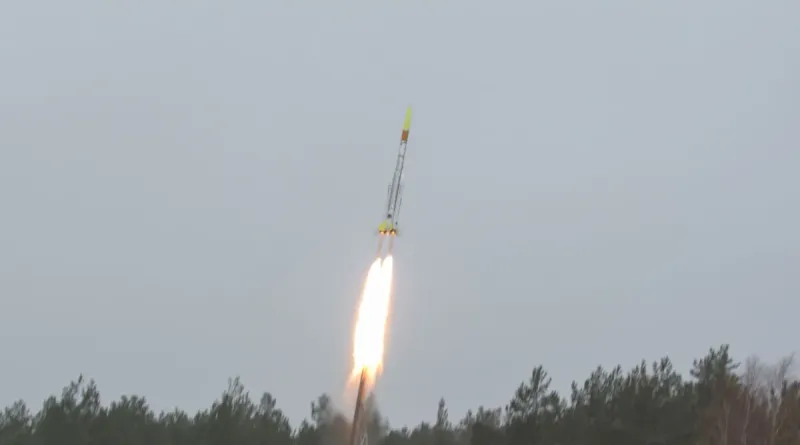
A Polish-developed suborbital rocket has successfully reached twice the speed of sound during a test flight from Poland’s Baltic coast, completing its first dedicated mission carrying equipment for a commercial customer and demonstrating new communications and tracking technologies.
The ILR-33 Bursztyn 2K rocket, developed by the Łukasiewicz Institute of Aviation, was launched on 12 November 2026 from the Central Air Force Training Range in Ustka, northern Poland.
The rocket reached Mach 2, approximately twice the speed of sound, during a flight designed to test technology developed by Polish space company Thorium Space.
- Find more news from Poland on our Homepage .
The Łukasiewicz Institute of Aviation confirmed the successful mission on 13 November, describing it as an important step towards the commercial use of Polish-built suborbital rockets.
Unlike the rocket’s previous flights, the latest mission was specifically configured to carry and test equipment developed for an external customer.
Polish communications technology tested at twice the speed of sound
The principal objective was not to reach a record altitude but to verify whether new communication, location and tracking systems could operate reliably during an actual rocket flight.
The technology was developed by Wrocław-based Thorium Space, which leads the SUBCOM research project in cooperation with the Łukasiewicz Institute of Aviation.
During the mission, a telemetry module aboard Bursztyn 2K exchanged data with a ground station while the rocket travelled at supersonic speed.
The station received telemetry, transmitted commands and maintained contact with the moving rocket using a tracking system incorporating specialised algorithms.
Engineers also tested equipment intended to help locate and monitor different sections of a rocket, together with antennas and radio communication modules.
According to Thorium Space’s official stock-market disclosure of 13 November, the initial results confirmed the operation of the rocket’s telemetry communications and the ground station’s tracking system.
The results are significant because communication and tracking can become technically demanding during high-speed flight, particularly when equipment must maintain contact with a rapidly moving vehicle.
The new systems are being developed to support future suborbital missions, where reliable communication between rockets and ground infrastructure is essential.
First dedicated flight for a Polish customer
A major milestone was the rocket’s ability to carry a payload tailored to a particular customer’s requirements.
Engineers modified the Bursztyn 2K platform, expanding its avionics systems, integrating additional navigation equipment and installing the communications components developed by Thorium Space.
The equipment was distributed across several sections of the rocket, including its propulsion and avionics compartments.
The team also adjusted the flight profile to ensure the conditions were appropriate for the planned experiments.
The test included an assessment of the Polish-developed WR-2 mobile rocket launcher.
The launcher was transported to the test site inside a standard shipping container, an approach intended to make future launches more flexible while simplifying transport and protecting the equipment.
Cezary Szczepański, director of the Łukasiewicz Institute of Aviation, described the mission as an important contribution towards developing Poland’s domestic space technology industry and commercial applications for its suborbital rockets.
You May Also Be Interested In


Thorium Space chief executive Piotr Mierzejewski also emphasised the importance of moving beyond laboratory testing to demonstrate whether systems work during real flight conditions.
The successful test represents progress towards a potential market in which Polish rockets could carry scientific instruments and technology experiments for domestic and international customers.
Bursztyn 2K already reached space in 2024
The latest mission builds on an earlier achievement by Polish aerospace engineers.
On 3 July 2024, Bursztyn 2K was launched from the Andøya space centre in Norway and reached an altitude of 101 kilometres, crossing the Kármán line, commonly used as the boundary of outer space.
The achievement marked a major milestone for Poland’s domestic rocket development programme.
As Poland-24 reported at the time, the flight demonstrated Poland’s growing capability to design, build and operate suborbital rockets.
The November 2026 mission had a different purpose.
Rather than seeking to repeat the 101-kilometre flight, engineers concentrated on verifying equipment carried for a customer under a specially designed test programme.
The newly reported achievement therefore does not represent the rocket’s first flight into space or a new orbital launch capability.
Bursztyn 2K remains a suborbital research rocket, meaning it follows a trajectory that does not place a spacecraft into orbit around Earth.
Its potential applications include scientific research, testing electronic equipment and demonstrating technologies intended for future space systems.
What happens next for Poland’s rocket programme?
The November flight formed part of SUBCOM Phase II, a project focused on developing communication and remote-sensing technologies for suborbital research rockets.
The programme receives support from Poland’s National Centre for Research and Development under the EU-backed European Funds for a Modern Economy initiative.
Although the initial results were positive, the development work is not complete.
Thorium Space said it would conduct a detailed analysis of the flight data and system performance over the following weeks.
The next stages include further optimisation of the equipment, additional testing and preparations for potential commercial deployment.
The company also plans another testing campaign before bringing the technologies to market.
The broader objective is to develop equipment that could eventually become standard on future versions of rockets built by the Łukasiewicz Institute of Aviation.
The project also has potential applications beyond research missions, including communications technologies relevant to the wider space and defence industries.
For Poland, the significance of the latest flight lies in demonstrating that its rocket technology can support a mission designed around a customer’s specific technical requirements.
Following the 2024 achievement of reaching space from Norway, the successful launch from Ustka represents another step towards establishing a domestic capability for conducting increasingly sophisticated suborbital missions.