A Polish scientist working in Switzerland has helped demonstrate how ordinary natural clay could play an important role in protecting containers holding radioactive waste, after an eight-and-a-half-year underground experiment showed that densely compacted bentonite can suppress the growth of potentially corrosive bacteria.
Dr Natalia Jakus, a researcher at the Swiss Federal Institute of Technology Lausanne (EPFL), led the study with Nikitas Diomidis and Rizlan Bernier-Latmani, working alongside Switzerland’s radioactive-waste management organisation, Nagra.
The findings, published in the peer-reviewed journal Applied Clay Science, suggest that bentonite could provide an effective biological barrier around containers intended for deep underground disposal of spent nuclear fuel.
- Find more news from Poland on our Homepage .
The researchers found that bacterial populations declined over time, with no sustained growth detected even in the least densely compacted clay tested.
However, the experiment also established that some microorganisms remained alive after eight and a half years, demonstrating that suppressing microbial activity is not the same as eliminating it entirely.
The research was highlighted by Polish science news service Nauka w Polsce on 14 November, following earlier publication of the findings by the Swiss research partners.
Why bacteria are a concern for nuclear-waste storage
One of the major challenges facing nuclear energy is managing radioactive waste that must remain isolated from the environment over extremely long periods.
A widely pursued approach involves placing spent nuclear fuel or other high-level radioactive waste in specialised containers deep underground, within stable geological formations.
The containers are surrounded by multiple engineered and natural barriers intended to prevent radioactive substances from reaching the environment.
Bentonite is one of the materials being considered for these barriers.
It is a naturally occurring clay that swells when exposed to water, allowing it to fill gaps and form a tightly packed layer around waste containers.
But the underground environment also contains microorganisms.
Some, particularly sulphate-reducing bacteria, can produce substances that accelerate corrosion of steel.
In a detailed explanation of the research, Nagra noted that these microorganisms can have both beneficial and potentially harmful effects.
Some consume hydrogen produced during corrosion, helping limit gas pressure. Others generate sulphur compounds capable of damaging metal.
Although biological corrosion is generally a smaller concern than corrosion caused by non-biological processes, it remains relevant when evaluating waste-storage systems designed to function for hundreds of thousands of years.
The researchers therefore wanted to determine whether bacteria could survive, multiply or become more active within compacted bentonite over extended periods.
Eight and a half years beneath a Swiss mountain
The experiment took place at the Mont Terri underground rock laboratory in the Swiss canton of Jura.
Researchers placed compacted Wyoming bentonite into stainless-steel experimental cylinders and installed them in a borehole within a geological formation known as Opalinus Clay.
The conditions were designed to resemble important aspects of the underground environment expected in a future geological repository.


Three different dry densities of bentonite were tested: 1.25, 1.45 and 1.55 grams per cubic centimetre.
Samples were examined after approximately 18 months, five and a half years, and finally eight and a half years.
The scientists used DNA-based techniques to measure microbial abundance and examine changes in the composition of bacterial communities.
They also attempted to cultivate microorganisms recovered from the samples to determine whether they were still viable.
The peer-reviewed study, published in Applied Clay Science, found that microbial populations remained low and generally declined as the experiment progressed.
The density of the bentonite was the strongest factor influencing microbial communities, while the length of exposure provided another important influence.
Even at the lowest density tested, the researchers observed no evidence of sustained microbial growth under the experimental conditions.
Bacteria survived — but were unable to multiply
One of the most significant findings concerned sulphate-reducing bacteria, which are of particular interest because of their potential contribution to corrosion.
After eight and a half years, these bacteria accounted for less than 0.1% of the microbial community identified in the samples.
The scientists found no evidence that they had progressively multiplied inside the compacted clay.
Nevertheless, some remained viable.
When researchers removed samples and provided favourable conditions in the laboratory, certain bacteria could be cultivated again.
Speaking to PAP, Jakus explained that their survival illustrated the importance of distinguishing between an environment that prevents microorganisms from growing and one that kills them.
Compacted bentonite appears to restrict the space available to microorganisms while limiting access to the water and nutrients needed for growth.
The clay also makes it more difficult for microorganisms to remove metabolic waste products.
Together, those conditions can substantially reduce biological activity.
However, the findings do not mean the surviving microorganisms could never become active again.
Jakus explained that changes in the underground environment, such as the development of fractures that create additional space or allow nutrients to enter, could potentially alter microbial behaviour.
Bentonite’s ability to swell and seal gaps provides an additional safeguard against such changes.
Could nuclear-waste repositories become cheaper to build?
The research could eventually influence how engineers design the clay barriers surrounding underground waste containers.
An important result was that even bentonite with a dry density of 1.25 grams per cubic centimetre inhibited microbial growth during the experiment.
That finding suggests some existing assumptions about the degree of compaction needed to suppress bacteria may be conservative.
Using less densely compacted material could potentially simplify aspects of repository construction or help optimise costs.
Nagra has suggested that the findings may provide opportunities to refine future repository designs without sacrificing the biological barrier’s intended function.
However, the study did not establish actual construction savings, and it does not demonstrate that lower compaction would automatically satisfy every mechanical, hydraulic and long-term safety requirement.
The findings concern microbial behaviour under specific experimental conditions, not a complete assessment of a nuclear-waste repository.
As Nagra acknowledged in its September research summary, eight and a half years is a very short period compared with the million-year timescale considered in some long-term repository safety assessments.
The findings will therefore need to be considered alongside other evidence about corrosion, groundwater movement, geological stability and the behaviour of engineered barriers.
Why the research matters for Poland
Although the experiment took place in Switzerland, its findings are relevant to countries preparing to develop nuclear power, including Poland.
The Polish government is pursuing its first commercial nuclear power station at Lubiatowo-Kopalino in Pomerania.
The planned facility will use three Westinghouse AP1000 reactors, with the first unit currently scheduled to begin commercial operations in 2036.
Poland-24 previously reported on the project’s latest permitting preparations, including an application covering preliminary construction activities at the site.
The Polish government’s updated nuclear-energy programme also envisages a second nuclear power plant.
Developing those facilities will require long-term arrangements for managing spent fuel and radioactive waste, alongside decisions about storage, treatment and eventual disposal.
The Swiss experiment does not establish how Poland should design a future repository, nor has any Polish repository design been approved as a result.
It does, however, contribute to the international scientific evidence that governments and nuclear-waste organisations can use when assessing potential disposal systems.
For Jakus and her colleagues, the findings strengthen the evidence that compacted bentonite can substantially limit microbial activity under repository-relevant conditions.
The research also underlines an important distinction in nuclear-waste safety: some potentially harmful microorganisms may survive deep underground for years, yet remain unable to multiply while the surrounding engineered barriers maintain the conditions that suppress their activity.
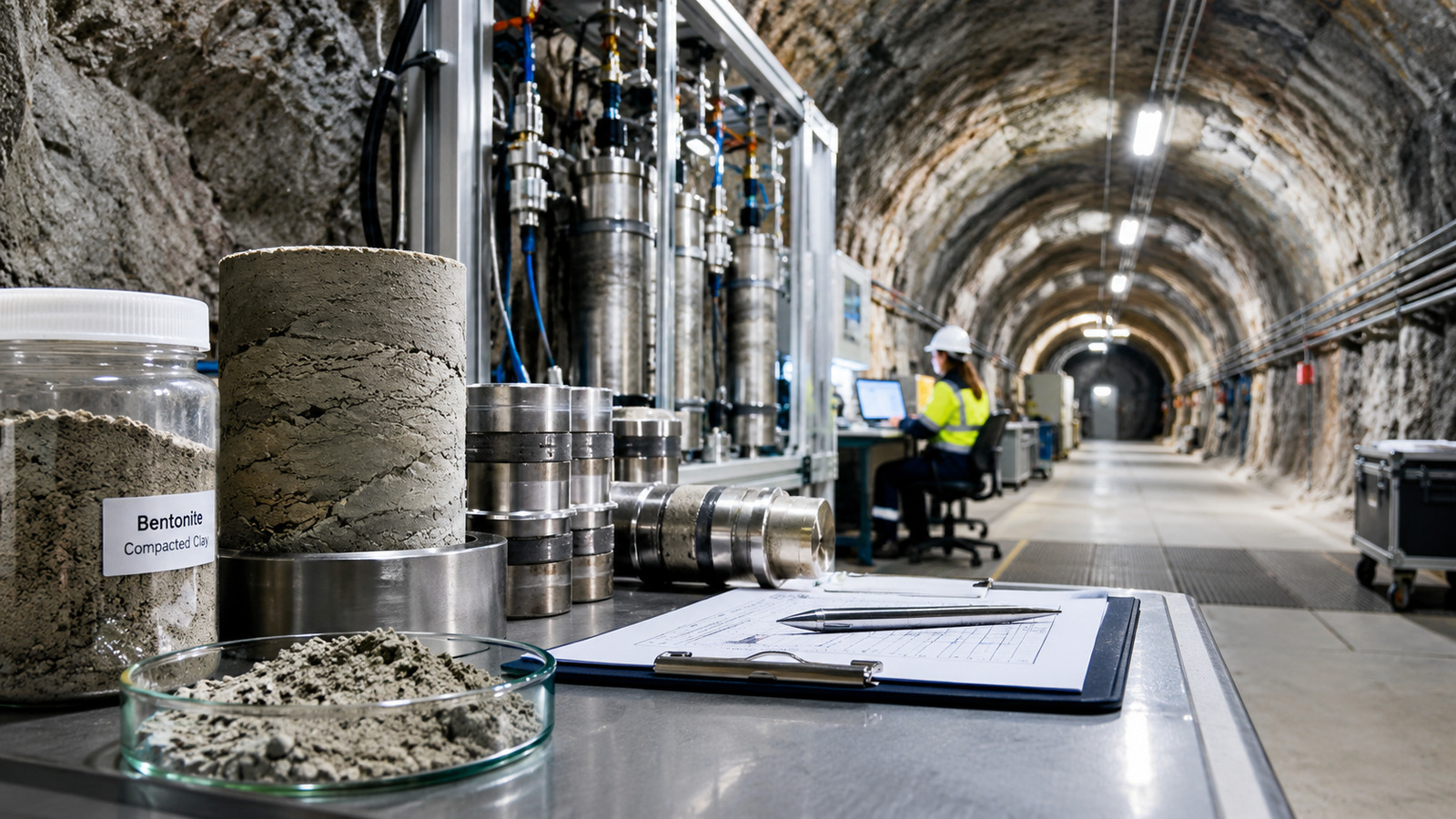
Featured image: Digitally generated editorial illustration of an underground geological research laboratory. Not a photograph of the experiment.