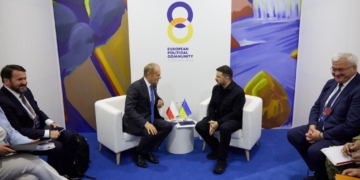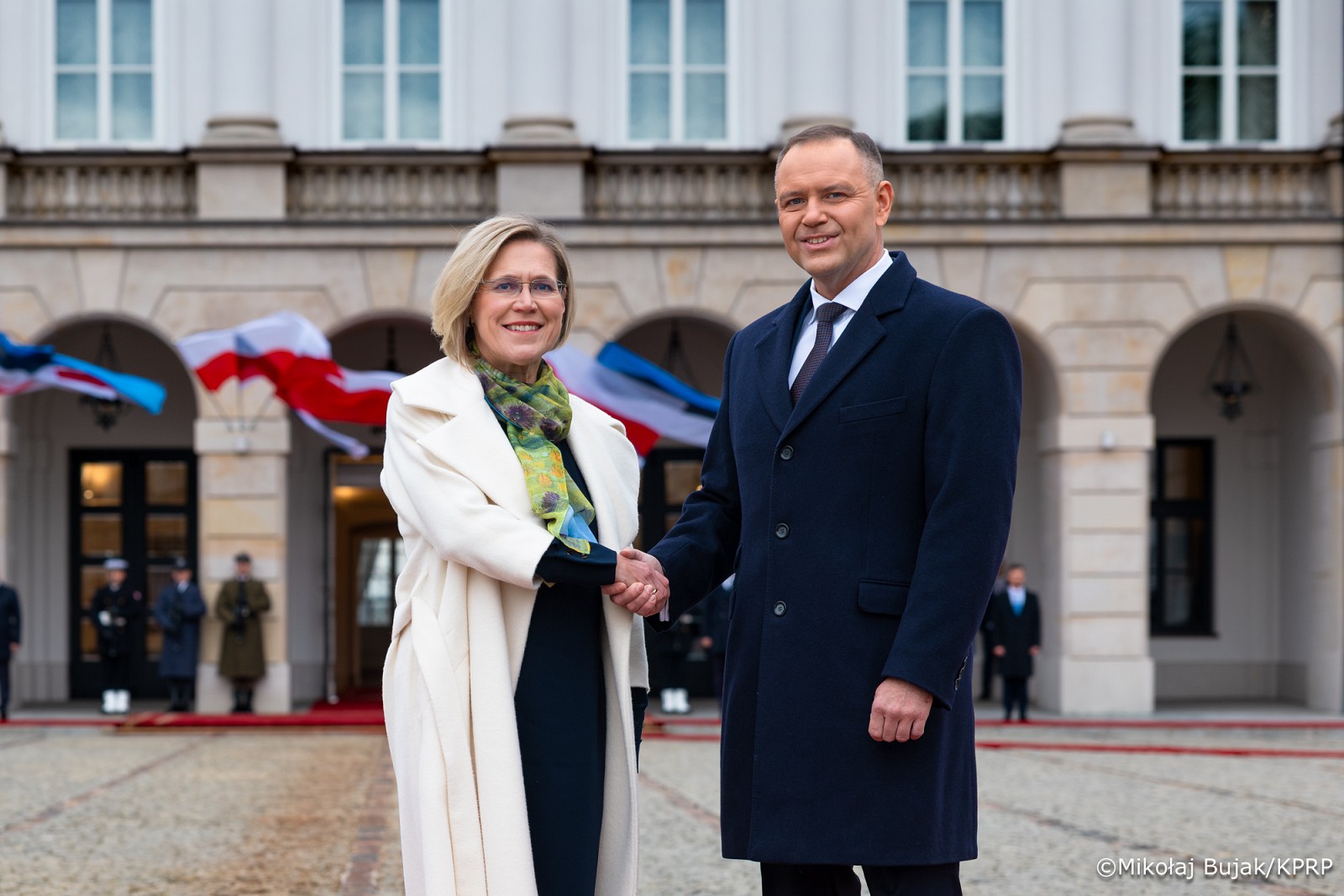
Poland and Estonia have called for stronger NATO defences on the alliance’s eastern flank, closer security cooperation and greater protection of critical infrastructure in the Baltic Sea during talks between their presidents in Warsaw on Monday, 16 November.
Polish President Karol Nawrocki hosted his Estonian counterpart, Ülle Madise, at the Presidential Palace, where the two leaders discussed Russia’s military and hybrid threats, the war in Ukraine and the importance of maintaining American involvement in European security.
The meeting was among Madise’s first foreign visits since becoming Estonia’s president on 12 October 2026, succeeding Alar Karis.
- Find more news from Poland on our Homepage .
Following the talks, Nawrocki said both countries shared an assessment of the threats facing Europe and considered strengthening NATO’s eastern flank a central priority.
The Polish president also called for deeper cooperation on cybersecurity, defence technology and the protection of strategic infrastructure.
According to the Polish President’s Office, the visit included a private meeting between the two presidents, followed by discussions involving their delegations and statements to the media.
Shared concerns about Russia and NATO security
Russia’s war against Ukraine dominated the security discussions.
In his official statement following the meeting, Nawrocki said Moscow’s actions presented a challenge extending beyond Ukraine to the security of Europe as a whole.
“Our shared priority is to strengthen NATO’s eastern flank and develop our own defence capabilities,” the Polish president said.
He emphasised the importance of maintaining a strong American military presence in Europe while calling on European NATO members to take greater responsibility for their defence.
Nawrocki said the objective was to develop credible deterrence capabilities so that any potential aggressor would understand that an attack against a NATO member would trigger a collective response.
Both Poland and Estonia belong to NATO and the European Union.
Their geographical positions give them particular interests in the defence of the alliance’s eastern territories. Poland borders Russia’s Kaliningrad region and Belarus, while Estonia shares a land border with Russia.
Both countries have also been among Ukraine’s supporters since Russia launched its full-scale invasion in February 2022.
Madise echoed the importance of NATO and national defence capabilities.
In a statement published by the Estonian presidency, she said Poland and Estonia’s shared historical experiences contributed to a common understanding of regional security threats.
She stressed that Estonia was working to strengthen its military capabilities alongside its allies to deter future aggression.
Protecting the Baltic Sea from hybrid threats
Beyond conventional military deterrence, the Polish president highlighted the danger of cyberattacks, sabotage, disinformation and other forms of hostile activity.
Nawrocki accused Russia of engaging in such operations and argued that Poland and Estonia needed to cooperate more closely in protecting critical infrastructure.
He specifically identified infrastructure in the Baltic Sea as an area requiring joint attention.
You May Also Be Interested In

The region contains strategically important electricity connections, telecommunications cables and energy infrastructure linking NATO and EU member states.
Security concerns surrounding this infrastructure have increased in recent years amid incidents involving damaged undersea cables and warnings about sabotage and hybrid threats.
Nawrocki also praised Estonia’s experience in digital government and cybersecurity, suggesting the two countries had opportunities to deepen cooperation in technology and the protection of essential systems.
However, neither presidential office announced a new binding agreement on Baltic infrastructure protection following Monday’s meeting.
The discussions instead reaffirmed an existing area of cooperation and a shared intention to strengthen it.
Poland’s Piorun missiles and Baltic air defence
The presidents also highlighted practical examples of military cooperation already taking place between their countries.
Nawrocki recalled Poland’s repeated participation in NATO’s Baltic air-policing operations, which protect the airspace of Estonia, Latvia and Lithuania.
According to the Polish president, Polish forces have undertaken 13 rotations supporting Baltic air defence.
He also thanked Estonia for sending military personnel to assist Poland during the border crisis involving Belarus in 2021.
Another example was Estonia’s earlier purchase of Polish-made Piorun portable air-defence systems.
The weapons are designed to engage low-flying aerial targets, including helicopters and aircraft.
Nawrocki welcomed the existing defence relationship and expressed interest in its further development.
The Estonian presidency provided additional details about possible industrial cooperation.
Its account of the Warsaw visit said the leaders discussed collaboration involving defence companies, universities and researchers developing weapons systems, drones and counter-drone technologies.
Madise also highlighted existing relationships between Estonian defence companies and Poland’s state-owned defence group PGZ.
These discussions did not constitute an announcement of a new weapons purchase or production agreement.
Infrastructure and energy security also discussed
The meeting extended beyond military cooperation to infrastructure, energy independence and regional economic resilience.
Nawrocki highlighted the importance of the Three Seas Initiative, which promotes transport, energy and digital connections across Central and Eastern Europe.
He identified the Rail Baltica railway and Via Baltica road corridor as projects with both economic and defence significance.
Such connections could help NATO countries move military personnel and equipment across the region more effectively during a crisis.
The Polish president also pointed to the Baltic states’ electricity-grid synchronisation with continental Europe through Poland as an example of infrastructure investments reducing dependence on Russia.
Estonia’s presidential office confirmed that discussions during the Warsaw visit included priorities for the European Union’s next long-term budget, including eastern-border security and financing for Rail Baltica.
These issues connect infrastructure development directly to the wider security agenda of both countries.
Estonia’s president also meets Donald Tusk
During her visit, Madise also met Polish Prime Minister Donald Tusk.
According to the Estonian presidency, their discussions included the continued presence of American forces in the region and Poland’s possible role in future peace negotiations concerning Ukraine.
The issue follows European leaders’ recent agreement to include Poland in a five-country group preparing to represent Europe in diplomatic discussions about ending the war.
Poland-24 reported on the negotiating arrangement, which also includes Britain, France, Germany and Italy, alongside EU institutions.
Madise’s discussions with Tusk addressed the importance of ensuring that the interests of countries in Central and Eastern Europe are represented in those negotiations.
The Estonian leader also visited the University of Warsaw and the headquarters of Frontex, the European Border and Coast Guard Agency.
At Frontex, she met officials including deputy executive director Uku Särekanno and Estonian personnel working for the agency.
No new defence agreement announced
Monday’s visit reinforced the close security relationship between Poland and Estonia, but it did not produce an announced new defence treaty, military deployment or arms contract.
The immediate outcome was political agreement on shared priorities, including NATO deterrence, cybersecurity, Baltic infrastructure protection and continued support for Ukraine.
Both presidents presented closer regional cooperation as an important part of responding to Russia’s military and hybrid threats.
For Poland and Estonia, those priorities reflect an established partnership between two NATO members whose geographical positions place them near the alliance’s eastern frontier.
The next test will be how the areas identified during the Warsaw discussions translate into further practical cooperation between their governments, armed forces and defence industries.
Featured photograph: Mikołaj Bujak / KPRP.