A Polish research team has developed an artificial intelligence-controlled laboratory robot capable of discovering previously undescribed chemical reactions. During a 30-day experimental programme in Warsaw, the system made more than 3,000 decisions about which experiments to pursue and identified four chemical transformations that selectively produce particular molecular forms. The results, published in the scientific journal Nature Communications, demonstrate how artificial intelligence could accelerate chemical research by allowing machines to conduct experiments, analyse their results and decide what to investigate next.
The system was developed at the Institute of Organic Chemistry of the Polish Academy of Sciences (IChO PAN).
The research was conducted by Patryk Klochowicz, Ahmad F. Kassir, Chandrakanta Parida and Jarosław M. Granda.
- Find more news from Poland on our Homepage .
Their peer-reviewed study, published on 13 October, describes a robotic platform that combines laboratory automation with a form of artificial intelligence known as deep reinforcement learning.
Unlike conventional laboratory robots that repeatedly carry out predetermined instructions, the Polish system can use the results of one experiment to decide what should happen next.
That capability allowed it to search for previously unknown chemical transformations within a research programme designed by human scientists.
The findings were subsequently explained in an interview with PAP’s Science in Poland service, published on 25 October.
Four chemical discoveries in 30 days
The researchers demonstrated their technology by investigating chemical reactions that produce chiral molecules.
These are molecules whose three-dimensional structures can exist in forms that are mirror images of each other, much like a person’s left and right hands.
Although the two forms may look almost identical chemically, their interactions with other molecules can be very different.
This makes chirality particularly important in chemistry and pharmaceutical research.
In the experiment, the researchers wanted to discover reactions that would produce one molecular form preferentially over its mirror image.
Such reactions are described as enantioselective.
According to the scientific paper, the robot identified four previously undescribed highly enantioselective transformations.
One produced a molecule displaying axial chirality, in which its spatial asymmetry arises around an axis rather than a conventional asymmetric atom.
The other three involved the synthesis of allenes, organic compounds containing a distinctive arrangement of two carbon–carbon double bonds.
The researchers report that one transformation included the first enantioselective functionalisation of a pyrrolopyrrole chemical structure.
The institute’s own announcement on 16 October confirms that the team investigated 100 candidate reactions and discovered four enantioselective transformations.
These results constitute new chemical methods rather than the discovery of medicines or commercially available products.
Further investigations would be required to establish whether any of the transformations have useful pharmaceutical or industrial applications.


A robot that decides what experiment to perform next
The system combines several technologies that would ordinarily require separate laboratory procedures.
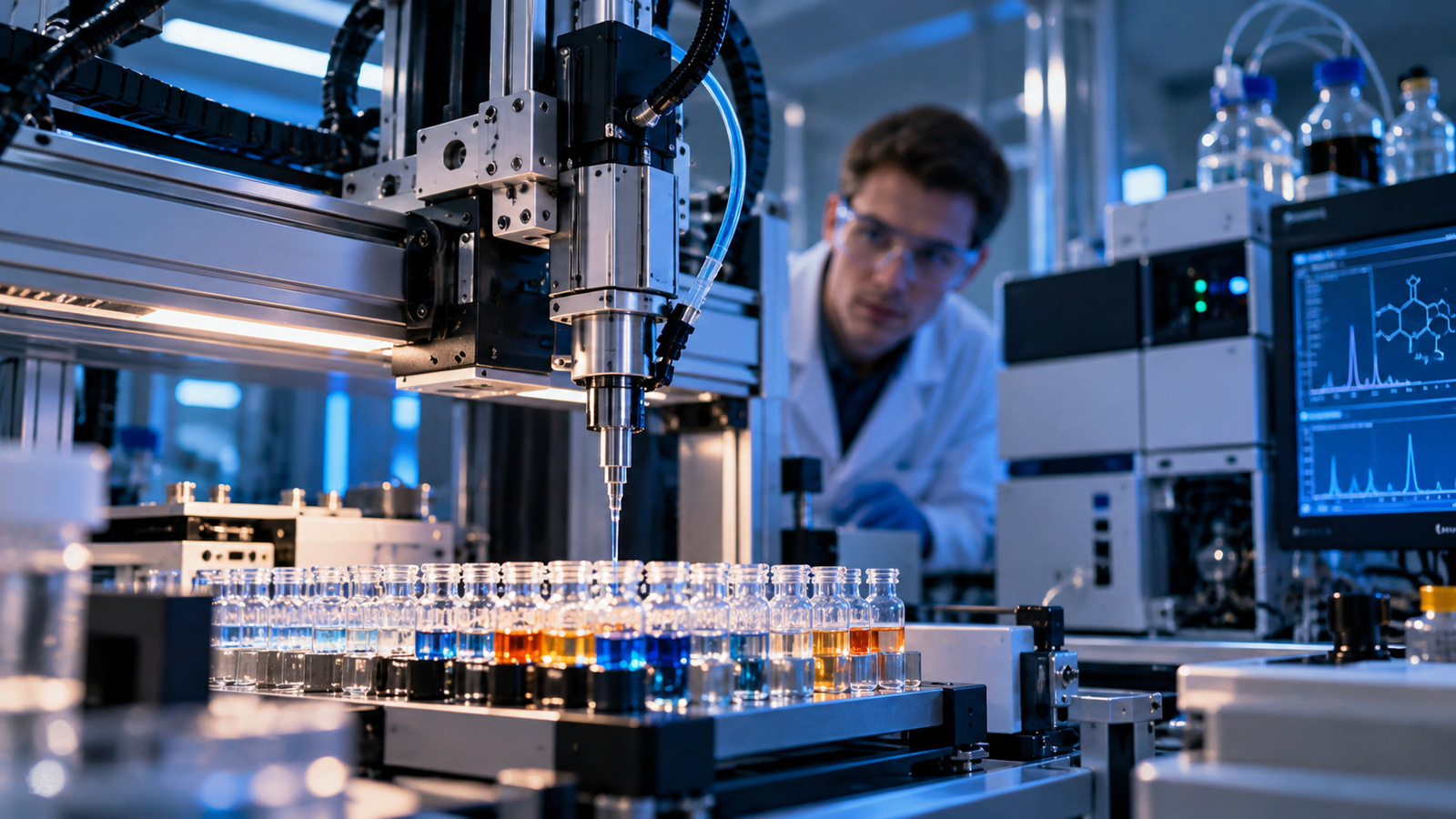
At its centre is a three-axis liquid-handling robot.
It uses a specialised needle and remotely controlled syringe pump to transfer prepared chemical solutions into reaction vessels.
The equipment includes custom components produced using 3D printing, as well as temperature-control modules capable of heating or cooling reaction mixtures.
According to Klochowicz, the platform can operate between approximately −40°C and 90°C, allowing it to explore reactions under different temperature conditions.
Once the robot has mixed the substances, it can control how long a reaction proceeds before sending samples for analysis.
The analytical equipment uses chromatography, a technique that separates the components of a mixture and helps identify the products of a chemical reaction.
In this case, the system was also designed to assess the relative proportions of the two mirror-image forms of a product.
That information allows the artificial intelligence to distinguish between reactions that produce useful selective results and those that do not.
The research team installed two analytical modules.
According to Klochowicz, this arrangement allowed the laboratory to examine approximately 40–50 reaction mixtures per day.
The system could continue operating overnight and at weekends rather than depending on scientists being physically present for every experimental step.
Its most important innovation, however, was not simply the speed of the equipment.
It was the ability to make decisions based on experimental evidence.
How the artificial intelligence learned chemistry
The researchers used a machine-learning technique called deep reinforcement learning.
In simplified terms, reinforcement learning allows an AI system to develop strategies by trying different actions and receiving feedback about how successful those actions are.
The system learns which decisions are more likely to achieve its objectives.
However, training such an algorithm entirely through real chemical experiments would be extremely expensive and time-consuming.
The Polish scientists addressed that problem by creating simulated laboratory environments.
Their approach uses what researchers call a digital twin: a computer-based representation of relevant aspects of the physical experimental process.
The simulated environments modelled chemical reactions and the information obtained from chromatographic analysis.
The AI agents could therefore practise making decisions without consuming real laboratory chemicals during every training step.
According to Klochowicz, one agent underwent approximately 20 million simulated interactions, while another underwent approximately 10 million.
These were computer-simulation interactions, not 30 million physical laboratory experiments.
Only after training did the researchers transfer the decision-making algorithms to the physical robotic platform.
The AI could then use the results of actual experiments to select subsequent actions within the permitted research space.
This approach enabled the machine to search for promising reactions, investigate catalysts and explore how different starting materials behaved.
During the 30-day programme, the software made more than 3,000 decisions.
That number describes algorithmic choices, which can include several decisions associated with an experiment. It should not be interpreted as 3,000 separate chemical reactions successfully performed.
Why the new chemistry matters
The scientific importance of the work lies partly in the type of reactions being investigated.
A major challenge in organic chemistry is developing reliable ways to produce molecules with a particular three-dimensional structure.
This is essential because many biological systems distinguish between mirror-image molecular forms.
Two versions of the same chiral compound can interact differently with biological targets, potentially affecting a substance’s usefulness or safety.
Chemists therefore often need reactions that strongly favour the production of one form.
Finding those reactions can require extensive experimentation.
Researchers must investigate different combinations of starting materials, catalysts, temperatures and reaction times.
They must then analyse the results to determine both whether the desired compound formed and which molecular forms were produced.
The Polish system brings these stages together in a largely automated experimental process.
Its potential advantage is the ability to explore many possible conditions while directing attention towards the most promising results.
The researchers demonstrated the approach using reactions catalysed by chiral phosphoric acids.
These are organic catalysts capable of influencing the three-dimensional structure of products formed during certain reactions.
The findings show that AI-controlled experimentation can help researchers investigate complex chemical selectivity rather than simply search for any reaction that produces a detectable product.
Nevertheless, the system has so far been demonstrated within a defined area of chemistry.
Its performance across much broader classes of reactions remains to be established.
Could the technology help develop new medicines?
The research could eventually contribute to pharmaceutical chemistry, where precise control over molecular structure is important.
Drug development frequently requires chemists to investigate complex molecules and the methods used to manufacture them.
The enormous number of theoretically possible organic compounds creates a major challenge.
Only a small fraction can be investigated through conventional experimental programmes.
Klochowicz noted that some estimates place the number of theoretically possible organic molecules with potentially useful pharmaceutical properties at around 10 to the power of 60.
That figure illustrates the scale of the research problem rather than representing a catalogue of compounds that scientists could realistically manufacture.
AI-assisted laboratory systems may help chemists explore parts of this chemical space more efficiently.
However, the Polish robot has not discovered a new medicine, demonstrated a treatment or established the pharmaceutical effectiveness of any compound.
Its achievement concerns the discovery of chemical transformations and the development of an automated research method.
Any potential drug application would require extensive additional chemical, biological and medical investigation.
Scientists remain essential to the discoveries
Despite the robot’s autonomous capabilities, the researchers emphasise that it does not replace scientists.
The team designed and constructed the platform, selected the chemical materials and determined the research objectives.
The AI operated within those boundaries.
Human researchers also remained responsible for interpreting the broader scientific significance of the findings and confirming the identities of products.
Klochowicz told PAP that the complexity of organic chemistry means human intuition and abstract reasoning remain essential when deciding which scientific questions are worth investigating.
The new system instead offers a way to automate some of the repetitive and time-consuming stages of experimentation.
That distinction is central to understanding what the technology demonstrates.
The robot did not independently decide to investigate all possible chemical substances or formulate an unrestricted scientific research programme.
Rather, it explored a carefully designed experimental environment and made a series of decisions based on the results it obtained.
This is a more limited form of autonomy than the idea of an AI scientist operating entirely without human involvement.
Even so, the capability represents a substantial development beyond routine laboratory automation.
A Polish contribution to autonomous scientific research
The project forms part of a wider research programme at the Institute of Organic Chemistry of the Polish Academy of Sciences.
The work was carried out by a team led by Dr Jarosław M. Granda, whose research focuses on asymmetric synthesis, machine learning, organocatalysis and computer-assisted chemical discovery.
The institute’s research-group profile identifies Klochowicz as a doctoral researcher working in the group.
The scientific paper also credits Ahmad F. Kassir and Chandrakanta Parida as co-authors.
The project received funding from the Polish National Agency for Academic Exchange through its Polish Returns programme and from Poland’s National Science Centre.
The researchers have made software associated with the laboratory platform publicly available.
Their robot-control code and reinforcement-learning software are hosted in repositories maintained by the research group.
Making these tools available could help other scientists examine the system’s methods and develop related approaches.
However, reproducing the complete experiment would also require suitable laboratory equipment, materials and specialist expertise.
What happens next for AI-controlled laboratories?
The study contributes to a rapidly developing area of science often described as self-driving laboratories.
Such laboratories combine automated instruments, analytical equipment and computer algorithms to conduct experiments with reduced need for continuous human intervention.
The objective is not merely to make existing procedures faster, but to allow experiments to guide further experiments.
For chemistry, this could be particularly useful when researchers face a large number of possible combinations of materials and experimental conditions.
The Polish study demonstrates that this approach can be applied to complex asymmetric reactions, where both the formation of a product and its molecular structure must be assessed.
Its limitations remain important.
The experiments were conducted in a predefined chemical system, and the four discoveries do not establish that the platform will perform equally well across unrelated areas of chemistry.
Further testing would be needed to establish its reliability, efficiency and broader applications.
For now, the research demonstrates a concrete use of artificial intelligence in experimental science.
Over a month of laboratory work, a robot developed by Polish scientists used learned decision-making strategies to investigate chemical reactions and identify four previously undescribed transformations.
The achievement suggests that the future of chemical discovery could increasingly involve researchers defining important scientific questions while intelligent laboratory systems help them explore the answers.