Poland has applied for permission to begin major preliminary construction works at its first commercial nuclear power station, marking another step towards building a three-reactor facility on the country’s Baltic coast.
State-owned project developer Polskie Elektrownie Jądrowe (PEJ) submitted the application to the Pomeranian Voivode on Friday, 30 October 2026.
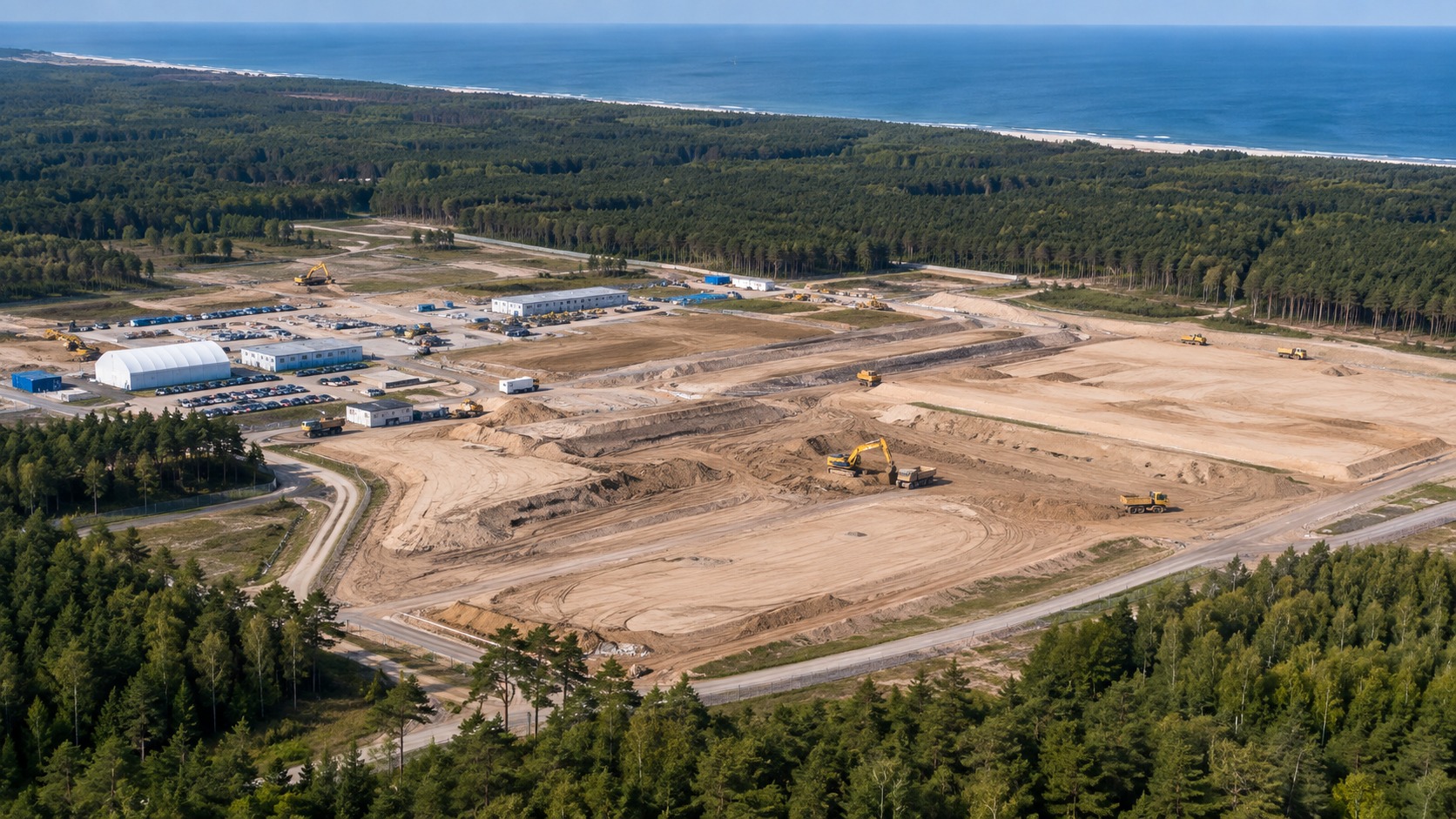
The proposed works at Lubiatowo-Kopalino, in the northern municipality of Choczewo, include deep excavations, groundwater protection, internal roads and parts of the infrastructure needed to supply cooling water to the future power station.
- Find more news from Poland on our Homepage .
They are intended to prepare the site for three American-designed Westinghouse AP1000 reactors with a combined installed generating capacity of 3,750 megawatts.
According to the Ministry of Energy’s official announcement, the application makes use of recently introduced legislation allowing certain construction activities to proceed before all authorisations for the nuclear facility itself have been obtained.
The application has not yet been approved.
It is also separate from the nuclear-safety authorisation that PEJ requested earlier this year and from the main building permit it intends to seek in 2027.
What construction work is Poland seeking permission to begin?
The application concerns a defined category of activities known in Polish legislation as Wstępne Roboty Budowlane, or preliminary construction works.
Unlike routine site investigations, these activities would involve substantial engineering operations.
One of the most important elements is preparing the ground where the three reactor units are eventually expected to stand.
That includes excavating deep foundations, reinforcing excavation walls and installing measures to protect the work areas from groundwater entering the pits.
The application also covers a retention reservoir intended to collect rainwater and snowmelt, together with internal roads and other infrastructure required for the future construction site.
Another major component involves preparing the plant’s cooling-water system.
Under the plans, the station will use water from the Baltic Sea, requiring infrastructure for both intake and discharge.
The preliminary works would include sections of the circulation-water system on land and specialised launch chambers for tunnel-boring machines.
The cooling-water tunnels are planned to pass beneath the beach and seabed using a trenchless construction method.
That approach would allow the pipes to be installed underground rather than excavating an open trench through the beach and into the sea.
The National Atomic Energy Agency has previously classified the relevant cooling-water infrastructure as not being of significant importance to nuclear safety and radiological protection.
That classification allows this part of the project to proceed through the preliminary-works procedure without the separate nuclear-safety authorisation required for construction of the main nuclear facilities.
It does not mean the cooling-water system is exempt from all applicable environmental, engineering or building requirements.

New law allows construction to proceed in stages
The application follows changes to Poland’s legislation governing nuclear-energy infrastructure.
The amending law adopted on 3 July 2026 was designed to allow nuclear projects to be developed in stages rather than requiring every construction activity to await the full set of authorisations for the principal facilities.
The law was published in the Journal of Laws on 18 August.
Its central purpose is to make it possible to carry out specified non-nuclear construction activities earlier, while retaining the regulatory requirements that apply to the reactor buildings and other safety-critical structures.
Energy Minister Miłosz Motyka described the October application as a practical use of the new rules.
He presented the legislation as a way of advancing what the government considers Poland’s largest energy infrastructure investment.
PEJ president Marek Woszczyk made a similar argument, saying that the ability to undertake selected work before obtaining all subsequent permits could help protect the project’s construction timetable.
The government has argued that a more flexible sequence of administrative approvals can reduce the time between preparing a site and beginning the main construction phase.
However, the changes do not eliminate nuclear licensing requirements or grant automatic permission for the proposed works.
The Pomeranian Voivode must still consider the application and issue a decision.
Three different permissions for one nuclear power station
The latest announcement is part of a wider series of administrative procedures, each covering a different aspect of the investment.
The distinction is particularly important because reports about nuclear construction permits can refer to very different stages of the same project.
On 31 March 2026, PEJ submitted an application to the National Atomic Energy Agency, known as PAA, seeking authorisation to construct the nuclear facility.
That application concerns nuclear safety, radiological protection and other specialised requirements.
The Ministry of Energy said the submission contained more than 40,000 pages of documentation, including a preliminary safety analysis report.
It is a separate process from the preliminary-works application submitted on 30 October.
The latest application was addressed to the Pomeranian Voivode, the regional representative of the national government responsible for the relevant building-permit procedure.
It concerns only the specified early works.
PEJ is also preparing a further application for the main building permit, which it plans to submit in 2027.
That later permit will address the principal construction phase.
The distinction means that Poland has neither received its main construction permit nor secured final nuclear-safety approval merely by submitting the October application.
The March nuclear-safety procedure is also still under examination.
According to specialist regional publication Moc Pomorza, which obtained information directly from PAA, the regulator was awaiting outstanding supporting documentation in late October.
As of 26 October, PEJ had supplied some of the requested materials, but PAA had not confirmed that the application was complete.
The original deadline for supplying the outstanding documents was 2 November.
No subsequent confirmation resolving that issue had been established at the time of this report.
The preliminary-works application can progress separately under the new legislation, but both regulatory processes remain relevant to the wider timetable.
Preparatory work is already under way at Lubiatowo-Kopalino
Although the latest application concerns major new construction activities, work at the coastal site did not begin in October.
PEJ has been undertaking preparatory activities at Lubiatowo-Kopalino since 2025.
Those have included site preparation, access infrastructure and investigations into the geological conditions beneath the future power station.
The current programme includes a second stage of preparatory works, together with detailed geotechnical investigations.
American engineering company Bechtel is carrying out extensive geological studies on land and offshore.
These studies are intended to establish the characteristics of the ground and seabed that engineers must account for when designing the reactors, foundations and associated infrastructure.
The site lies near Poland’s Baltic coastline in the municipality of Choczewo, in Pomerania.
Its coastal location is important to the planned cooling-water system and to the wider logistics of transporting equipment and materials for an exceptionally large construction project.
However, the presence of machinery and ongoing site investigations should not be confused with construction of the reactor buildings.
The Polish nuclear programme’s published timetable still identifies the beginning of the main reactor-construction phase as a later milestone.
The new permit, if granted, would allow additional major groundwork to be undertaken ahead of that stage.
Three American reactors, with first electricity targeted for 2036
The Lubiatowo-Kopalino power station is planned as Poland’s first large commercial nuclear power plant.
It will comprise three Westinghouse AP1000 reactors, with a total installed electrical capacity of approximately 3,750 megawatts.
Westinghouse and Bechtel are the principal American industrial partners for the project.
The technology was selected in 2022, and the two companies have subsequently worked with PEJ on the engineering and construction preparations.
The current government timetable envisages the main reactor-construction phase beginning in the fourth quarter of 2028, marked by the pouring of the first nuclear concrete.
The first reactor is scheduled to enter commercial operation in 2036, followed by the second in 2037 and the third in 2038.
These dates remain project targets rather than guaranteed commissioning dates.
Large nuclear projects require extensive engineering, component manufacturing, testing and regulatory approval before they can supply electricity commercially.
The timeline is also dependent on resolving outstanding administrative processes, concluding construction arrangements and securing the necessary financing.
The World Nuclear Association’s October 2026 assessment confirmed the same broad construction and commissioning timetable.
The immediate effect of the October application is therefore to seek an earlier start for selected construction activities, rather than to bring the opening of the power station itself into the near future.
Why Poland is investing in nuclear energy
Poland has historically generated most of its electricity from coal, although renewable sources have taken a growing share of the energy mix.
The government sees nuclear power as part of a long-term strategy to diversify electricity generation and reduce dependence on fossil fuels.
Nuclear reactors can generate substantial amounts of electricity independently of weather conditions.
That makes them potentially complementary to expanding wind and solar capacity, although the operation of any future electricity system will also depend on its network infrastructure, demand and other generating sources.
The government argues that nuclear energy will strengthen supply security and support industrial investment by providing large-scale electricity generation over several decades.
Those are strategic objectives, rather than confirmed outcomes of a power station that has yet to be built.
The programme also has an international dimension.
The involvement of Westinghouse and Bechtel makes the project a major element of Polish-American economic and technological cooperation.
Poland-24 previously reported on a new agreement between Poland and the United States advancing the first nuclear power station.
Poland is also planning a second large nuclear power plant.
In October, the Ministry of Energy, PEJ and Polish energy company PGE signed an agreement concerning cooperation on that separate development.
As Poland-24 reported at the time, the second project remains at an earlier stage, with decisions about its technology and partners still being prepared.
The two schemes form part of the government’s longer-term ambition to establish nuclear energy as a major component of Poland’s electricity system.
What happens next?
The immediate next step is a decision by the Pomeranian Voivode on PEJ’s application for preliminary construction works.
The Energy Ministry’s 30 October announcement did not provide a firm date for that decision.
At an industry event on 20 October, PEJ president Marek Woszczyk indicated that the company intended to seek permission by the end of October and carry out major excavations in 2027.
The application has now been submitted in line with the first part of that timetable.
Whether the planned work can begin next year will depend on the required approval and the project’s technical preparations.
Separately, PAA must complete its assessment of the nuclear-safety application submitted in March.
PEJ also intends to seek the main building permit in 2027, ahead of the planned start of reactor construction in late 2028.
The 30 October application is another administrative milestone in Poland’s first commercial nuclear power project. It could allow important construction activities to advance sooner, but the principal nuclear facilities remain subject to further permits, safety assessments and years of construction before electricity generation can begin.
Featured image: Digitally created conceptual illustration of potential future preliminary construction works. It is not a photograph of the Lubiatowo-Kopalino site and does not show works already authorised under the pending permit.