Poland and Vietnam have formally established a strategic partnership following talks between Prime Ministers Donald Tusk and Lê Minh Hưng in Hanoi on Monday, 26 October. The two governments adopted a joint declaration and a five-year action plan, alongside agreements covering higher education, scientific research and tourism. They also set a target of increasing bilateral trade to $6 billion by 2030 and pledged closer cooperation in defence, technology and security.
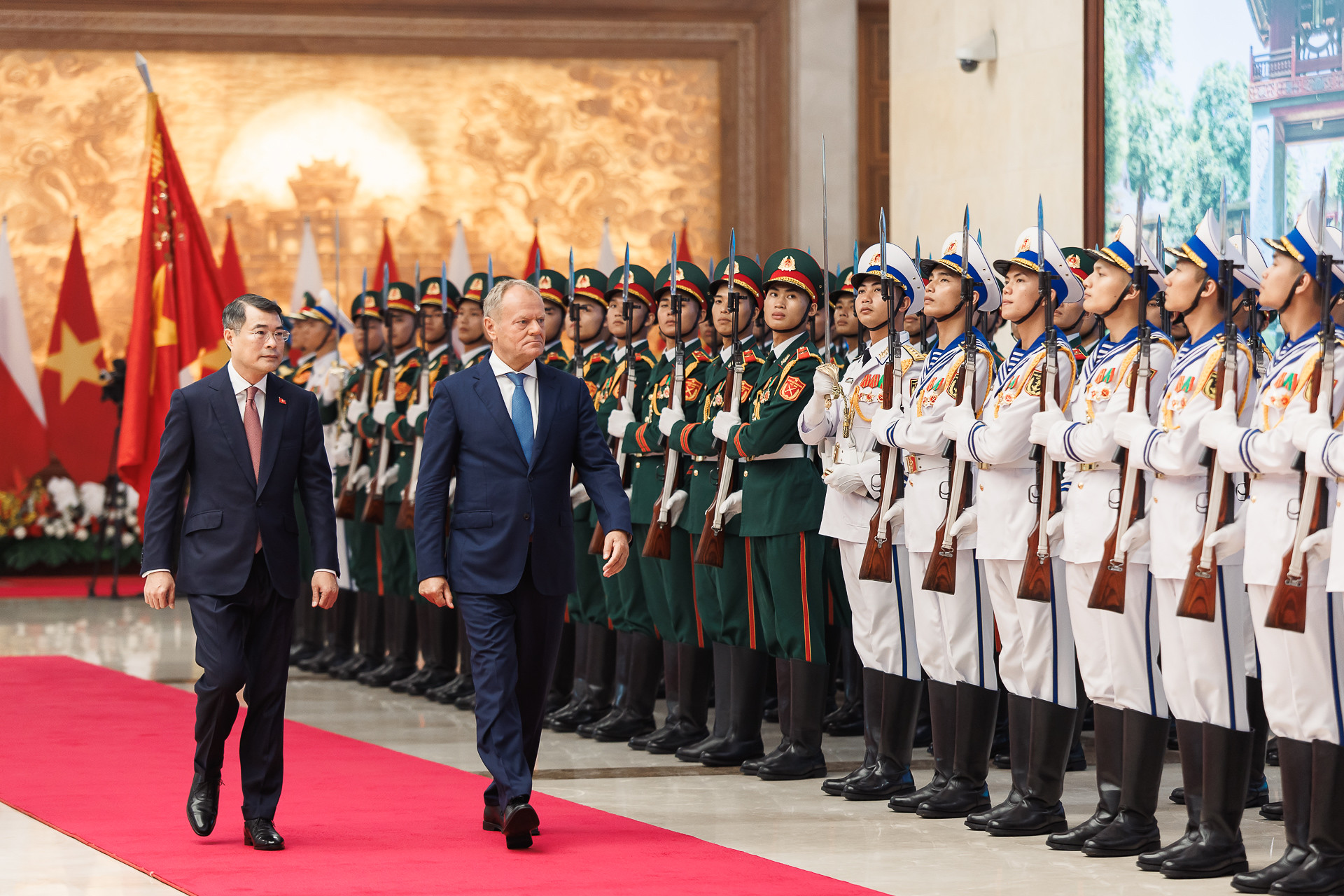
The agreement was announced after an official welcoming ceremony and bilateral talks at the Vietnamese government’s headquarters.
The two leaders adopted a joint statement published by the Polish Prime Minister’s Office, formally elevating relations between the two countries to a strategic partnership.
- Find more news from Poland on our Homepage .
An accompanying action plan covers 2026–2030 and is intended to guide the implementation of the new relationship.
Tusk’s visit marks a concrete diplomatic outcome following earlier discussions about strengthening Poland’s relations with Vietnam, an increasingly important economic partner in Southeast Asia.
Speaking after the talks, Tusk said the two countries should turn their economic achievements into practical cooperation that would create further opportunities for their businesses and citizens.
The agreement does not establish a military alliance or automatically create new investment contracts. Instead, it provides a political framework for expanding cooperation across several sectors.
Two agreements signed on education, research and tourism
Alongside the strategic partnership declaration, the two prime ministers witnessed the exchange of two sectoral cooperation documents.
The first is an agreement between Poland’s Ministry of Science and Higher Education and Vietnam’s Ministry of Education and Training covering higher education and scientific research.
It is intended to strengthen university cooperation, support academic exchanges and create opportunities for joint research.
The second is a memorandum of understanding between the countries’ ministries responsible for tourism.
According to the Polish government’s account of the Hanoi talks, the agreements are intended to improve academic and tourism links while encouraging closer contacts between Polish and Vietnamese institutions.
The strategic partnership also identifies scientific cooperation, innovation and digital transformation as important areas for future development.
Both governments want closer collaboration between universities, research institutes and businesses, including the exchange of expertise and technology.
Vietnam’s government has highlighted potential cooperation in geology, strategic minerals, environmental technology, heritage conservation and agricultural research.
These are identified areas of cooperation rather than completed research projects announced during the visit.
Trade target of $6 billion by 2030
Economic cooperation is one of the main priorities of the partnership.
According to the Vietnamese government’s report on the talks, bilateral trade reached almost $4 billion in 2025, an increase of 14.8% compared with the previous year.
The two governments have now set a target of raising that figure to $6 billion by 2030.
Achieving it would require continued growth in commercial exchanges and improvements in market access.
Both leaders expressed support for implementing the existing European Union–Vietnam Free Trade Agreement more effectively.
The agreement, which entered into force in August 2020, provides a framework for reducing trade barriers between Vietnam and EU member states, including Poland.
However, businesses continue to encounter regulatory and administrative obstacles in some sectors.
The new joint declaration specifically identifies the reduction of non-tariff barriers, including sanitary and phytosanitary restrictions, as a priority.
These rules are particularly important for agricultural and food products, where exporters must satisfy health, safety and certification requirements.
The governments also agreed to strengthen customs cooperation and improve access to each other’s markets.
Officials responsible for agricultural cooperation are expected to meet through a bilateral working group, with the next meeting planned by April 2027.
Defence, space technology and pharmaceuticals
Tusk identified several sectors in which Polish companies could potentially expand their presence in Vietnam.
Speaking in Hanoi, the Polish prime minister highlighted defence manufacturing, satellite and space technology, pharmaceuticals and food products, particularly dairy.
The joint declaration also commits both countries to strengthening defence cooperation.
Possible areas include defence-industry collaboration, exchanges of military expertise, training and trade in defence equipment.
The agreement does not announce a specific arms contract, weapons purchase or completed defence investment.
Security cooperation will also include efforts to combat transnational crime, cyber-enabled fraud, human trafficking, money laundering and threats to critical infrastructure.
Outside defence, officials identified energy, renewable technologies, infrastructure, agriculture and digital transformation as potential areas of collaboration.
Vietnam has expressed interest in developing railway, aerospace and other advanced industrial projects with international partners.
For Poland, the agreement provides an opportunity to expand its economic presence in a region where European governments are increasingly seeking stronger trade relationships.
Visa discussions and planned direct Warsaw–Hanoi flights
The two governments also discussed measures intended to make travel between Poland and Vietnam easier.
Vietnam agreed to consider expanding the scope of its visa exemptions for Polish citizens.
In return, Vietnam asked Poland to consider visa exemptions for Vietnamese holders of official passports.
These are proposals for further consideration, not visa changes that automatically entered into force on 26 October.
Polish tourists already benefit from a Vietnamese visa-waiver arrangement introduced in 2025, meaning the discussions concerned possible additional measures rather than the introduction of visa-free tourism for the first time.
Air connections were another subject.
The Polish Prime Minister’s Office reported that LOT Polish Airlines plans to launch a direct connection between Warsaw and Hanoi during the first quarter of 2027.
The Vietnamese government welcomed the announcement of the route.
A direct service could improve travel for businesses, tourists, students and families with connections to both countries.
However, the planned start date does not mean flights were already operating when the strategic partnership was announced.
A relationship built over more than 75 years
Poland and Vietnam established diplomatic relations in 1950, and their ties developed extensively during the Cold War.
Polish specialists contributed to Vietnamese projects involving engineering, education, medicine and industrial development.
Poland also played a role in conserving significant Vietnamese cultural heritage.
Vietnamese officials highlighted Polish experts’ contributions to heritage restoration, including work associated with the historic imperial city of Huế and the Mỹ Sơn sanctuary.
Educational exchanges helped create a lasting community of Vietnamese graduates of Polish universities.
Vietnamese migrants and their families have also established a longstanding community in Poland, providing social, cultural and commercial links between the two countries.
The latest partnership builds upon those historical relationships while seeking to expand cooperation in contemporary industries.
Tusk previously visited Vietnam as Polish prime minister in 2010. His return comes 16 years later, during a wider Asian diplomatic trip that also included India.
Ukraine and international security included in declaration
The joint statement extends beyond bilateral economic cooperation.
Poland and Vietnam reaffirmed support for the United Nations Charter, international law and the peaceful settlement of disputes.
On Ukraine, the governments called for a comprehensive, just and lasting peace respecting the independence, sovereignty and territorial integrity of states.
The declaration does not announce a new Vietnamese military or financial commitment to Ukraine.
The two governments also emphasised freedom of navigation and the importance of international law in the South China Sea, where competing territorial claims remain a significant regional security issue.
They expressed support for the 1982 United Nations Convention on the Law of the Sea and peaceful resolution of maritime disputes.
For Poland, closer engagement with Vietnam offers another channel for cooperation with Southeast Asia and the Association of Southeast Asian Nations, known as ASEAN.
For Vietnam, Poland represents an EU member state with a substantial industrial economy, growing defence sector and access to European commercial networks.
The immediate achievement in Hanoi is the formal establishment of the strategic partnership and adoption of its implementation framework.
Its longer-term significance will depend on whether both governments translate the commitments into new trade opportunities, institutional cooperation and practical projects during the 2026–2030 period.