Imagine living in Poland and receiving flowers, gifts and congratulatory messages on a day that is not your birthday.
Nobody has mistaken the date. Nobody is celebrating your wedding anniversary.
Instead, your friends and relatives are wishing you a happy name day.
- Find more news from Poland on our Homepage .
In Poland, many people celebrate imieniny, a traditional occasion associated with the date assigned to their first name in the calendar.
For some families, it can be just as important as a birthday. For others, it might mean nothing more than a telephone call, a bunch of flowers or a friendly message.
Although the tradition is not uniquely Polish, it remains one of the country’s most recognisable everyday customs — and one that can surprise international visitors.
It also explains why someone in Poland might receive birthday-style congratulations twice in the same year.
What exactly are imieniny?
The Polish word imieniny means name day. It comes from imię, meaning a person’s name.
The concept is straightforward: many traditional Polish calendars list several first names alongside each date.
Someone whose name appears on that date may celebrate their name day, even though their actual birthday falls at another time of year.
The Adam Mickiewicz Institute’s Culture.pl explains the custom in its Poland Word by Word series, describing how congratulations, flowers, small presents and social visits traditionally accompany the occasion.
A birthday, or urodziny, marks the anniversary of someone’s birth.
A name day celebrates an association between their name and a particular calendar date.
The distinction is particularly visible in Poland because calendars displaying names remain familiar household objects.
For people unfamiliar with the tradition, however, understanding the calendar is only the beginning.
Why does Poland have name days?
The custom has deep historical roots in Christianity.
In the Catholic tradition, particular dates are associated with saints and their feast days.
Children were historically often given names connected with saints, who were regarded as their spiritual patrons.
Over time, celebrating the feast day associated with a person’s name developed into a social tradition.
The practice became part of family and community life, extending beyond religious observance into everyday celebrations.

A 2024 article published by the Mazovian regional government explains that choosing a child’s name according to a saint’s feast day was once customary.
As parents increasingly chose names independently of the religious calendar, the association between names and individual dates remained.
Today, celebrating imieniny does not necessarily mean that the person is particularly religious.
For many, it is simply an inherited family tradition and another opportunity to spend time with people they care about.
How do you know when someone’s name day falls?
This is where the apparently simple tradition becomes more complicated.
The same Polish first name can appear on several different dates throughout the year.
For example:
- Anna is commonly celebrated on 26 July, a date associated with Saint Anne.
- Mikołaj has a well-known name day on 6 December, the feast of Saint Nicholas.
- Barbara is widely associated with 4 December, Saint Barbara’s Day, known in Poland as Barbórka.
These are familiar examples, not compulsory dates for everyone with those names.
A name can appear several times because multiple saints or other historical figures carried it.
Traditionally, one way to choose a date was to take the first listed name day after a person’s birthday.
Others celebrate on the date associated with a particular patron saint, the most widely recognised date for their name, or simply the day their family has always observed.
There is no universal rule requiring everyone with the same name to celebrate together.
Consequently, finding Anna or Jan in a Polish calendar does not automatically mean every Anna or Jan you know is celebrating that day.
As Culture.pl notes, people normally choose one date and continue observing it.
The easiest way to avoid an awkward mistake is therefore to ask someone which date they celebrate.
Flowers, cake and good wishes
Name-day celebrations are often smaller and less formal than milestone birthdays, although customs differ considerably between households.
A person celebrating their imieniny might invite relatives or friends for coffee, cake or an evening meal.
Guests may bring flowers, chocolates or a small present.
In other families, a phone call or a simple message is considered enough.
One particularly useful Polish expression is:
Wszystkiego najlepszego z okazji imienin!
It means All the best on your name day!
A shorter Wszystkiego najlepszego! — All the best! — also works.
The person celebrating is called the solenizant or solenizantka, depending on gender.
Traditionally, name-day gatherings often involve the person celebrating acting as host, welcoming guests into their home.
That emphasis on visiting, hospitality and spending time together helps explain why the custom has endured.
Are name days more important than birthdays?
There is no single answer.
Culture.pl describes name days as especially significant in many parts of Poland, particularly among older generations.
However, the tradition varies geographically.
Upper Silesia and Kashubia are among the regions where birthdays have historically received greater emphasis than name days.
A Polish-language cultural publication supported by the Polish National Agency for Academic Exchange likewise explains that birthdays are now more commonly celebrated, although name-day customs remain familiar.
Among younger people, birthdays may be more prominent, while some families continue to observe both occasions.
It would therefore be misleading to suggest that every Polish person celebrates two personal holidays or that name days are universally considered more important than birthdays.
For many Poles, the occasion depends on their family traditions, social circle and personal preferences.
A tradition shared beyond Poland
Poland is far from the only country where people celebrate name days.
Similar customs exist in countries including Greece, Bulgaria, Hungary, Sweden and the Czech Republic, although their calendars and forms of celebration differ.
In some countries, the religious association remains particularly strong.
In others, the celebration has become largely social or secular.
Poland’s version is notable for how recognisable the tradition remains in everyday language and calendars.
One particularly interesting example is 6 December, celebrated as Mikołajki.
The date is associated with Saint Nicholas and is also a popular occasion for giving children small presents.
As Culture.pl explains in its guide to Polish Christmas traditions, the connection originates in the feast of Saint Nicholas.
But Mikołajki as a gift-giving custom should not be confused with a personal name-day celebration, even though they share the same historical association.
A small tradition that keeps family connections alive
In an increasingly international Poland, many people work, study and build friendships with people who have never encountered imieniny.
For newcomers, the custom can be a charming discovery.
For Poles living abroad, receiving a name-day message from relatives back home can be a small reminder of a familiar tradition.
A birthday marks how long someone has been alive.
A name day celebrates something different: a personal connection to a name, a calendar and a custom passed through generations.
Not everyone observes it, and not everyone makes a fuss.
But for those who do, imieniny is another reason to gather around a table, bring someone flowers or simply let them know they are remembered.
And sometimes, that is reason enough for a celebration.
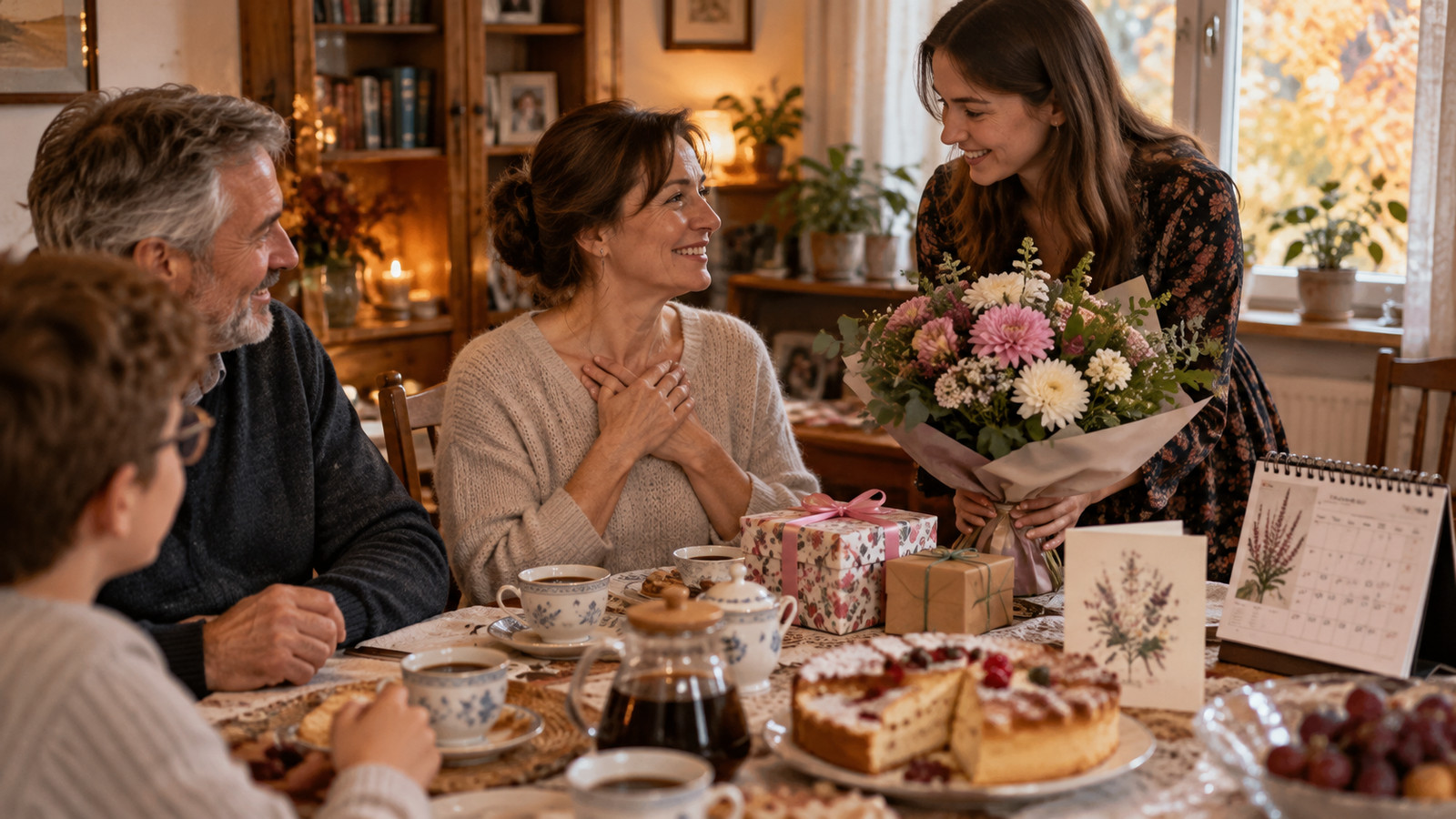
Featured image: digitally generated editorial illustration of a family name-day celebration, not a documentary photograph of a real occasion.