Archaeologists in eastern Poland have uncovered a remarkable collection of prehistoric remains, including a cache of flint material buried approximately 6,000 years ago and a substantial defensive ditch whose builders remain unknown. The discoveries at Gródek, near the Ukrainian border, also include a 2,500-year-old cremation burial and objects associated with the Goths and early medieval Slavs, revealing how successive communities occupied the same landscape over thousands of years.
The findings emerged during archaeological investigations at site 29 in Gródek, a village in Hrubieszów municipality, close to where the Huczwa River flows into the Bug.
The latest discoveries were reported on 25 October following excavations and geophysical surveys carried out during 2026.
- Find more news from Poland on our Homepage .
According to Lublin112’s report, citing the Stanisław Staszic Museum in Hrubieszów, the excavations have revealed evidence from several different archaeological periods, ranging from the Neolithic to the early Middle Ages.
The work forms part of a two-year research programme intended to document the site and improve protection of its archaeological remains.
A mysterious ditch that once protected a large settlement
One of the most intriguing discoveries concerns a long feature that had been visible in aerial photographs for decades.
Researchers could identify its outline in historical photographs taken approximately 50 years ago, as well as in modern drone and satellite imagery.
However, its original purpose was uncertain.
One possibility was that the feature represented an old road. Archaeologists had also considered whether it might have been a military trench, although its shape and dimensions appeared inconsistent with First World War earthworks.
Excavations have now provided evidence supporting a different interpretation.
The Hrubieszów museum described the feature as a wide, deep ditch forming part of an extensive defensive system around an elevated area covering more than ten hectares.
The structure appears to have served as a fortification, potentially controlling access to an enclosed settlement or protected area.
That would make it an important discovery for understanding how one of the communities living at Gródek organised and defended its surroundings.
But a central question remains unanswered.
Researchers have not yet established when the ditch was constructed or which community built it.
Although they have developed possible interpretations, further archaeological investigation is required before the structure can be assigned to a particular historical period.
The ditch must therefore be distinguished from the much older flint deposit discovered elsewhere within the investigated site.
Flint material hidden for approximately 6,000 years
Another discovery takes the history of the site back to the Neolithic period, when farming communities were becoming established across much of Europe.
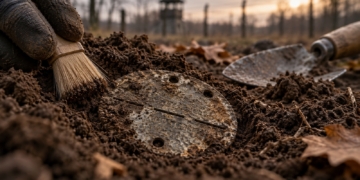
Around one metre beneath the surface, archaeologists encountered a deliberately gathered collection of flint material.
The objects were not finished tools ready for use.

Instead, they appear to be pieces of raw material or partially worked flint that had been placed together for storage or later production.
Researchers believe the collection may originally have been kept in a container made from organic material, such as leather or fabric.
If such a container existed, it has not survived in a form identified in the published report.
The museum estimates that the deposit remained underground for approximately 6,000 years.
Flint was an important resource for prehistoric communities because it could be shaped into sharp cutting edges, points and other tools.
The discovery suggests that people living in the area deliberately gathered and stored valuable material, potentially for future use.
However, the exact reason for the deposit remains uncertain.
It could represent material stored by a craftsperson, a temporary cache or another form of deliberate deposition.
Further study of the flint pieces and their archaeological context may help narrow those possibilities.
A cremation burial from the early Iron Age
The excavations also revealed a burial associated with the Pomeranian culture, an archaeological culture of the early Iron Age.
Researchers estimate that the burial dates to approximately 2,500 years ago.
It contained small quantities of cremated human bone and fragments of a clay vessel.
According to the museum’s account, the vessel had been placed upside down over the burial.
The discovery provides evidence of funerary practices among communities occupying this part of Europe centuries before the Roman period.
The Pomeranian culture is known from archaeological sites across parts of present-day Poland and neighbouring regions.
Its name is an archaeological classification and does not mean that the people buried at Gródek should be understood as members of any modern regional or national population.
The burial is also unrelated in date to the Neolithic flint deposit.
Together, the two discoveries demonstrate that the same area continued to attract human activity across widely separated periods.
A Roman coin, a Gothic comb and traces of early Slavic settlement
The new excavations have also produced objects associated with later periods.
In one trench, archaeologists had initially expected to encounter remains connected with the Gothic settlement previously identified in the area.
Instead, they discovered an early medieval refuse pit containing hundreds of pottery fragments, animal bones and glass beads.
Nearby, another feature was interpreted as an older storage pit.
The same relatively small excavation also produced a Roman coin and a fragment of a comb associated with the Goths.
These objects reflect the complex history of the region, which formed part of wider networks of trade, migration and cultural contact.
The presence of a Roman coin does not necessarily indicate that Roman soldiers or settlers lived at the site.
Roman currency circulated far beyond the empire’s frontiers and frequently appears in archaeological contexts associated with communities outside Roman political control.
Earlier investigations in the western part of site 29 recovered numerous Roman silver denarii, items of clothing and personal adornment, pottery and animal remains associated with the Gothic period.
In the eastern section, researchers have identified an extensive early medieval cemetery, parts of which have been damaged by agricultural activity.
The museum has described the cemetery as containing some of the earliest known skeletal burials associated with Slavic communities in Poland.
These discoveries concern different phases of occupation, rather than one population living continuously at Gródek for six millennia.
How archaeologists are searching beneath the fields
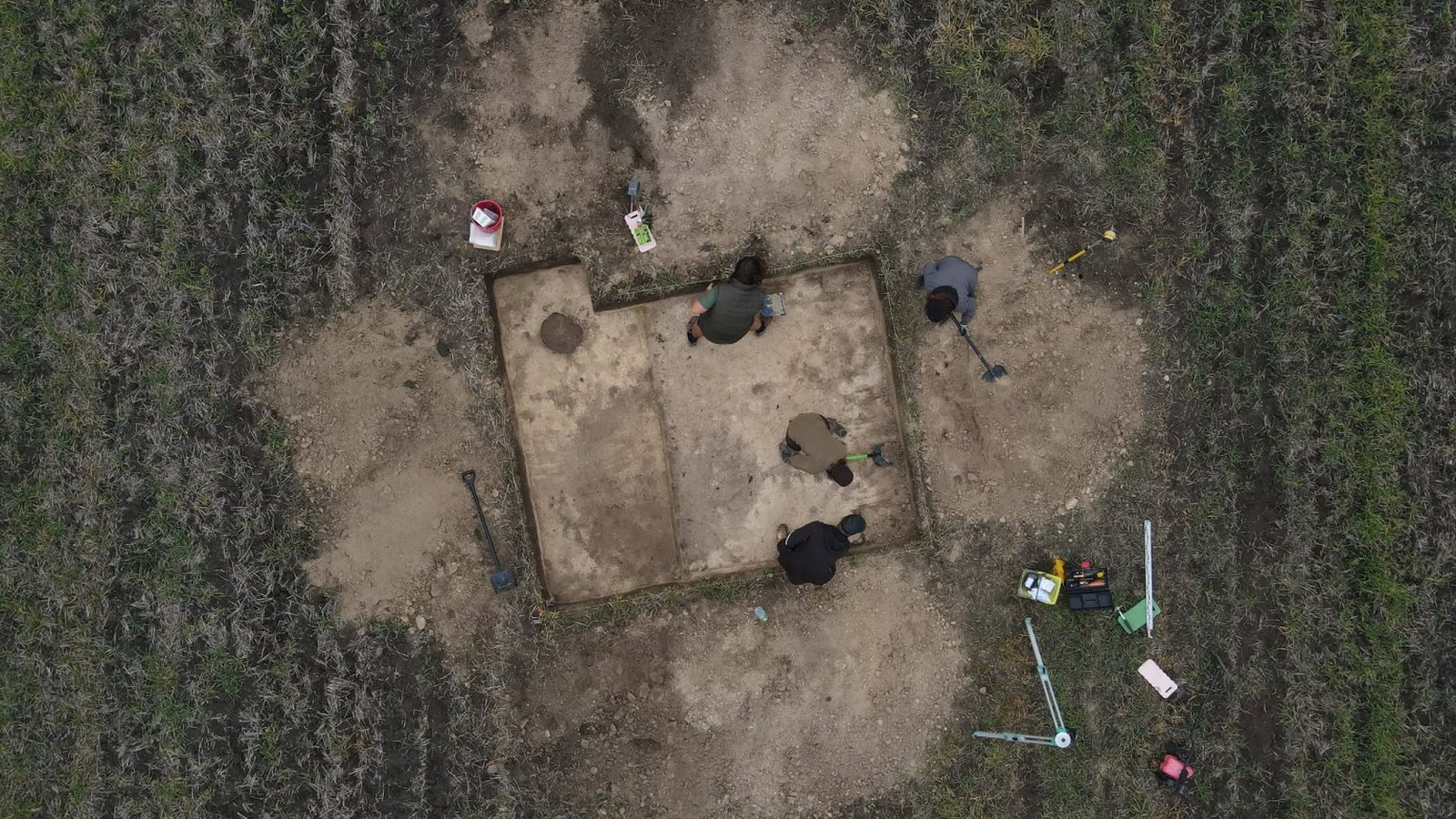
The latest discoveries were made possible by combining traditional excavation with non-invasive archaeological techniques.
Researchers initially identified promising locations using aerial photographs and magnetic surveys.
Magnetometry can detect variations in the magnetic properties of soil, potentially revealing buried ditches, pits, hearths and other archaeological features without extensive digging.
The team then opened three small exploratory trenches, covering a combined area of several dozen square metres.
The contrast between the relatively small excavated area and the wider surveyed landscape highlights the usefulness of combining these methods.
According to the regional report, approximately 11.5 hectares have now been investigated using non-invasive techniques.
That figure describes the area surveyed; it is not the measured size of the defensive enclosure.
Dr Michał Jakubczak and Robert Ryndziewicz, specialists from the Institute of Archaeology and Ethnology of the Polish Academy of Sciences, are responsible for the non-invasive investigations.
Students from Maria Curie-Skłodowska University in Lublin also participated in the fieldwork under the supervision of Professor Barbara Niezabitowska-Wiśniewska.
The research has been conducted in cooperation with heritage specialists and local institutions.
Why Gródek matters to the history of eastern Europe
Gródek lies within a region that has witnessed major changes in settlement, trade and cultural connections over thousands of years.
The Hrubieszów museum’s official description of the research project explains that site 29 lies close to the early medieval fortified settlement known as Wołyń, near the confluence of the Huczwa and Bug rivers.
The museum notes that the area was initially known mainly through surface finds associated with the Roman period and the Middle Ages.
Subsequent investigations revealed a much more complex archaeological landscape.
The latest discoveries extend that picture further, providing evidence of Neolithic activity and early Iron Age burial practices alongside later Gothic and Slavic remains.
The site is also vulnerable.
Intensive agricultural cultivation has damaged archaeological layers, while some medieval burials have been disturbed by farming equipment.
Part of the research programme is therefore concerned not simply with making discoveries, but with recording and protecting evidence that might otherwise disappear.
Government-funded research to continue into 2027
The investigation forms part of a project whose title translates as At the crossroads of Goths and Slavs: Non-invasive investigation of the multicultural site 29 at Gródek.
The museum’s project documentation confirms that the research is scheduled for 2026–2027.
It has received PLN 87,000 in funding through the Polish Ministry of Culture and National Heritage’s archaeological heritage protection programme.
The total project budget is PLN 114,300.
The project is coordinated by Anna Mucha, with Bartłomiej Bartecki responsible for organisational coordination.
One of its objectives is to gather the documentation needed to begin the process of placing the archaeological site on the official register of protected monuments.
That work will be particularly important as investigators attempt to establish the age and purpose of the newly identified defensive ditch.
For now, the discoveries demonstrate how much of the site’s history remains buried.
A flint cache left by a Neolithic community, an Iron Age burial, Roman-era objects and evidence of early medieval settlement have all survived in the same landscape.
The next challenge for researchers is to understand how those traces fit into the wider history of human settlement in eastern Europe — and determine who built the mysterious defensive system that has remained visible in the landscape for generations.