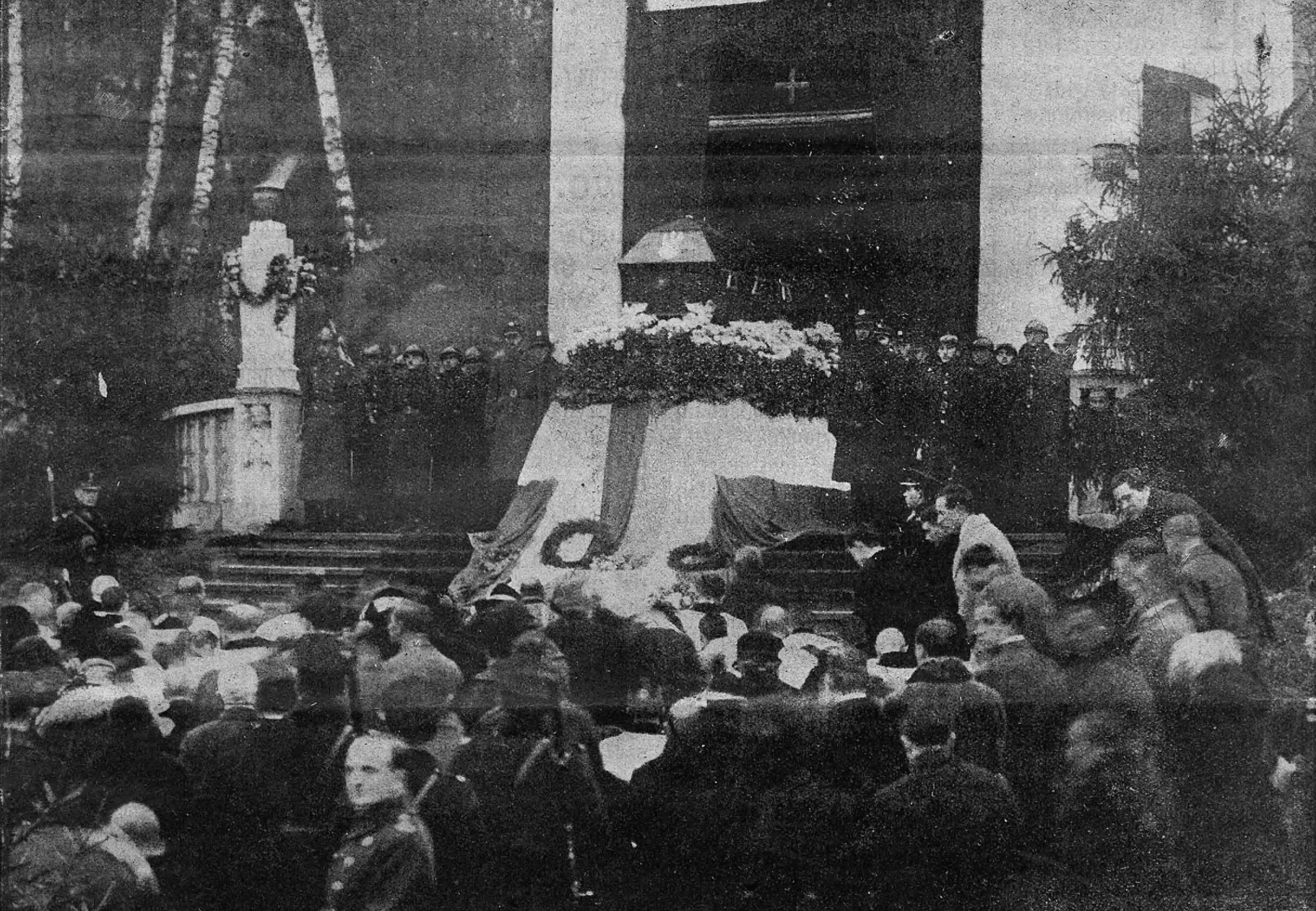
On 2 November 1925, a coffin carrying a soldier whose name nobody knew passed through the streets of Warsaw. Behind it walked military officers, political leaders, veterans and families who had lost loved ones in Poland’s recent wars.
The soldier had been brought from Lwów, a city then within Poland and now Lviv in western Ukraine. His identity was unknown, but his funeral would establish one of the country’s most enduring national memorials.
The coffin was buried beneath the colonnade of Warsaw’s Saxon Palace, creating the Tomb of the Unknown Soldier — Grób Nieznanego Żołnierza — which remains a central site of Polish remembrance.
- Find more news from Poland on our Homepage .
Now, 101 years later, the monument still stands in the heart of Warsaw, preserving the memory of those whose names, graves or final resting places were never identified.
Behind its creation lies a particularly human story: that of a grieving mother asked to choose the soldier whose remains would represent countless others.
The mother who chose an unknown soldier
Poland had regained independence in 1918, after 123 years during which its territory had been partitioned between neighbouring powers.
Independence did not immediately bring peace. The newly restored state fought several conflicts over its borders, including the Polish-Ukrainian War and the Polish-Soviet War of 1919–1921.
Thousands died during these struggles, and many families never recovered or identified the bodies of their relatives.
The idea of honouring an unidentified soldier had gained international prominence after the First World War, particularly through memorials established in France and Britain.
Poland followed this example, eventually choosing a site beneath the central arches of the Saxon Palace, then home to the Polish Army’s General Staff.
In April 1925, representatives of the Polish military held a draw to select one of 15 battlefields associated with the country’s struggles for independence and its borders.
The chosen location was Lwów, where Polish forces had fought Ukrainian troops from November 1918.
On 29 October 1925, a commission gathered at the Cemetery of the Defenders of Lwów, also known as the Cemetery of the Lwów Eaglets.
Three unidentified soldiers’ graves were opened.
The responsibility for choosing one of the coffins was given to Jadwiga Zarugiewiczowa, a woman who knew personally what it meant to lose a son without knowing his final resting place.
Her son, Konstanty Zarugiewicz, had been killed on 17 August 1920 during the Battle of Zadwórze, fought against Soviet forces during the Polish-Soviet War. His remains had not been securely identified.
Jadwiga selected one of the three coffins.
Inside were the remains of a soldier without rank insignia. A traditional Polish military-style cap, known as a maciejówka, suggested that he had served as a volunteer.
His name, family and precise circumstances of death remained unknown.
The remains were transferred into a new coffin, prepared for the journey to Poland’s capital.

For Jadwiga, the selection carried a significance beyond the state ceremony. The soldier she had chosen was a stranger, but the absence of a known identity reflected the uncertainty that had also marked her own family’s loss.
The funeral that brought Warsaw together
Following ceremonies in Lwów, the coffin departed by special train on 1 November 1925.
Crowds gathered along the route to pay their respects as it travelled towards Warsaw.
The train reached the capital the following morning.
At the railway station, the coffin was carried by decorated Polish soldiers and placed on a gun carriage for the ceremonial journey through the city.
A funeral service took place at St John’s Cathedral, attended by President Stanisław Wojciechowski and senior representatives of the Polish state.
After the service, the procession moved towards Saxon Square, accompanied by military formations, clergy, officials and representatives of organisations from across Poland.
Contemporary newspaper accounts described an extraordinary public turnout.
Mothers, widows, war veterans and disabled former soldiers joined the procession, while thousands watched from the pavements.
The coffin, draped in Poland’s national colours, was accompanied by military standards and an honour guard.
Its destination was the central colonnade of the Saxon Palace.
There, the remains were placed in a tomb designed by the Polish sculptor Stanisław Ostrowski.
The ceremony was attended by the highest civilian and military authorities of the Second Polish Republic.
The monument’s central inscription declared:
“Here lies a Polish soldier who fell for the Fatherland.”
An eternal flame was lit, and the tomb became a permanent national memorial.
A palace destroyed, a memorial preserved
The original monument formed part of the Saxon Palace, one of Warsaw’s most prominent buildings.
That setting changed dramatically during the Second World War.
Following the Warsaw Uprising of 1944, German forces systematically destroyed large areas of the Polish capital.
In late December 1944, they blew up the Saxon Palace.
Much of its colonnade collapsed, and the Tomb of the Unknown Soldier suffered substantial damage. Only a fragment of the central arcade and parts of the memorial survived.
After the war, Polish authorities decided not to reconstruct the entire palace. Instead, the remaining central section was conserved and partly rebuilt, preserving the monument as a permanent reminder of the city’s destruction.
The restored tomb was reopened in May 1946.
Over subsequent decades, its commemorative plaques and inscriptions were altered, reflecting the political divisions and official historical narratives of communist-era Poland.
Following the end of communist rule in 1989, further changes restored references to historical battles and military traditions that had previously been excluded.
Today, the tomb stands on Marshal Józef Piłsudski Square, surrounded by the open space where the Saxon Palace once stood.
A national memorial without a name
The Tomb of the Unknown Soldier remains one of Poland’s principal sites for state commemorations.
A military honour guard stands beside it, and an eternal flame continues to burn.
Presidents, visiting foreign dignitaries and representatives of the Polish armed forces regularly lay wreaths there during national ceremonies.
The memorial is particularly associated with Independence Day on 11 November and other anniversaries connected to Poland’s military history.
Yet its meaning extends beyond military ceremony.
The remains buried there belong to one unidentified person, selected to represent many others whose names and burial places were lost during war.
That symbolism was established through the decision made in Lwów in October 1925 by Jadwiga Zarugiewiczowa, whose own son never received an identified grave.
More than a century later, the fragments of the Saxon Palace still shelter the tomb.
Warsaw has changed almost beyond recognition since the funeral procession of 2 November 1925. The palace that surrounded the monument has disappeared, and the country has endured another world war, occupation and decades of communist rule.
But beneath the surviving arches, the Unknown Soldier remains — a permanent reminder that behind the public history of war are families left without answers.