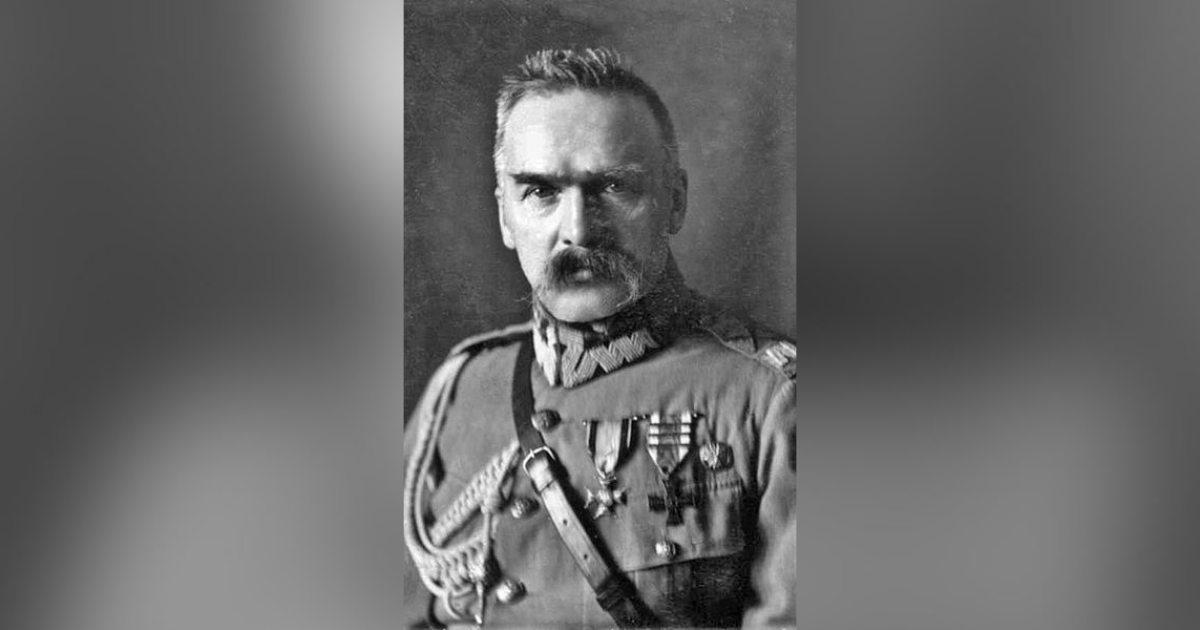
Restored independence in November 1918 did not immediately give Poland a finished constitutional order. In the days after the end of the First World War, political leaders had to turn a reborn state into a functioning system of authority, administration and law. One of the most important steps in that process came on 22 November 1918, when Józef Piłsudski approved the Decree on the Supreme Representative Authority of the Polish Republic. It made him Tymczasowy Naczelnik Państwa — Temporary Chief of State — until the Constituent Sejm assembled.
The decree matters because it explains what powers Piłsudski actually held after independence, where those powers came from, and how Poland was governed in the crucial transitional weeks between the collapse of the partitioning empires and the arrival of parliamentary rule.
Independence first, institutions second
Piłsudski’s elevation on 22 November did not come out of nowhere. On 11 November 1918, the Regency Council transferred military authority to him and entrusted him with the post of commander-in-chief. On 14 November, the same body dissolved itself and transferred full civil authority to Piłsudski, who then began forming a national government. On 18 November, Jędrzej Moraczewski formed the first Polish government in Warsaw, with the preparation of parliamentary elections as one of its main tasks.
- Find more news from Poland on our Homepage .
This sequence is important for international readers, because 11 November is often treated as the single founding moment of modern Poland. In practice, state-building continued through a series of decisions and decrees. The 22 November decree was one of the key legal acts that defined how the new Polish state would operate before an elected parliament could take over.
What the 22 November decree actually said
The text of the decree was published in the Dziennik Praw Państwa Polskiego and stated that, on the basis of the decree of 14 November, the prime minister had submitted a project establishing the supreme representative authority of the Republic until the Constituent Sejm was convened. Piłsudski then approved that project and set out the new arrangement in eight articles.
Article 1 was the core provision. Piłsudski declared: “I assume, as Temporary Chief of State, the Supreme Authority of the Polish Republic and I shall exercise it until the Constituent Sejm is convened.” Article 2 stated that the government of the republic consisted of the prime minister and ministers appointed by him and responsible to him until the Sejm gathered.
Article 3 gave the interim government a provisional law-making mechanism. Legislative bills adopted by the Council of Ministers required Piłsudski’s approval and gained binding force once published, unless the law itself provided otherwise. But the same article also imposed an important limit: such laws would lose force if they were not presented to the first sitting of the Constituent Sejm for approval.
The remaining provisions established further elements of the transitional system. Government acts required the countersignature of the prime minister; courts were to issue judgments in the name of the Polish Republic; state officials were to swear loyalty to the republic; higher state officials were to be appointed by Piłsudski on the proposal of the prime minister and the relevant minister; and the government would prepare the budget for the first budgetary period and submit it to him for approval.
Not a president, but a provisional head of state
A key distinction is that Piłsudski should not be described here as president. The office of president did not yet exist in the constitutional sense later associated with the Second Polish Republic. The 22 November decree created a provisional arrangement, and Piłsudski’s title was Temporary Chief of State, not president.
The Polish Foreign Ministry’s historical summary describes this decree as the first legal act regulating the political system of the Polish state. It notes that the decree gave Piłsudski very broad legislative and executive powers, while also preserving the temporary character of the arrangement and the need for the future Constituent Sejm to accept it.
That combination is the heart of the story. Piłsudski received wide powers, but those powers were not meant to be permanent. They were designed to bridge the gap between the collapse of the old order and the establishment of a representative parliamentary system.
Why the decree mattered so much
The decree helped turn Poland’s restored independence into functioning state authority. In late 1918 the country still faced enormous instability. The borders were unsettled, rival political centres existed in different former partition zones, and fighting was already under way in places such as eastern Galicia. A state emerging from more than a century of partitions needed recognised institutions capable of appointing officials, approving laws, supervising the government and representing the republic domestically and internationally.
The 22 November decree supplied that framework, at least for the interim. It also clarified that the Moraczewski government was accountable to Piłsudski until an elected parliament met, which was crucial in a moment when legitimacy had to be built quickly rather than assumed from long-established institutions.
Independence in November 1918 was not only a patriotic or military event. It was also a legal and institutional process. The decree shows that statehood required not just symbols and declarations, but procedures for legislation, administration, the courts and the formation of government.
From provisional power to parliamentary legitimacy
The decree was never intended to be the final constitutional settlement. On 28 November 1918, Piłsudski signed the electoral decree setting elections for the Constituent Sejm, and the Museum of Polish History notes that voting was held on 26 January 1919. The first sitting of the Sejm followed in February 1919.
The Foreign Ministry summary notes that on 20 February 1919 the Constituent Sejm adopted the so-called Little Constitution, formally entrusting Piłsudski with the continued exercise of the office of Chief of State while transferring part of his earlier powers to the speaker of the Sejm and the prime minister. In other words, the 22 November decree created a temporary bridge, and the Little Constitution replaced that improvised framework with a more parliamentary one once elected representation was in place.
That is why the 22 November act deserves attention. It was one of the decisive steps in converting the restoration of Poland into a functioning republic.