


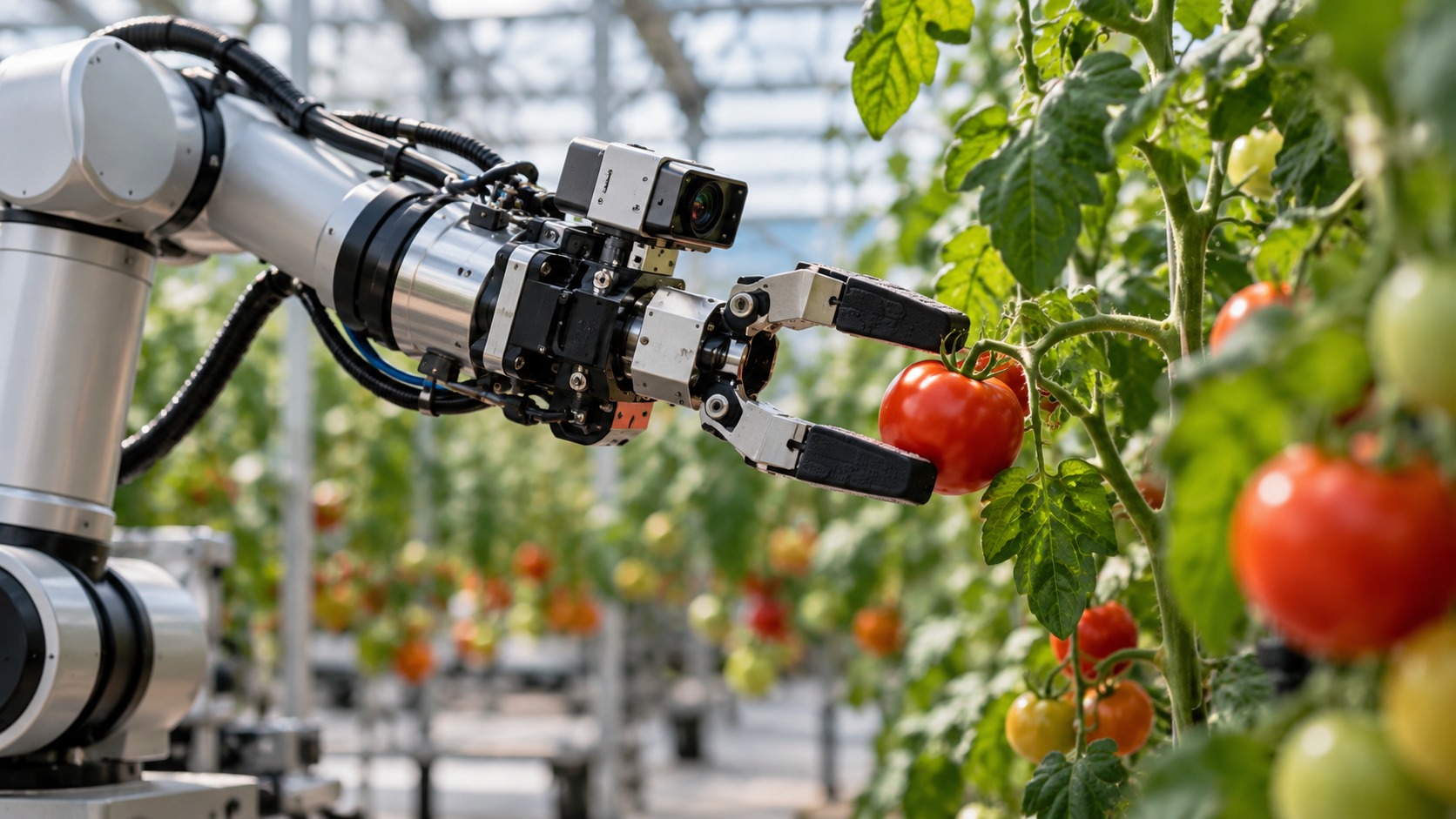
Technology developed to help robots explore distant planets is now being tested for a rather different purpose: harvesting tomatoes.
Researchers from the Polish Academy of Sciences have begun field trials of an experimental agricultural robot designed to recognise tomatoes and eventually pick them autonomously, using techniques originally developed through space-robotics research.
The project, called MobiRobAI, is being developed jointly by the Space Research Centre of the Polish Academy of Sciences (CBK PAN) and Germany’s IHP Leibniz Institute for High Performance Microelectronics.
- Find more news from Poland on our Homepage .
Field testing began in September 2026, following laboratory work to integrate the robot’s movement controls with its image-recognition system. The latest progress was reported by Poland’s PAP news agency on 16 October.
The goal is to create a machine capable of navigating agricultural environments, identifying fruit and planning how to collect it, without requiring an operator to control every movement.
It is an unusual example of how research associated with future space missions could find practical applications much closer to home.
From exploring the Moon to harvesting tomatoes
The connection between planetary exploration and agriculture may initially seem surprising.
But from a robotics perspective, the challenges have important similarities.
A robot exploring the Moon might need to recognise rocks, identify which samples are worth collecting and work out how to approach and pick them up.
An agricultural robot faces a comparable series of tasks.
It must recognise tomatoes among leaves and stems, determine where the fruit is located and guide a robotic arm towards it without damaging the plant.
Both require sophisticated image recognition, precise movement planning and the ability to coordinate different components.
The MobiRobAI project builds on technologies developed through an earlier Polish-German research initiative called SpaceRegion.
These include hierarchical task planning, in which a robot breaks a complex job into smaller actions, and trajectory planning, which determines how a robotic arm should move towards an object.
Professor Marek Banaszkiewicz, who leads the project on the Polish side, has previously explained the connection between collecting tomatoes on Earth and gathering rock samples on the Moon.
In both cases, a robot must use sensor information to distinguish objects, plan its movements and perform a collection task.
The differences lie in what the robot is examining and the environment in which it operates.
The researchers are not claiming that their tomato-harvesting machine has already worked in space. Instead, they are adapting techniques developed for space applications while building capabilities that might also prove useful in future planetary exploration.
Polish engineering meets German artificial intelligence
MobiRobAI combines expertise from two research institutions near the Polish-German border.
The Space Research Centre’s team in Zielona Góra is responsible for developing the robot’s control and navigation methods, integrating its hardware and software, and connecting the robotic manipulator to the mobile platform.


The German IHP institute, based in Frankfurt (Oder), focuses on image-recognition technology and preparing a pathway towards an industrial prototype.
The partners cooperate on component selection, system integration and testing.
A significant part of the work involves teaching the robot to recognise the objects it needs to manipulate.
During an earlier development phase, researchers assembled a substantial image dataset showing greenhouse-grown tomatoes.
They tested different artificial-intelligence models designed to distinguish tomatoes and their stems, providing information the machine can use to plan a harvesting operation.
The researchers also decided to develop a customised mobile platform after concluding that existing commercial designs did not adequately meet the project’s requirements.
These developments have now progressed beyond software design.
According to the Polish Press Agency’s 16 October report, the team has already integrated and tested the system in laboratory conditions.
The tests examined how effectively the platform’s movement controls cooperate with its visual recognition system.
Field trials began in September, initially concentrating on recognising and harvesting tomatoes.
However, the researchers have not yet demonstrated a commercially ready machine capable of operating independently at industrial scale.
Another robot could help maintain solar panels
Tomato harvesting is only one application being developed through MobiRobAI.
The team is also working on robotic technology for inspecting and cleaning photovoltaic panels.
Solar panels can lose efficiency when dirt, dust and other material accumulate on their surfaces, creating a potential role for automated inspection and maintenance.
The researchers initially considered a ground-based robotic system for this work.
However, during development, they revised the concept to use small unmanned aerial vehicles, or drones, offering greater flexibility for the experimental system.
The agricultural robot and photovoltaic-maintenance demonstrator are intended to operate under a common higher-level control architecture.
This would allow related software and planning techniques to coordinate two different types of robotic tasks.
For the researchers, developing reusable control systems is part of the project’s wider significance.
Instead of building completely separate software for every new application, they hope to create modular components that can be adapted for different machines and environments.
A Polish-German project with European support
MobiRobAI began in October 2024 and is scheduled to continue until 31 March 2027.
It has a total budget of approximately €822,000, with 80% financed through the European Union’s Interreg Brandenburg–Poland programme.
The programme supports cooperation between institutions in the Polish-German border region.
The project also involves opportunities for students and doctoral researchers connected with the University of Zielona Góra and Brandenburg University of Technology Cottbus-Senftenberg.
Beyond the agricultural and energy-maintenance applications, the researchers want to develop skills and technologies that could support further work in autonomous robotics.
Such capabilities may eventually contribute to more sophisticated machines for exploration, industry and other environments where constant human control is impractical.
For now, several important development tasks remain.
The team must complete field testing of its demonstrators, further validate the photovoltaic-panel inspection system and simplify parts of the robotic manipulator’s control algorithms.
The central challenge is turning promising laboratory integration into reliable operation under real-world conditions.
A small step towards more capable robots
The MobiRobAI prototype is not yet replacing human tomato pickers, and its performance in commercial agricultural conditions remains to be established.
Nor does its development mean that similar machines are ready to collect samples from the Moon or Mars.
But the project demonstrates a practical connection between two fields that rarely appear together: space engineering and agriculture.
Polish researchers are helping take technologies associated with autonomous planetary exploration and test how they might be used for routine work on Earth.
The immediate goal is relatively modest: enabling a robot to identify tomatoes, plan its movements and collect fruit reliably.
The broader ambition is more far-reaching.
If the research succeeds, the same underlying robotics expertise could help machines perform increasingly complex tasks in greenhouses, industrial facilities and perhaps, in the more distant future, on other worlds.
For now, the next proving ground for technology inspired by space exploration is a tomato plant.