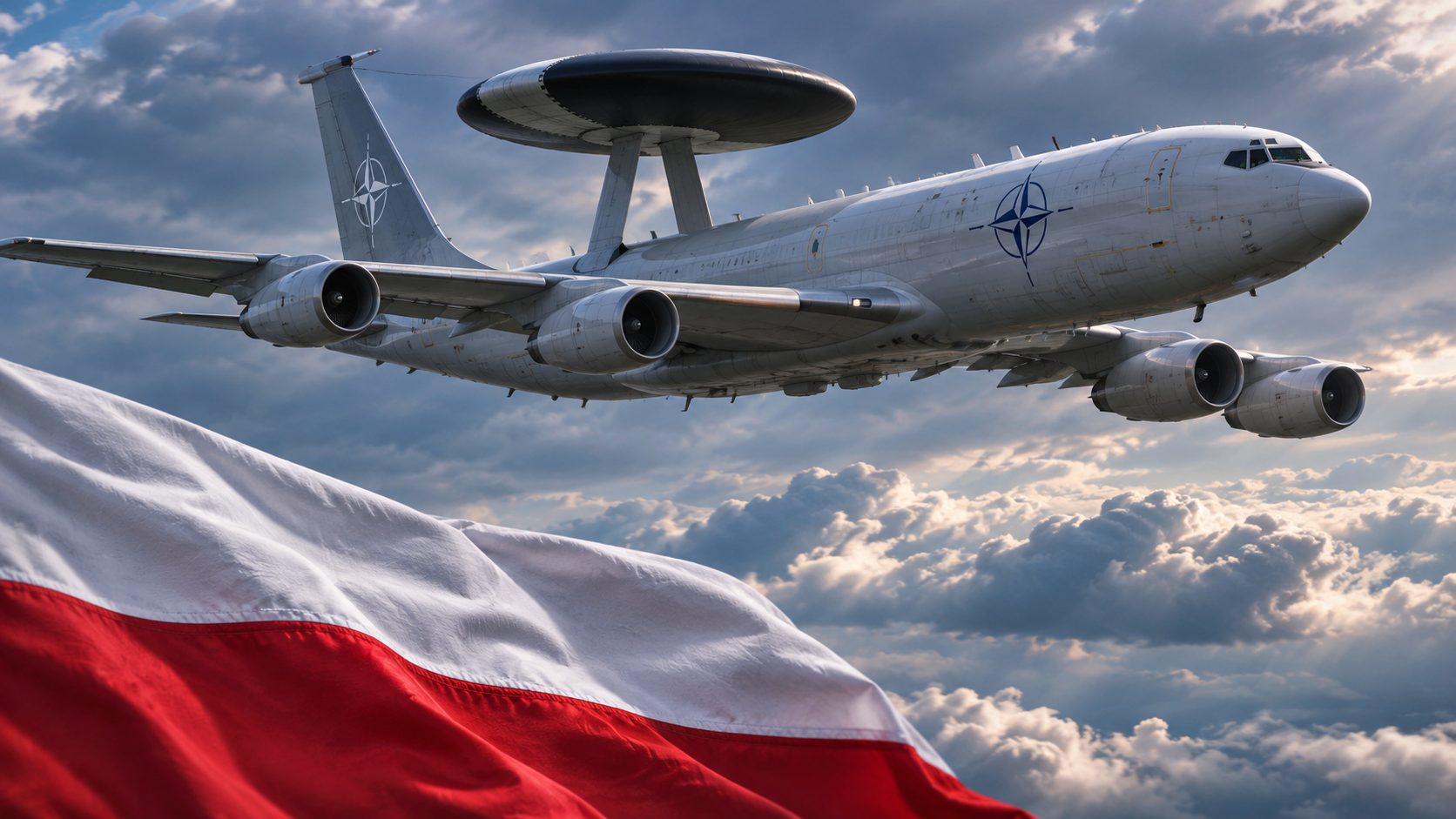
NATO has authorised the forward deployment of an AWACS airborne early-warning aircraft to strengthen surveillance of Poland’s airspace following the incursion of three Russian cruise missiles on 20 November. The decision was confirmed on Monday, 23 November, after an extraordinary meeting of NATO ambassadors in Brussels, marking a concrete military response to the latest security incidents on the alliance’s eastern flank.
The authorisation was issued by General Alexus Grynkewich, NATO’s Supreme Allied Commander Europe (SACEUR).
NATO spokesperson Allison Hart confirmed the decision in a statement following the North Atlantic Council meeting, while Polish Deputy Defence Minister Paweł Zalewski said one AWACS aircraft would be made available to Poland.
- Find more news from Poland on our Homepage .
The announcement, reported by Reuters, follows several days of urgent consultations between Warsaw and its NATO allies.
The aircraft is intended to improve surveillance and early warning of potential airborne threats. It is not a missile interceptor or combat aircraft.
NATO confirms AWACS authorisation for Poland
NATO ambassadors met in Brussels on Monday to discuss the Russian missiles that entered Poland during a large-scale attack on neighbouring Ukraine on Friday.
The meeting was convened at Poland’s request.
Following the discussions, NATO spokesperson Allison Hart said the alliance held Russia responsible for the airspace violations and had already taken measures in response.
She confirmed that Grynkewich had authorised the forward deployment of an AWACS aircraft.
Hart also said NATO’s military command was examining whether further defensive capabilities should be deployed to Poland and other parts of the alliance.
The possible additional measures have not yet been specified or formally announced.
Speaking to reporters after the meeting, Zalewski confirmed that one AWACS aircraft would be placed at Poland’s disposal.
The deputy defence minister described the aircraft as a significant capability that would improve Poland’s operational awareness and ability to respond to airborne threats.
According to TVP Info’s account of his remarks, Zalewski also argued that the missile incursions should be understood as part of a wider escalation of Russian activity affecting NATO.
Poland’s Defence Minister Władysław Kosiniak-Kamysz welcomed the decision as an additional layer of protection alongside ground-based air defences, Polish F-16 fighters and aircraft operated by NATO allies.
What is an AWACS aircraft, and how will it help Poland?
AWACS stands for Airborne Warning and Control System.
NATO operates a fleet of 14 Boeing E-3A Sentry aircraft, recognisable by the large circular radar dome mounted above their fuselage.
Unlike fighter jets, AWACS aircraft are designed primarily for surveillance, early warning and the coordination of military operations.
Their radar systems can detect and track aircraft and other airborne threats over considerable distances, providing commanders with a more comprehensive picture of activity across a region.
According to NATO’s official explanation of its AWACS capabilities, a single aircraft operating at approximately 30,000 feet can monitor an area exceeding 312,000 square kilometres — roughly the size of Poland.
You May Also Be Interested In


Its sensors can detect certain low-altitude targets at distances of up to approximately 400 kilometres, although actual detection performance depends on factors including terrain, the target and operating conditions.
AWACS aircraft can also relay information to other military assets and help coordinate the activities of allied fighter jets.
This is especially important when identifying fast-moving aerial threats, such as cruise missiles, which may approach at low altitude and present challenges for ground-based radar systems.
An AWACS aircraft does not shoot down missiles itself.
Instead, it can provide information that helps air-defence operators and fighter pilots assess threats and determine how to respond.
Where will the NATO aircraft be stationed?
NATO has confirmed the forward-deployment authorisation but has not publicly specified the aircraft’s final operating location or when its newly assigned mission will begin.
The alliance’s permanent AWACS base is located at Geilenkirchen in western Germany.
German news agency dpa, citing information from NATO’s military headquarters in Mons, Belgium, reported that the authorisation concerned moving an AWACS aircraft to Lithuania.
That account was published by dpa on 23 November.
NATO has not publicly confirmed Lithuania as the aircraft’s forward-operating location.
An aircraft stationed in another allied country can still support the surveillance of Polish airspace, depending on its mission and flight arrangements.
The distinction is significant because the decision to make an AWACS aircraft available to Poland does not necessarily mean it will be permanently based at a Polish military airfield.
NATO AWACS aircraft have already conducted surveillance missions along the alliance’s eastern flank for years, particularly since Russia’s full-scale invasion of Ukraine in February 2022.
The new development is the specific authorisation of additional forward-deployed capability following the latest missile incursions.
Three Russian cruise missiles entered Poland
The NATO decision follows the events of Friday, 20 November, when three airborne objects entered Polish airspace during a Russian attack on Ukraine.
The objects fell at separate locations in eastern and south-eastern Poland.
Wreckage was recovered near Nowy Lipowiec in Lubelskie province, and near Rudnik nad Sanem and Mołodycz in Podkarpackie province.
Although initial reports suggested one object might have been a drone, subsequent examinations identified all three as Russian Kh-101 cruise missiles.
Polish prosecutors confirmed the identification of the missiles after examining the recovered wreckage.
The incidents raised concerns about the risks posed by Russian attacks on Ukraine to neighbouring NATO countries.
Polish officials described the incursions as serious provocations and sought additional military support from the alliance.
NATO Secretary General Mark Rutte subsequently reaffirmed the alliance’s commitment to defending Poland, including its airspace and territory.
The Polish government also requested additional surveillance and air-defence capabilities.
Monday’s AWACS authorisation represents the first specifically confirmed deployment decision arising from those consultations.
Another Russian drone entered Polish airspace
The security situation developed further on Monday evening, after the North Atlantic Council meeting.
Poland’s military reported that a Russian drone briefly crossed into Polish airspace during renewed attacks on western Ukraine.
Polish commanders authorised its interception but ultimately decided against firing after the aircraft changed course towards Ukraine.
Emergency warnings were issued to residents of parts of Lubelskie province, where air-raid sirens sounded.
Poland-24 reported the subsequent drone incursion and emergency alerts following the military’s announcement.
The drone incident was separate from the three cruise missiles that prompted Monday’s NATO consultations.
It nevertheless underscored the continuing risks confronting Poland’s air-defence forces.
The newly authorised AWACS deployment is intended to improve the alliance’s ability to monitor such threats, although NATO has not announced that the aircraft was already operational in its new assignment when Monday night’s incident occurred.
NATO considering further defensive measures
The AWACS authorisation may not be the alliance’s final response.
NATO spokesperson Allison Hart confirmed that Grynkewich was reviewing the possibility of deploying additional military assets as part of the alliance’s wider assessment of its defensive posture.
Polish officials have also indicated that other proposals for strengthening air defences may be discussed in forthcoming NATO meetings.
However, no further specific aircraft, missile-defence systems or military units have been confirmed as part of the 23 November decision.
The North Atlantic Council meeting did not involve a publicly announced invocation of NATO’s collective-defence Article 5.
Nor does the AWACS authorisation represent a NATO decision to engage Russian aircraft or missiles over Ukrainian territory.
Instead, it strengthens the alliance’s surveillance and command capabilities in response to threats affecting its member states.
What happens next?
The immediate question is when and where the newly authorised AWACS aircraft will begin its assigned operations.
NATO has yet to confirm the operational start date, the length of the deployment or whether additional aircraft will follow.
The alliance’s military command is continuing to review defensive arrangements in Poland and across its eastern flank.
For Warsaw, the announcement provides a concrete outcome from its request for stronger protection following the Russian missile incursions.
For NATO, it demonstrates a willingness to adjust military capabilities in response to the security risks created by Russia’s continuing attacks on Ukraine.
The latest decision enhances Poland’s access to airborne surveillance, but it remains distinct from the deployment of additional missile interceptors or fighter aircraft.