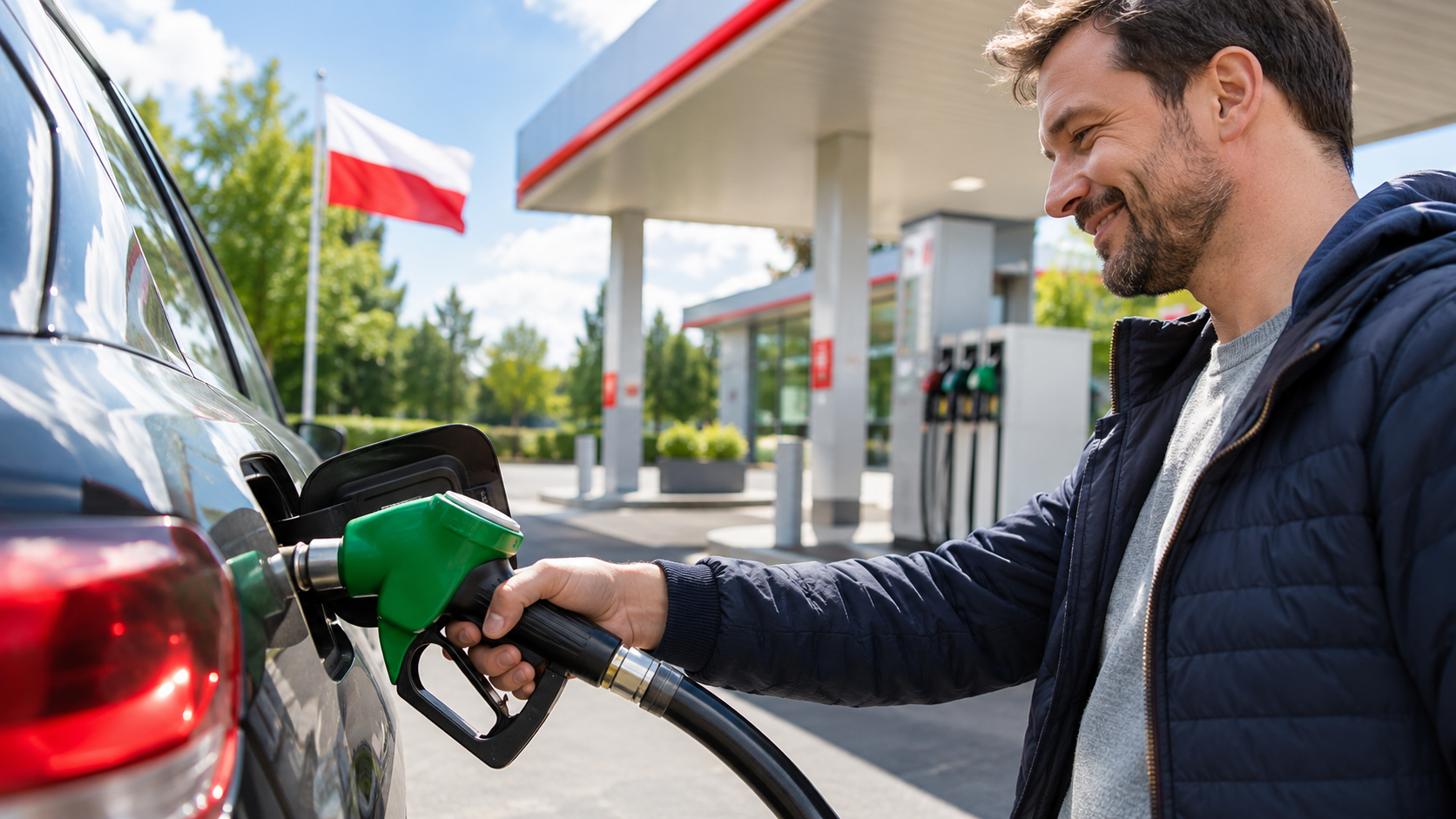
Poland recorded the largest monthly falls in petrol and diesel prices in the European Union in October 2026, according to figures released by Eurostat on Monday, 23 November. Petrol prices fell by 12%, while diesel prices declined by 9%, as the country reintroduced fuel-tax reductions and limits on retail prices. However, the latest figures also show that Polish motorists were still paying substantially more for fuel than a year earlier.
The new Eurostat figures show that Poland experienced the steepest month-on-month reductions for both types of fuel among the EU’s 27 member states.
The falls were considerably larger than the EU averages, which were 3% for petrol and just 0.2% for diesel.
- Find more news from Poland on our Homepage .
The figures provide the first comprehensive European comparison of fuel-price movements during October, when Poland’s government reinstated measures intended to reduce the impact of high energy costs on households and businesses.
Poland leads Europe in falling petrol prices
Petrol prices in Poland declined by 12% between September and October, the largest reduction recorded anywhere in the EU.
Spain registered the second-largest decrease, at 6.1%, followed by Germany at 5.8%.
Across the EU, petrol prices fell by an average of 3%.
The picture differed considerably between member states. Petrol prices increased in 16 EU countries during October, with the largest rises recorded in Slovenia, Sweden and Cyprus.
The largest monthly petrol-price falls in October 2026 were 12% in Poland, 6.1% in Spain and 5.8% in Germany, according to Eurostat’s harmonised consumer price data.
Poland’s October performance represented a reversal from September, when petrol prices had increased by 9.7% compared with August.
That earlier rise was among the largest recorded in the EU, illustrating how sharply fuel costs fluctuated during the autumn.
Diesel prices also fall sharply in Poland
Poland recorded the EU’s largest monthly reduction in diesel prices, with a fall of 9%.
Germany followed with a decrease of 5.1%, while the Czech Republic registered a decline of 3.6%.
Diesel prices fell by just 0.2% across the EU as a whole.
In fact, diesel became more expensive in 20 member states during October.
Ireland recorded the largest increase, at 6.1%, followed by Sweden at 3.1% and Romania at 3%.
The contrast is important for Poland’s transport and logistics industries, where diesel represents a significant operating expense.
Lower diesel prices can ease costs for businesses transporting goods, operating delivery fleets or providing passenger services.
However, the October figures do not establish how much individual transport companies saved, or whether any savings were passed on to customers.
Why did fuel prices fall so sharply in Poland?
One important factor was the government’s decision to reintroduce its fuel-price intervention programme at the beginning of October.


The measures followed renewed increases in fuel costs during September.
Under the programme, known in Polish as Ceny Paliw Niżej (CPN), the government reduced value-added tax on eligible petrol and diesel from 23% to 8%.
Excise duties were also lowered, while maximum retail prices were introduced to limit what petrol stations could charge consumers.
The measures took effect on 3 October and were designed to provide relief after a period of rising global energy costs.
Poland-24 previously reported on the government’s decision to cut fuel VAT to 8% and introduce lower prices at petrol stations.
According to the Polish Ministry of Energy’s announcement, the renewed programme combined tax reductions with government-set maximum prices for fuel.
The Ministry of Finance subsequently confirmed that the reduced VAT and excise arrangements would remain in place until 31 December 2026.
The policy’s implementation coincided with the substantial falls recorded in Eurostat’s October figures.
However, the statistical release does not calculate precisely how much of the monthly reduction resulted from tax cuts, price caps or wider movements in wholesale fuel costs.
The European Bank for Reconstruction and Development also highlighted Poland’s fuel-price intervention in its November 2026 country assessment.
The bank noted that the government had reinstated fuel-tax reductions and retail price controls in October after renewed price increases, extending the support package to the end of the year.
Fuel still more expensive than a year ago
Despite the sharp monthly reductions, Eurostat’s figures show that fuel remained significantly more expensive than in October 2025.
The broader index covering fuels and lubricants for personal transport rose by 21.9% year on year in Poland.
That was one of the smallest annual increases in the European Union, behind Hungary at 11.3% and Ireland at 21.5%.
Nevertheless, it means that October’s falls did not return the overall price index to its level a year earlier.
Across the EU, fuel and lubricant prices were 29.5% higher than in October 2025.
Three countries recorded annual increases exceeding 40%: Estonia at 44.1%, Bulgaria at 42.8% and Lithuania at 42.3%.
The contrast illustrates the distinction between falling prices during a single month and the longer-term cost increases experienced by consumers.
Poland recorded particularly strong monthly reductions, but the annual figures still reflected considerable pressure on motorists’ budgets.
What do Eurostat’s figures actually measure?
Eurostat’s latest analysis is based on the Harmonised Index of Consumer Prices, or HICP, which allows inflation developments to be compared across EU member states.
The figures measure percentage changes in consumer prices rather than publishing the average amount charged for a litre of fuel at every filling station.
Consequently, Poland’s 12% monthly fall in petrol prices does not mean that every petrol station reduced its prices by exactly 12%, or that petrol is necessarily 12% cheaper than it was at the start of the year.
It also does not establish that Poland has the lowest absolute petrol or diesel prices in the EU.
For direct comparisons of pump prices expressed in euros per litre, the European Commission publishes separate weekly fuel-price statistics.
Eurostat’s latest release instead highlights the scale and direction of price changes during October.
What happens next for Polish motorists?
Poland’s reduced fuel-tax rates are scheduled to remain in place until the end of December 2026, providing continued support to motorists through the final weeks of the year.
Retail price caps are also part of the government’s intervention framework.
The next question is how fuel prices will respond as those temporary measures approach their scheduled expiry.
Future prices will depend on a combination of government decisions, international oil markets, currency movements and domestic fuel-market conditions.
The government has not, on the basis of Eurostat’s October release, announced a further extension of the existing programme.
For Polish households, October’s reductions provided relief following September’s increases.
But the longer-term figures underline the continuing challenge: even after recording the EU’s biggest monthly falls, fuel prices in Poland remained more than one-fifth higher than a year earlier.