

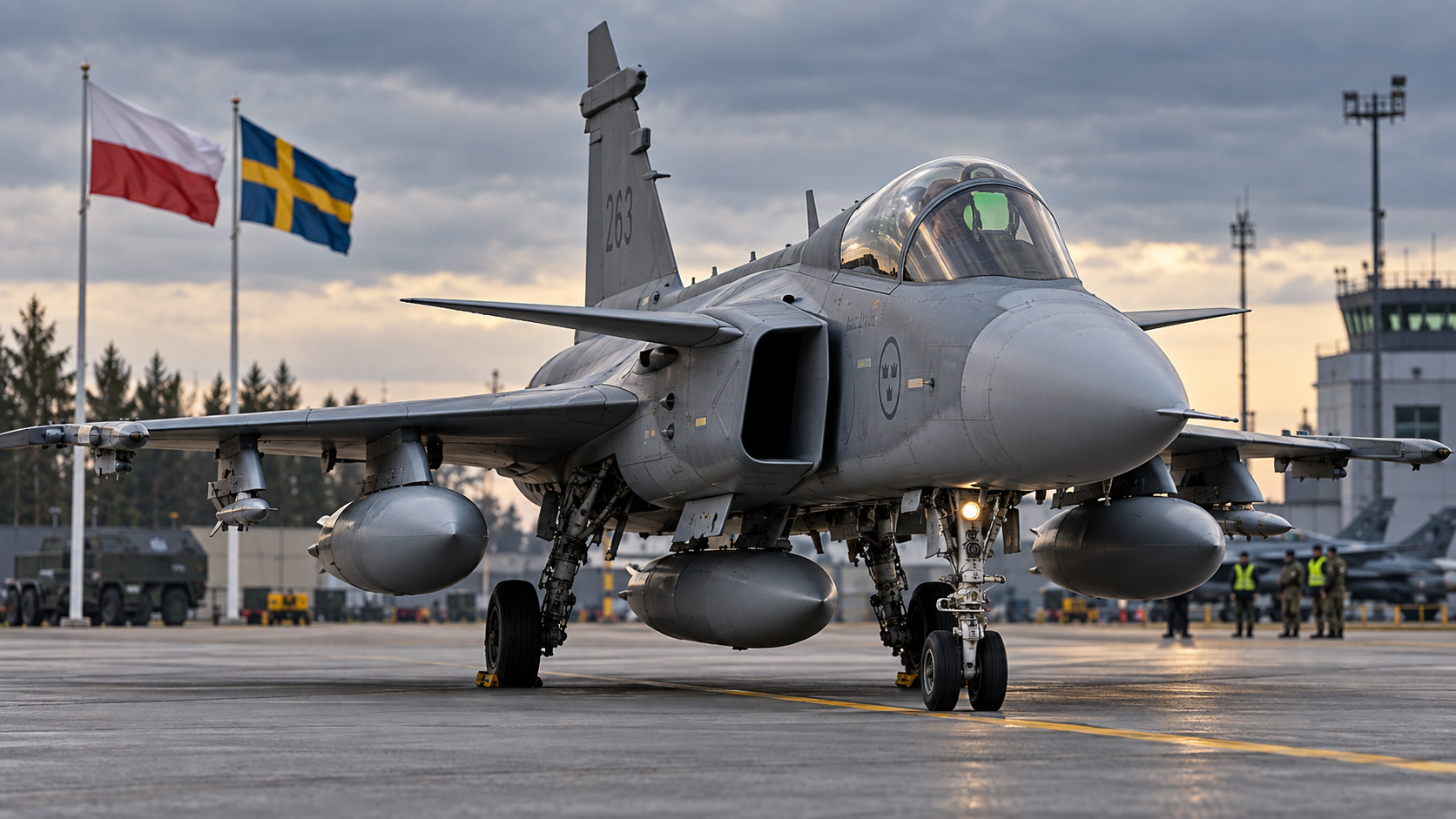
Swedish JAS 39 Gripen fighters will begin a new NATO mission supporting the defence of Polish airspace on 1 October, with the aircraft also tasked with helping protect the strategically important logistics hub in southeastern Poland used to channel military and civilian assistance to Ukraine.
The Swedish government announced the deployment on Wednesday, saying the Gripens would contribute to NATO’s Integrated Air and Missile Defence and reinforce the alliance’s eastern flank. Most of the aircraft will remain based in Sweden and fly missions into Polish airspace, while a smaller forward operating presence will be established in Poland.
The Swedish Armed Forces says the mission begins on 1 October and will run for two months, with personnel and aircraft from Blekinge Air Wing, F 17, participating. The aircraft will operate under NATO air-command arrangements involving the Combined Air Operations Centre at Uedem in Germany.
- Find more news from Poland on our Homepage .
Sweden has not publicly disclosed how many Gripens will take part in the new mission.
The Swedish government has also not identified the location of the forward operating base in Poland or formally named the southeastern logistics hub in its announcement. It described the facility only as the hub used to provide military and civilian support to Ukraine.
That distinction matters because the current announcement should not automatically be read as confirmation that the aircraft themselves will be permanently based at Rzeszów-Jasionka Airport.
The logistics network in southeastern Poland is, however, already central to NATO’s support operation for Ukraine. NATO has publicly described an NSATU logistics hub in Poland that coordinates the onward movement of military equipment to Ukraine, while Polish government reporting on Sweden’s previous 2025 deployment identified the protected hub as being in the Rzeszów area.
Swedish Defence Minister Pål Jonson linked the new deployment to the deteriorating air-security environment on NATO’s eastern flank.
“The serious security situation and repeated violations of NATO airspace demonstrate the need for a high level of military readiness along the eastern flank,” Jonson said in the government announcement.
He said the Swedish aircraft would contribute both to defending allied airspace and protecting important logistical flows of military support to Ukraine.
Swedish Air Force commander Major General Jonas Wikman described the mission as a direct operational contribution to NATO’s collective air defence, saying Swedish combat aircraft would help protect allied airspace while supporting the continued flow of assistance to Ukraine.
More than traditional air policing
The new mission sits within NATO’s broader air-defence architecture rather than being simply another peacetime patrol.
NATO says its Integrated Air and Missile Defence, or IAMD, combines allied aircraft, ground-based air-defence systems, sensors and command structures to detect, track and respond to threats including aircraft, missiles and drones.
During 2026, NATO has been moving from the traditional concept of Air Policing towards a broader Air Defence posture capable of responding to a wider range of threats. The alliance says this development has been driven in part by repeated Russian drone and aircraft incursions around its eastern flank.
The Swedish mission also intersects with NATO Security Assistance and Training for Ukraine, or NSATU, but the two should not be confused.
NSATU coordinates military assistance and training for Ukraine. The Swedish fighters are not being sent to fight in Ukraine; their role is to defend NATO airspace and help protect the Polish logistics infrastructure through which assistance is moved eastwards.
NATO said last year that the Polish NSATU hub handles approximately 18,000 tonnes of material each month and is already protected by allied air-defence systems.
Sweden has defended Polish airspace before
This will be Sweden’s second fighter contribution specifically connected with protecting the Polish logistics hub.
In 2025, Swedish Gripens operated from the 22nd Tactical Air Base in Malbork as part of NATO Air Policing, patrolling Polish airspace and contributing to protection over the logistics hub near Rzeszów.
The Polish Embassy in Sweden said earlier this month that the 2025 mission ran from April until the end of August and later honoured 54 Swedish personnel with Polish Armed Forces medals for their service.


That earlier deployment was especially significant because it was Sweden’s first such fighter mission after joining NATO in 2024.
The new arrangement is operationally different: instead of basing the main force in Poland, most of the Gripens will operate from Sweden, supported by the smaller Polish forward presence.
That model allows Sweden to contribute combat aircraft to Poland’s defence while retaining much of the force at its home bases.
Deployment begins after another Russian strike wave
The announcement came on the same day that Poland again activated military aviation because of Russian attacks on Ukraine.
Poland’s armed forces placed ground-based air-defence and radar systems on heightened readiness on Wednesday morning, while civilian operations at Lublin and Rzeszów airports were temporarily suspended during the military activity. Both airports later resumed normal operations.
The Swedish government did not present that specific incident as the trigger for the deployment, which had already been prepared as a NATO operation.
It nevertheless illustrates the security environment into which the Swedish aircraft are entering.
Russian missile and drone attacks against western Ukraine repeatedly bring Polish and allied air-defence forces to heightened readiness because of the risk that weapons, drones or debris could approach or cross NATO territory.
NATO has also strengthened its air and missile defences along the eastern flank following a series of airspace violations.
For Poland, the Swedish contribution therefore adds another allied combat-air capability to a defence network that has to protect both the country’s own territory and one of the principal logistics routes sustaining Ukraine.
And for Sweden, it is another concrete step in the country’s transition from decades of military non-alignment to routinely deploying combat forces as part of NATO’s collective defence.