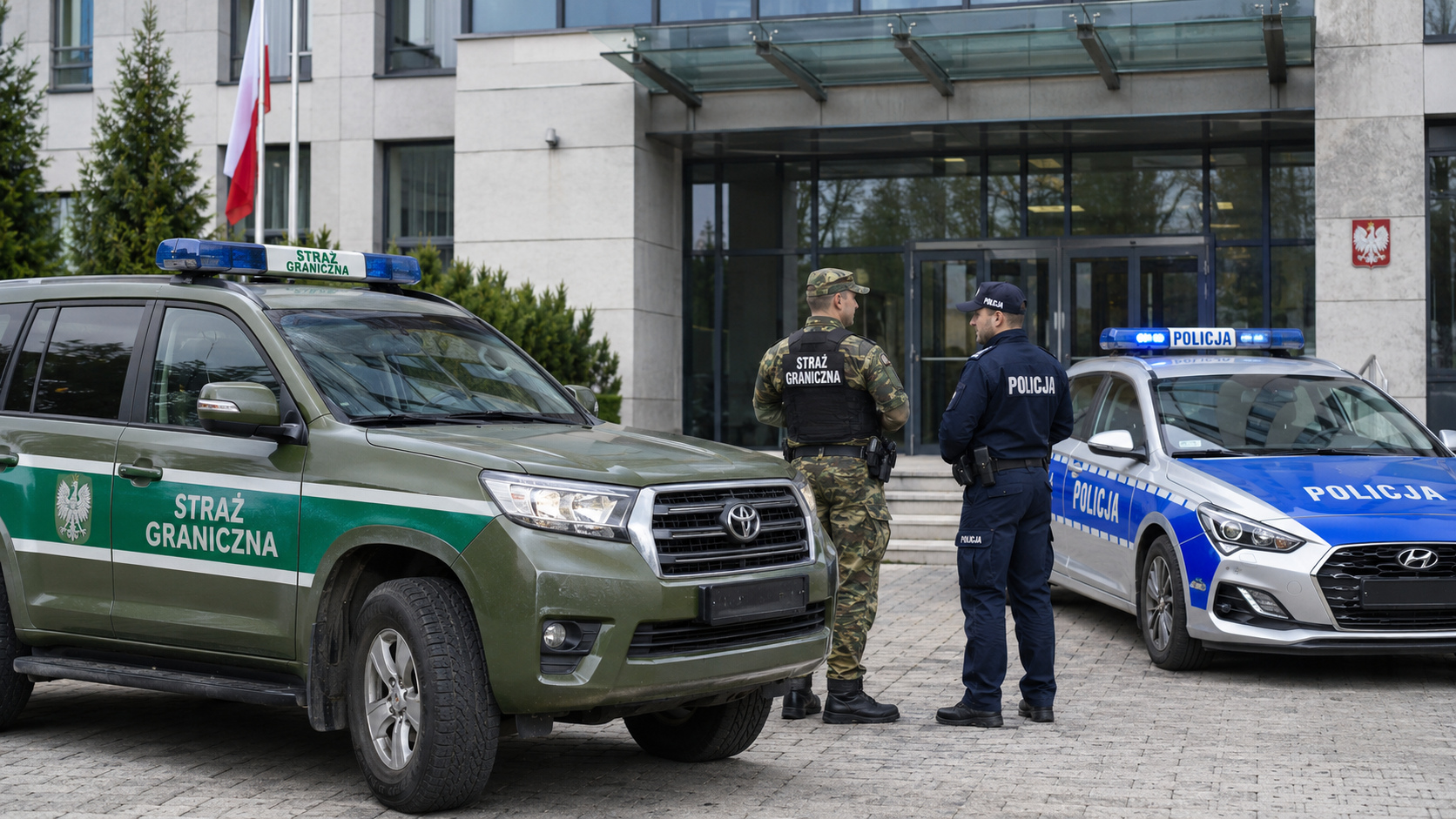
Polish Border Guard officers and police detained more than 80 foreign nationals during a two-day nationwide immigration-enforcement operation in October, carrying out over 1,400 checks into whether people were legally residing in the country. Nearly 600 Border Guard officers took part in the coordinated operation on 12 and 13 October, which resulted in more than 60 administrative proceedings aimed at requiring foreign nationals to leave Poland.
The results were announced by Border Guard headquarters on 15 October 2026.
According to the authorities, most of the return proceedings concerned people whose residence in Poland did not comply with immigration rules. A smaller number involved individuals whom officers considered a potential threat to state security.
- Find more news from Poland on our Homepage .
The checks took place across Poland and involved cooperation between the Border Guard and the national police.
The operation illustrates how Polish authorities conduct immigration enforcement within the country, rather than focusing exclusively on preventing unauthorised crossings at external borders.
More than 1,400 checks carried out across Poland
The Border Guard deployed nearly 600 officers from its regional units during the operation.
Working alongside police, they examined the immigration status of foreign nationals residing in Poland.
According to the official Border Guard headquarters announcement published on 15 October, officers carried out more than 1,400 checks into the legality of residence.
The agency also reported verifying the identities of nearly 1,400 foreign nationals.
The largest groups checked were:
| Nationality | Approximate number checked |
|---|---|
| Ukrainian | 530 |
| Colombian | 290 |
| Bangladeshi | 80 |
These figures refer to individuals whose status was checked. They are not the numbers of people detained or found to be residing unlawfully.
The Border Guard did not publish a full nationality breakdown of the more than 80 detainees.
Nor did it establish that the majority of people checked had violated immigration regulations.
The figures instead describe the scale and composition of the enforcement activity.
More than 80 detained and 60 return proceedings opened
The checks resulted in the detention of more than 80 foreign nationals, according to the Border Guard.
Officers also initiated more than 60 administrative proceedings to determine whether individuals should be ordered to leave Poland.
The agency reported two principal categories of cases.
In more than 50 proceedings, the grounds involved unlawful residence.
Nearly ten others involved individuals whom the authorities considered a threat to state security.
The announcement did not provide individual case descriptions, identify the alleged security risks or confirm that those concerned had been convicted of criminal offences.
You May Also Be Interested In


The security-related findings should therefore be understood as the Border Guard’s stated grounds for administrative action, rather than proof of criminal guilt.
The national figures were presented as rounded totals, and the authorities did not publish a detailed breakdown accounting for the outcome of every detention.
The initiation of return proceedings does not establish that a final return decision has been issued or that an individual has already been deported.
Regional operation identifies 38 cases requiring return proceedings
Additional details emerged from the Nadwiślański Border Guard Unit, which operates across parts of central Poland.
Its officers worked with police in the Mazowieckie, Łódzkie and Kujawsko-Pomorskie provinces.
According to the regional unit’s report, also published on 15 October, officers checked the immigration status of nearly 360 foreign nationals.
Among those examined were 144 Ukrainian citizens and 87 Colombian citizens.
The regional operation identified 38 people against whom return proceedings were initiated.
By the time the report was published, 20 of those proceedings had resulted in decisions requiring the individuals to leave Poland.
Sixteen decisions were based on unlawful residence.
The remaining four concerned people whose continued presence was considered a threat to security or public order.
These regional figures are part of the wider nationwide operation and should not be added to its national totals.
They also provide a useful example of the distinction between opening administrative proceedings and issuing a return decision.
Although 38 cases had entered the return procedure, decisions had been issued in only 20 at the time of the announcement.
The report did not establish that those 20 individuals had all physically departed Poland.
Police conducted a wider nationwide operation on the same dates
The immigration checks took place alongside a broader nationwide police initiative focused on identifying people wanted by Polish courts and law-enforcement agencies.
The operation, known as Poszukiwany — meaning Wanted — was coordinated by the National Police Headquarters’ Criminal Bureau.
The police’s separate operational summary, published on 15 October, reported that 23,414 police officers participated.
They detained 1,923 people wanted by Polish authorities, including 161 foreign nationals.
Police also reported submitting 88 applications to the Border Guard seeking return decisions concerning foreign nationals.
Those applications concerned people whose residence or conduct raised grounds for immigration enforcement.
The figures describe a broader law-enforcement operation that overlapped with the Border Guard’s immigration checks.
They cannot simply be added to the Border Guard’s figures, because the authorities did not establish that all the reported cases involved different individuals.
The police campaign was primarily aimed at locating wanted people, while the Border Guard’s separately reported statistics concerned immigration-status verification.
Both demonstrate the cooperation between Poland’s police and immigration authorities during the two-day operation.
What happens when Poland starts return proceedings?
Poland’s Border Guard has powers to investigate whether foreign nationals meet the conditions required for lawful residence.
Depending on the circumstances, return proceedings may be initiated against people who have exceeded their permitted period of stay, breached relevant immigration requirements or come within other statutory grounds.
A return proceeding is an administrative process intended to determine whether a foreign national should be required to leave Poland.
It is not automatically equivalent to a criminal prosecution.
According to the Polish Office for Foreigners’ official explanation of return procedures, a return decision is issued by the competent Border Guard authority under the conditions established by Polish law.
The procedure can include examination of whether the person qualifies for humanitarian or tolerated residence.
Return decisions are also subject to appeal under the applicable administrative rules.
The consequences depend on the individual case, including whether the person is required to depart voluntarily or is subject to enforced removal.
Accordingly, the October operation’s more than 60 newly initiated proceedings cannot be described as more than 60 completed deportations.
The Border Guard’s national announcement did not establish how many of the affected people had eventually left Poland.
Poland continues enforcement beyond its external borders
The operation formed part of Poland’s wider approach to checking compliance with immigration regulations.
Much of the country’s border-security debate focuses on the frontier with Belarus, where Poland has reinforced border infrastructure and deployed additional security personnel.
However, immigration enforcement also takes place within the country.
The Border Guard can investigate whether foreign nationals continue to satisfy residence conditions after entering Poland, while police can identify people whose circumstances require referral to immigration authorities.
These checks are particularly relevant in cases where people remain after their permission to stay has expired or otherwise fail to meet the requirements governing their residence.
The October operation was not reported as a mass interception of migrants crossing Poland’s physical borders.
It was a nationwide exercise examining the legal status of people already present in the country, conducted alongside a broader police operation.
The distinction matters because unlawful residence can arise in circumstances different from an unauthorised border crossing.
For example, a person may enter a country legally but subsequently exceed the period of permitted residence.
The Border Guard’s announcement did not provide enough detail to establish how each of the more than 80 detained individuals originally entered Poland.
Further immigration checks reported in November
The October exercise was followed by additional regional enforcement announcements.
On 3 November, the Silesian Border Guard command reported another operation involving 28 foreign nationals in Opole and other locations.
That operation involved residence and employment checks, including cases of unauthorised work and overstaying.
Poland-24 has separately reported on the detention of 28 foreign nationals during those November immigration checks, including the resulting administrative return decisions.
The November operation was separate from the nationwide exercise on 12–13 October.
Its results should not be included in the October detention total.
The two announcements nevertheless illustrate the continuing role of immigration-status inspections in the Border Guard’s work.
What is known about the October operation’s final outcome?
The nationwide operation took place on 12–13 October, with the principal results published two days later.
The Border Guard confirmed over 1,400 residence-legality checks, more than 80 detentions and more than 60 return proceedings.
The regional report also confirmed that 20 return decisions had already been issued in the Nadwiślański unit’s area.
However, no subsequent nationwide account was identified establishing how many proceedings ultimately resulted in final return orders, how many were appealed or how many people were physically removed from Poland.
The October figures therefore remain an official account of the operation’s immediate results, not a complete record of its longer-term outcomes.
For Poland’s immigration authorities, the operation demonstrated the scale of coordinated residence checks that can be undertaken across the country.
For those affected, the ultimate legal consequences depend on the circumstances and outcome of their individual administrative proceedings.