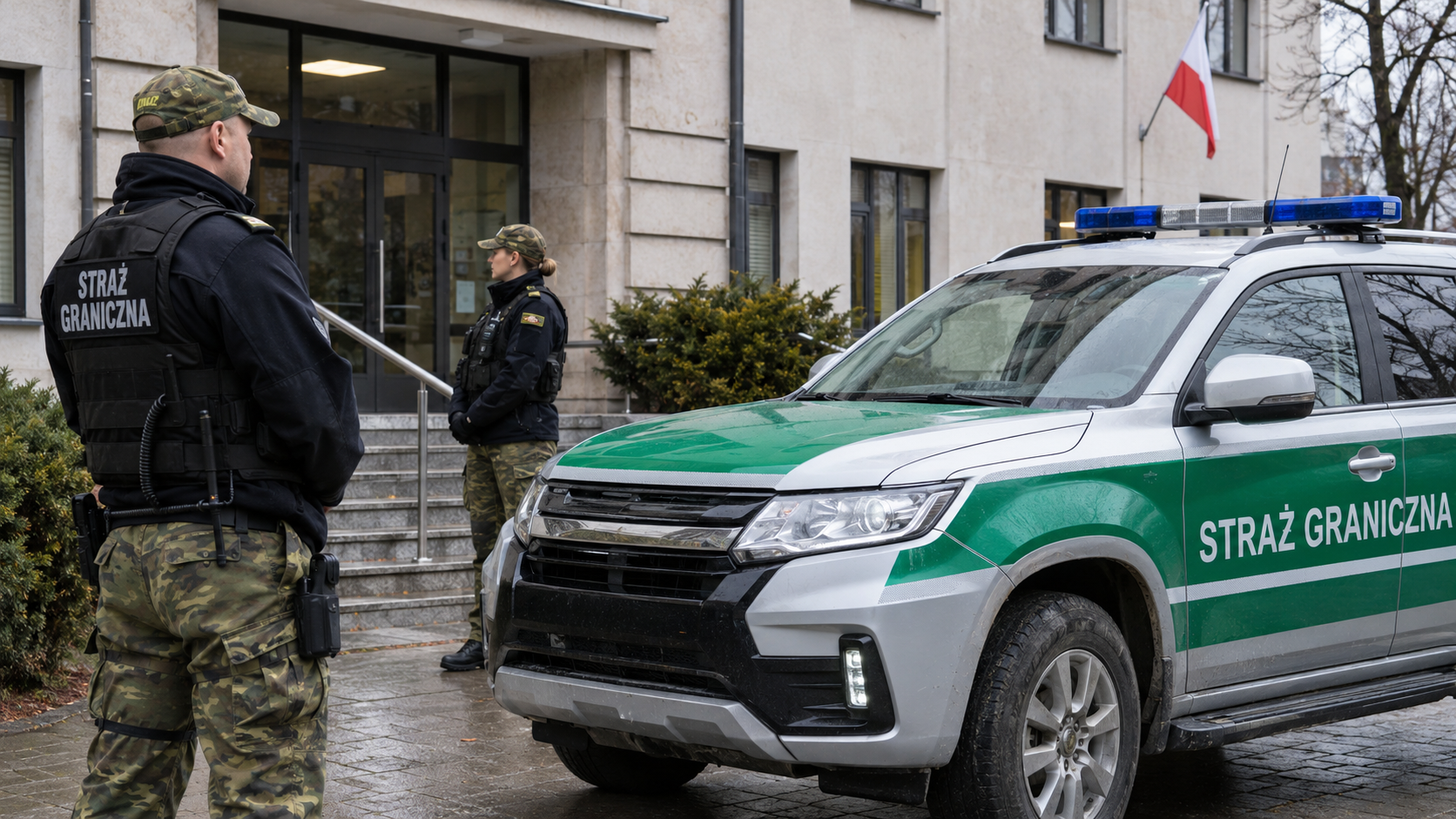
Poland’s Border Guard detained 28 foreign nationals during immigration and employment checks in Opole and other locations under its Silesian regional command, identifying cases of unauthorised work and breaches of residence conditions. In a statement published on 3 November, the authorities confirmed that the individuals had been subject to administrative return proceedings, with decisions requiring them to leave Poland and entry bans covering the Schengen Area for periods of up to three years.
The operation included 17 people detained by Border Guard officers based in Opole, among them citizens of Colombia, Sri Lanka, Peru and Moldova.
A further 11 foreign nationals were identified by other units operating under the Silesian Border Guard command.
- Find more news from Poland on our Homepage .
The authorities said the checks uncovered cases in which foreigners had undertaken employment without the necessary authorisation or remained in Poland without meeting their residence requirements.
The findings were detailed in an official announcement published by Border Guard headquarters on Tuesday, 3 November.
Twelve Colombians among 17 detained by Opole officers
The most detailed findings concerned the 17 foreign nationals detained by officers from the Border Guard post in Opole during the preceding weekend.
The group included:
- 12 citizens of Colombia
- Three citizens of Sri Lanka
- One citizen of Peru
- One citizen of Moldova
According to the Border Guard, most of those detained had been staying in Poland for purposes inconsistent with those previously declared to immigration authorities.
Officers also identified employment being undertaken without the required authorisations.
The authorities did not disclose the names of the individuals or identify the employers involved.
Nor did the announcement establish that every person detained had committed precisely the same violation.
Moldovan national overstayed by 114 days
One of the cases highlighted by the Border Guard involved a Moldovan citizen.
Officers established that the individual had exceeded the permitted duration of their stay in Poland by 114 days.
The person had also been working without the required authorisation, according to the authorities.
Overstaying permitted residence and undertaking unauthorised employment are separate grounds that can lead to immigration enforcement.
In this case, the Border Guard reported both violations.
The announcement did not provide additional information about the individual’s employment, immigration history or circumstances.
Another 11 foreign nationals identified in regional checks
The enforcement activity extended beyond the cases handled in Opole.
Officers from other posts within the Silesian Border Guard command identified a further 11 foreign nationals who did not meet the conditions required for lawful residence in Poland.
Together, the two groups brought the reported number of detainees to 28.

The Silesian Border Guard’s regional statement confirmed the combined total.
However, the statement did not identify the nationalities of the additional 11 individuals, their precise locations or the specific circumstances of each case.
It would therefore be inaccurate to assume that all 28 were working illegally or had overstayed their visas.
The overall operation concerned compliance with Poland’s residence and employment rules, with different violations identified among those checked.
Return orders and Schengen entry bans
According to the Border Guard, administrative proceedings involving the detained individuals resulted in decisions requiring them to return.
The decisions were accompanied by restrictions on re-entering Poland and other countries within the Schengen Area.
The reported entry bans could last for up to three years.
Such measures can have consequences beyond Poland because the Schengen Area allows travel between participating European countries without routine internal border checks.
A person subject to an applicable Schengen entry ban may therefore also be prevented from entering other participating states.
However, a return decision is not the same as confirmation that someone has already been physically deported.
The Polish Office for Foreigners explains that a return obligation is an administrative decision that can be appealed through the relevant procedures.
The 3 November announcement did not establish how many of the 28 individuals had subsequently left Poland, whether any departures were voluntary or whether particular decisions had been appealed.
No confirmed physical removal figures were provided.
Employers could also face penalties
The Border Guard warned that the enforcement findings could have consequences for businesses or other entities that provided unauthorised employment.
Polish employers are required to verify that foreign nationals have the legal right to undertake the work being offered.
For many non-EU nationals, legal employment requires both an appropriate basis for residence and work authorisation, unless an exemption applies.
A person may be permitted to enter Poland or remain in the country for a particular purpose without automatically having permission to undertake paid work.
The distinction is explained in the Polish government’s guidance on employing foreign nationals, which sets out the requirements concerning residence status and access to the labour market.
Employers can face legal consequences if they engage foreign nationals in breach of those requirements.
However, the Opole announcement did not identify specific employers, confirm that fines had been imposed or report criminal convictions.
Any potential employer liability must therefore be distinguished from the return proceedings concerning the 28 individuals.
Part of wider employment enforcement in southern Poland
The arrests reflect continuing checks by the Silesian Border Guard command, which covers areas including Opole and parts of southern Poland.
Earlier in 2026, the regional command reported extensive inspections of businesses employing foreign nationals.
In a September report on employment compliance in Opole province, the Border Guard said officers had completed 13 inspections involving 13 employers and 130 foreign nationals since the beginning of July.
Irregularities were identified in cases involving 53 foreign workers.
Those findings included employment without the necessary permits, breaches of residence requirements and cases where work was performed under conditions different from those formally authorised.
The regional command subsequently reported another, separate enforcement operation on 6 November.
Officers in Ruda Śląska announced the detention of seven foreign nationals in cases involving unlawful residence and employment.
Those seven individuals were not part of the earlier 28-person total reported on 3 November.
The separate announcements illustrate the continuing nature of the region’s employment and immigration compliance checks.
Enforcement focuses on residence and work conditions
The Opole cases demonstrate how Polish immigration enforcement can involve checks carried out within the country rather than only at its external borders.
Border Guard officers are responsible for verifying immigration status and detecting unauthorised employment, alongside their border-security duties.
The 28-person operation concerned the enforcement of residence and employment requirements.
It was not reported as an operation involving migrant-smuggling networks, a mass border crossing or an organised trafficking investigation.
For the individuals involved, the principal confirmed consequences were administrative return decisions and restrictions on future entry.
For employers, the authorities indicated that further legal consequences could follow where unauthorised work had been provided.
As of the latest verified information, however, the authorities had not published a final account confirming the physical departure of all 28 foreign nationals.