Poland will not issue visas to Russian ski jumpers seeking to compete in World Cup events in Wisła and Zakopane, even if they have been cleared to participate as neutral athletes by the International Ski and Snowboard Federation (FIS). The Polish Foreign Ministry confirmed on 11 November that existing restrictions on entry by Russian citizens remain applicable to sporting competitions, placing Poland at odds with the international federation’s decision to allow selected Russian competitors to return.
The decision affects two major events on the international ski-jumping calendar: the World Cup meeting in Wisła from 4 to 6 December 2026 and the competition in Zakopane from 15 to 17 January 2027.
The ministry told Reuters and Polish media that the existing rules do not provide an exemption for Russian nationals travelling to Poland specifically to participate in sporting events.
- Find more news from Poland on our Homepage .
The position was confirmed after FIS approved the return of eligible Russian and Belarusian competitors under a neutral-athlete framework for the 2026–27 season.
However, a Russian skiing federation official subsequently said that the country’s athletes had not planned to attend the Polish competitions and had not submitted entries.
Foreign Ministry says sporting events do not qualify for exemptions
Poland’s decision is based on entry restrictions introduced following Russia’s full-scale invasion of Ukraine in February 2022.
In its statement, the Foreign Ministry cited Section 3a of a regulation governing restrictions on border crossings, originally issued on 13 March 2020 and subsequently amended.
The relevant provisions restrict entry by Russian nationals through Poland’s section of the European Union’s external border, including applicable air and sea crossings.
The regulations provide exceptions for specified categories of travellers, but participation in international sporting competitions does not independently qualify someone for an exemption.
According to the ministry’s statement reported by Polish Radio, there are no legal grounds for issuing visas to Russian ski jumpers solely to take part in competitions in Poland.
The statement establishes the government’s position on prospective participation. It does not demonstrate that individual Russian competitors submitted visa applications that were subsequently rejected.
The underlying restrictions are not new.
Poland introduced tighter entry rules for Russian nationals on 19 September 2022, with the restrictions on air and sea crossings taking effect on 26 September.
The Interior Ministry’s original announcement of those restrictions specifically identified travel for sporting, tourism, cultural and business purposes among the categories affected.
Exceptions remain available for certain qualifying travellers, and the rules also provide for special authorisation in exceptional circumstances.
However, an invitation to participate in an international sporting event does not automatically override the restrictions.
FIS allows Russian athletes to return as neutrals
Poland’s position contrasts with the decision taken by FIS in September to permit selected Russian and Belarusian athletes to return to international competition.
The FIS Council announced its conditions for the 2026–27 season on 2 September, following changes to the International Olympic Committee’s approach to athletes from the two countries.
Under the federation’s rules, eligible athletes may compete individually after accepting neutrality conditions.
These include restrictions on displaying Russian or Belarusian national symbols, such as flags, anthems and national-team uniforms.

Athletes must also satisfy the relevant anti-doping requirements.
FIS says compliance with neutrality conditions will continue to be monitored and that violations may result in sanctions.
The framework does not authorise Russian or Belarusian national teams to participate in team competitions.
This distinction matters for Zakopane, where the January World Cup programme includes both individual and team events.
Among the Russian ski jumpers identified as eligible under the neutral-athlete framework are Evgenii Klimov and Danil Sadreev.
Both were members of the Russian Olympic team that won silver in the mixed-team ski-jumping competition at the 2022 Beijing Winter Olympics.
Their international sporting eligibility does not establish a right to enter Poland.
International federation cannot override national visa rules
The dispute highlights a distinction between sporting eligibility and immigration law.
FIS determines which athletes may enter competitions organised under its authority.
National governments, however, retain responsibility for deciding who can legally enter their territory, subject to their domestic laws and international obligations.
In a statement supplied to Reuters on 11 November, FIS said it was not responsible for national decisions refusing visas or entry permission to athletes approved under its neutrality policy.
This means an athlete could be eligible for an FIS World Cup competition but unable to participate because the host country’s entry rules prevent the necessary travel.
Poland’s position does not revoke the athletes’ neutral status.
Instead, it prevents sporting eligibility alone from being used as a basis for obtaining Polish visas.
The distinction could become relevant elsewhere in Europe as Russian and Belarusian athletes seek to return to international competitions.
Russian federation says athletes were not planning to travel
Following the Polish announcement, Russia’s skiing federation questioned the practical significance of the decision.
Dmitry Dubrovsky, a senior official responsible for ski jumping and Nordic combined within the Russian skiing federation, said Russia had not intended to send competitors to either of the Polish World Cup events.
According to Russian sports broadcaster Match TV’s account of his response, Dubrovsky said the Polish competitions had not been included in the team’s programme and that no entries had been submitted to their organisers.
He indicated that Russian athletes were instead preparing for a possible return to World Cup competition in Switzerland later in December.
His comments represent the Russian federation’s stated plans, rather than independent confirmation of future participation.
They also mean that the Polish announcement should not be described as evidence that specific athletes had already been denied visas.
Nevertheless, Poland’s Foreign Ministry has made clear that sporting participation alone would not justify issuing visas under the existing rules.
World Cup events scheduled for Wisła and Zakopane
Poland is one of the most established destinations on the international ski-jumping calendar.
The country has a strong following for the sport, built around the achievements of former Olympic and World Cup champions including Adam Małysz and Kamil Stoch.
The 2026–27 season will again feature competitions at two of Poland’s best-known venues.
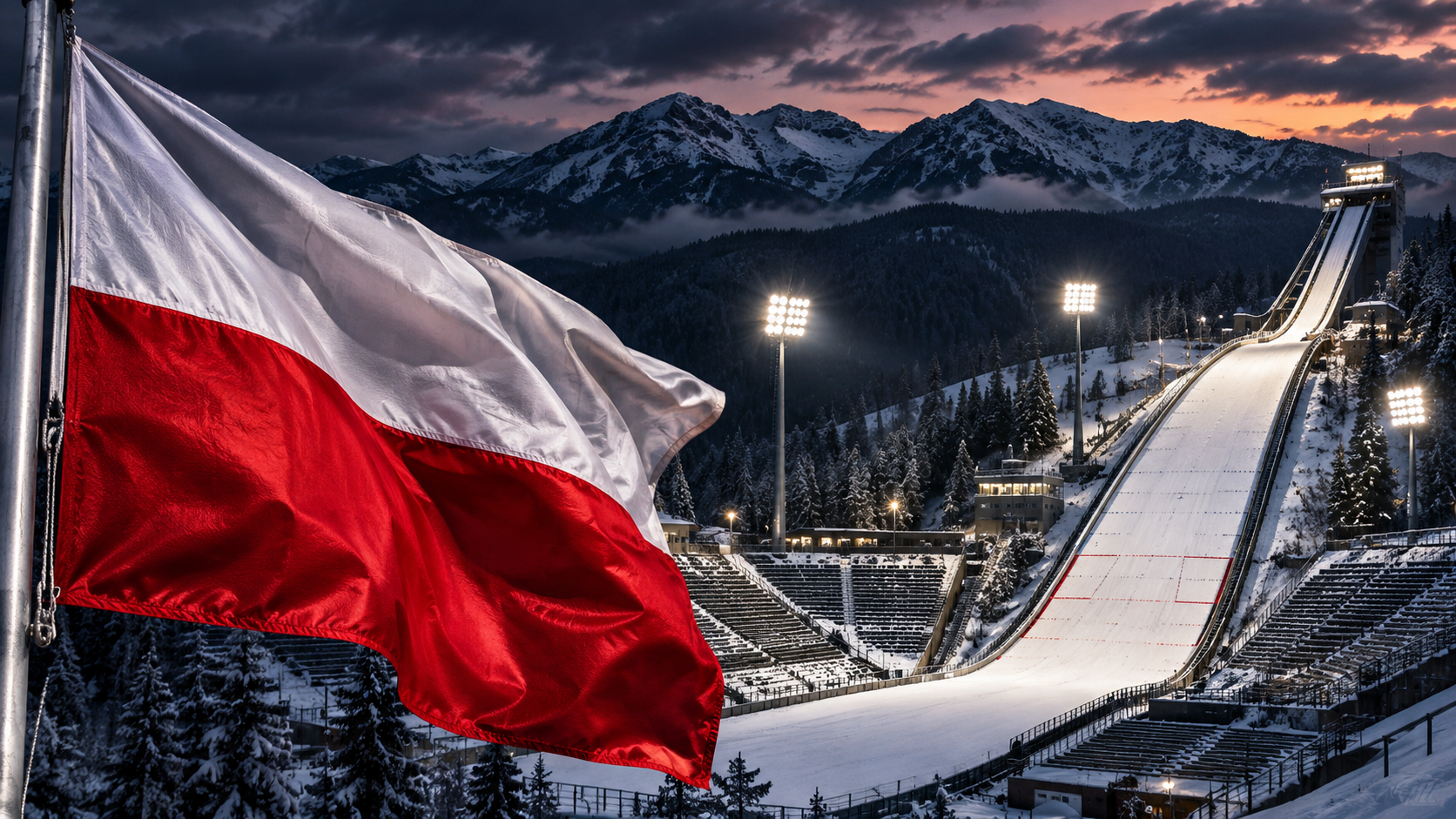
Wisła — Adam Małysz Ski Jumping Hill | 4–6 December 2026. Wisła will host men’s and women’s individual World Cup competitions, with training and qualifying activities included in the three-day programme.
Zakopane — Wielka Krokiew | 15–17 January 2027. The Zakopane meeting will feature the men’s World Cup circuit, including individual and team competition.
The dates are confirmed in the official FIS World Cup calendar for the 2026–27 season.
The World Cup season is scheduled to begin in Lillehammer, Norway, on 20 November.
Russian athletes approved as neutrals may be eligible for other FIS competitions, subject to the entry requirements and any additional restrictions imposed by the countries hosting them.
Russia’s return to international sport remains disputed
Restrictions on Russian and Belarusian athletes were introduced across numerous sports after Russia launched its full-scale invasion of Ukraine in February 2022.
Since then, international sporting organisations have taken different approaches to whether athletes from those countries should be permitted to return.
In August 2026, the International Olympic Committee provisionally lifted the suspension of the Russian Olympic Committee and withdrew some of its previous recommendations limiting Russian athletes’ participation.
The IOC’s published decision also maintained its condemnation of Russia’s invasion of Ukraine and confirmed that international federations retain discretion over their competitions.
FIS subsequently established the neutral-athlete arrangements governing its 2026–27 events.
The prospect of returning Russian competitors has nevertheless produced disagreement between sporting organisations, governments and sections of the sporting community.
Some argue that athletes should have opportunities to compete without being automatically excluded because of their nationality.
Others maintain that restrictions remain justified while Russia continues its war against Ukraine, particularly where questions arise over athletes’ political or military affiliations.
Poland has consistently supported Ukraine and maintained entry restrictions affecting Russian nationals.
In a separate case in October, Poland-24 reported that Polish authorities ordered 15 Russian and Belarusian nationals to leave following visa checks at an international karate event. That incident involved individual immigration proceedings and was not a decision by FIS.
Other European countries could face similar decisions
Poland is not the only country considering the implications of Russian athletes returning to international winter sports.
Sweden is also examining its approach to entry permission for Russian and Belarusian competitors ahead of the Nordic World Ski Championships scheduled for Falun in early 2027.
The Swedish government has not been reported as having made an equivalent final decision covering those championships.
The issue illustrates how different national entry policies could influence participation across an international sporting season, even when a single governing federation applies common eligibility rules.
For the upcoming World Cup meetings in Wisła and Zakopane, Poland’s stated position is unambiguous: approval to compete under neutral status does not qualify Russian ski jumpers for a Polish visa.
Unless the applicable rules or an individual athlete’s legal circumstances change, the existing restrictions will prevent participation on that basis.