

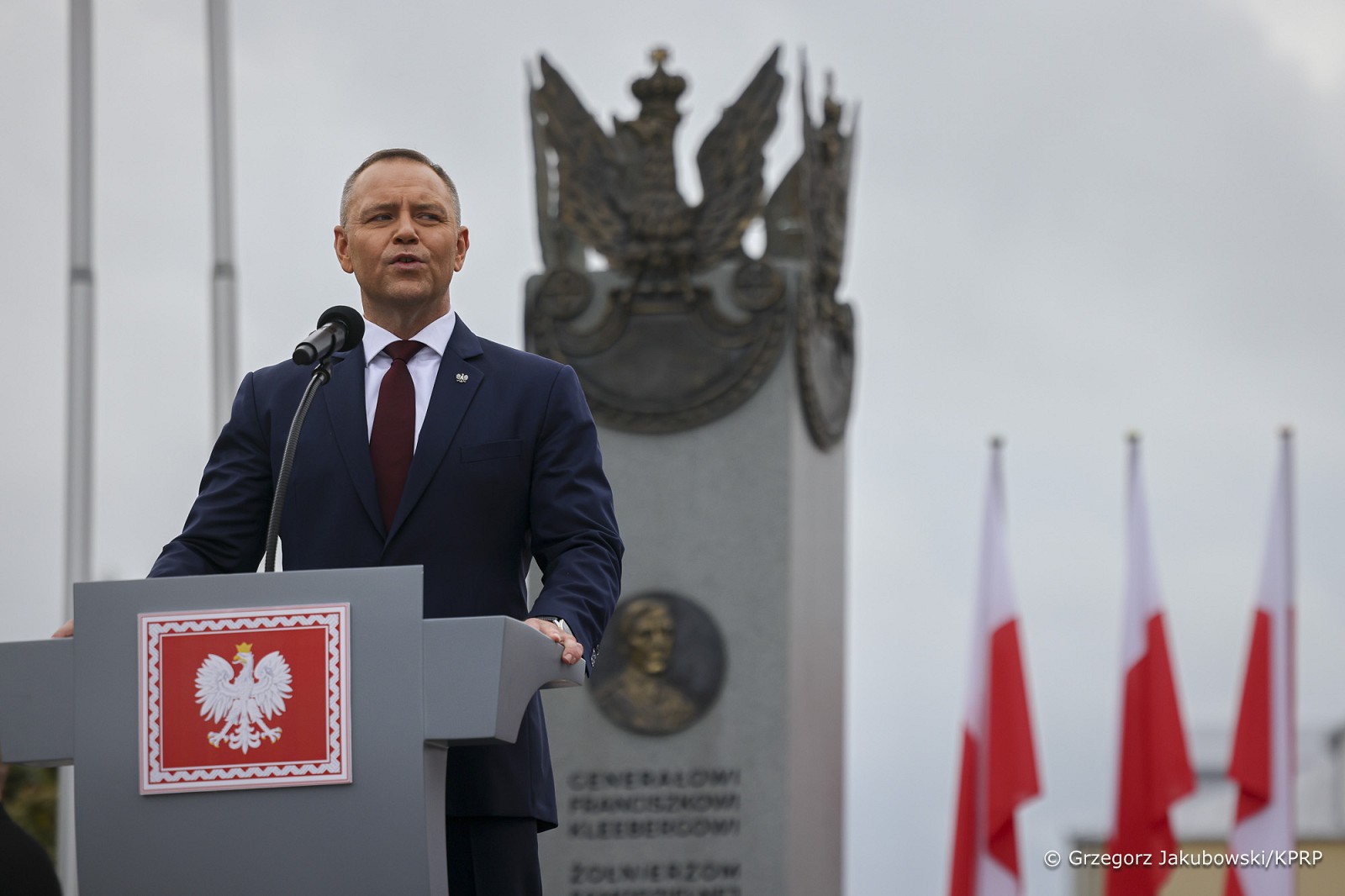
President Karol Nawrocki has used the anniversary of the Soviet invasion of Poland to deliver a sharply worded warning about modern Russia, telling a gathering in eastern Poland that Moscow’s imperial ambitions had survived changes of regime and that “Russia is not invincible”.
Speaking in Włodawa on Thursday during commemorations marking 87 years since the Soviet invasion of 17 September 1939, Nawrocki repeatedly linked the historical anniversary to Poland’s current security position on NATO’s eastern flank.
“Imperial Russia has for centuries threatened the independence and sovereignty of all the states of Central Europe,” the president said. He argued that people in Poland and across the region did not need to be taught about the Soviet or post-Soviet threat because the experience was embedded in their historical memory.
- Find more news from Poland on our Homepage .
Nawrocki said Russia had repeatedly combined military force with propaganda portraying domination as liberation.
“We have known this for centuries,” he said, adding that Russia had stood before neighbouring nations “with a weapon in one hand and a propaganda lie in the other”.
The president then moved from historical remembrance to a contemporary security message.
“Russia is not invincible,” Nawrocki said, recalling Poland’s victory over Bolshevik forces in 1920. “Empires begin to fall when nations stop being afraid of them.”
He expanded that argument by saying imperial powers lose their dominant position when countries are prepared to defend sovereignty and independence and when their allies remain united.
“Empires begin to fall when the world understands that no one will retreat from defending values, sovereignty and independence, and when the great powers are together in an alliance of great values,” he said.
‘When allies are together, empires lose their dominance’
Nawrocki explicitly linked that message to Poland’s current security policy.
He said one of his priorities as president was strengthening Poland’s position within NATO, deepening the strategic relationship with the United States and working towards a permanent US military presence in Poland.
“When nations are not afraid and when allies are together, then empires — even those with traditions as long as the Soviet or Russian empire — begin to lose their dominant position,” he said.
“And that is the direction of the Republic of Poland’s actions today.”
The choice of Włodawa for the remarks gave the speech an additional contemporary dimension.
The town lies close to the meeting point of the Polish, Ukrainian and Belarusian borders. Nawrocki described the geography around Włodawa as a snapshot of the region’s current political divide: a sovereign Poland, Ukraine fighting for its independence, and Belarus, which he characterised as dominated by Moscow and lacking full sovereignty.
“This border junction, Włodawa and the history of this town show that for centuries independent and sovereign states have constantly struggled with the same threat — the imperial attitude of Russia,” he said.
Nawrocki argued that, in his view, the political label attached to Russia had changed but the underlying behaviour had not.
He referred in succession to tsarist Russia, the Soviet Union and the Russia of Vladimir Putin, saying countries in the region were still confronting a power that described aggression as liberation and domination as justice.
That characterisation was the president’s political assessment rather than an independent historical or legal finding.
‘Here is Poland’
Nawrocki also directed part of his speech towards the Border Guard, thanking officers from the Nadbużański Border Guard unit for protecting Poland’s eastern frontier.
He said a state border was more than a line on a map.
“This is the place where we say: here is Poland, here are our rules, these are our values; we will defend this border, whatever happens,” he said.
The remark connected the wartime remembrance ceremony with current concerns over Poland’s eastern border, including the war in neighbouring Ukraine and Warsaw’s long-running security dispute with Belarus.
The president did not announce a new military or border policy during the Włodawa appearance. His speech was primarily commemorative and political, using the anniversary to set out his interpretation of the security lessons Poland should draw from its history.
From the invasion of 1939 to today’s security debate
Earlier in the speech, Nawrocki recalled the Soviet invasion itself in stark terms.
He said that after Nazi Germany attacked Poland from the west, the Soviet Union joined the assault from the east on 17 September 1939, leaving Poland facing two overwhelmingly stronger aggressors.
He described Adolf Hitler and Joseph Stalin as “two devils” whose common objective was for Poland to be “crushed, destroyed and erased from the map of Europe and the world”.
Nawrocki also used a formulation attributed to pre-war commander Edward Rydz-Śmigły, saying that while the Germans wanted to take Poland’s body, the Soviets wanted to take its soul.
“We may lose territory, but we will never lose our homeland,” he said.
The president took part earlier in a Roll Call of Remembrance at the War Cemetery of Polish Army Soldiers in Włodawa, where soldiers from September 1939 and members of the Border Protection Corps killed in the Battle of Wytyczno are buried. He also laid a wreath before meeting local residents.
The wider historical background to the Soviet invasion — including the Molotov-Ribbentrop Pact, subsequent occupation, deportations and Soviet repression — remains central to why 17 September is commemorated in Poland. Poland-24 covers that history separately in its dedicated explainer on the events of 17 September 1939.
Thursday’s political message from Włodawa, however, was focused firmly on the present.
For Nawrocki, the central lesson was that Russian power should be deterred through confidence, alliances and a willingness to defend national sovereignty — rather than treated as something inevitable or unbeatable.