


Poland can deploy more tanks and brigades than Germany, France and Britain combined, Foreign Minister Radosław Sikorski has said, pointing to the scale of Warsaw’s military expansion as Poland argues for a stronger role in European security decisions.
“We have more tanks and more brigades than Germany, France and Britain combined that we could deploy,” Sikorski said in remarks reported this week while discussing why Poland should be included in negotiations affecting Ukraine and European security.
- Find more news from Poland on our Homepage .
He said Poland now spends around $50 billion a year directly on defence, with the total higher once spending with both military and civilian applications is included. Sikorski argued that Poland’s geographical position, military strength and growing economic weight meant decisions about the future security architecture of Eastern Europe should not be made without Warsaw.
The statement closely echoes a point he made in an interview with Germany’s Der Spiegel in February.
At the time, Sikorski said Poland already possessed more tanks than Germany, France and Britain combined and that the gap was expected to widen further as new equipment entered service.
“Today Poland has more tanks than Germany, France and Britain put together — and in the coming years that lead will grow,” he said in the interview.
The comparison is significant because the three countries named by Sikorski have traditionally been regarded as Europe’s major Western military powers.
Poland, meanwhile, has embarked on one of the continent’s largest conventional rearmament programmes since Russia launched its full-scale invasion of Ukraine.
Poland’s tank fleet expands rapidly
The most visible part of that expansion is Poland’s armoured force.
Warsaw has bought large numbers of American M1 Abrams and South Korean K2 tanks while retaining substantial numbers of German-built Leopard 2s.
The first Polish contract for 180 K2 tanks was completed in 2025. A second agreement covers another 180, including K2PL variants due to be assembled partly in Poland.
By early September 2026, Poland had 208 K2 tanks in service or delivered, according to defence-industry reporting from the MSPO arms exhibition in Kielce.
Poland has also ordered a total of 366 Abrams tanks from the United States: 116 M1A1 vehicles and 250 of the newer M1A2 SEPv3 version.
At least 182 of the M1A2 SEPv3s had been delivered by early September, with the remainder expected by the end of the year, while all 116 M1A1s are already part of the Polish force.
Poland also continues to operate Leopard 2 tanks, including modernised Leopard 2PLs and Leopard 2A5s.
Taken together, the K2, Abrams and Leopard fleets amount to roughly 700-plus modern main battle tanks already available to Poland, with signed contracts pushing that total significantly higher as deliveries continue. One current defence-industry assessment put the operational or delivered figure at about 739 tanks in early September and said existing contracts could take the total close to 960.
Foreign Minister Sikorski: “Today Poland has more tanks than Germany, France and Britain put together — and in the coming years that lead will grow."
— Poland 24 🇵🇱 (@poland24com) September 17, 2026
Sikorski argued that Poland’s geographical position, military strength and growing economic weight meant decisions about the… pic.twitter.com/x1IpGSHdmC
Those figures depend on whether tanks undergoing modernisation, recently delivered vehicles and equipment not yet assigned to operational units are counted, so headline fleet numbers should not be treated as identical to immediately deployable combat strength.
Sikorski’s formulation is therefore important: he referred not simply to inventory totals, but to tanks and brigades Poland “could deploy”.
From buyer to major European land power
Poland’s build-up goes well beyond tanks.


Warsaw is simultaneously acquiring F-35 fighter aircraft, AH-64E Apache attack helicopters, Patriot air-defence systems, HIMARS rocket launchers and other equipment intended to create a larger combined-arms force on NATO’s eastern flank.
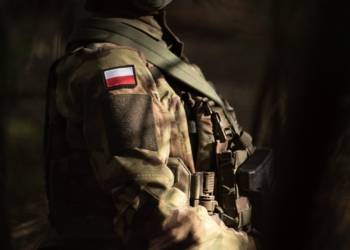
The government has also expanded the size of the armed forces and is building new formations, particularly in eastern Poland.
Sikorski’s comparison with Germany, France and Britain is intended to underline a broader political argument: military influence inside Europe should increasingly reflect the capabilities of countries on NATO’s eastern flank rather than being concentrated primarily in Western Europe.
In February, he argued that Europe should “breathe with two lungs” — western and eastern — and said Poland wanted to represent the interests of Central and Eastern European states more forcefully.
He has also supported greater use of the E5 format bringing together Poland, Germany, France, Italy and Britain on European security questions.
His latest comments come as Poland presses to be directly involved in discussions over the future of Ukraine.
Sikorski has argued that Poland would be immediately affected by any peace settlement because of its border with Ukraine, its role as a major logistics hub and its position on NATO’s eastern flank.
Defence spending among NATO’s highest
The expansion has been backed by exceptionally high levels of defence expenditure.
The Polish foreign ministry said this month that defence spending amounts to around 4.8% of GDP, placing Poland among NATO’s biggest military spenders relative to the size of its economy.
That level is well above NATO’s long-standing 2% benchmark and reflects successive governments’ decision to accelerate rearmament following Russia’s invasion of Ukraine.
The scale of purchases also means Poland faces substantial challenges involving personnel, maintenance, ammunition, logistics and the integration of several different types of equipment.
Operating Abrams, K2 and Leopard tanks simultaneously, for example, creates separate supply chains and training requirements.
Tank numbers alone are therefore not a complete measure of battlefield capability.
Modern armoured formations also require trained crews, artillery, air defence, drones, engineers, electronic warfare systems, secure communications and reliable logistics.
Nonetheless, the number of heavy armoured vehicles being assembled in Poland represents a major shift in European conventional military power.
Poland’s role on NATO’s eastern flank
The build-up has particular significance because Poland borders both Belarus and Russia’s Kaliningrad exclave and sits on the principal land routes linking the rest of NATO with Lithuania, Latvia and Estonia.
Polish armoured formations are increasingly concentrated in the country’s east, including units equipped with Abrams and K2 tanks.
Sikorski has recently argued that NATO should make greater use of that military weight, including through more intensive exercises close to Kaliningrad. Speaking at the Yalta European Strategy conference in Kyiv, he suggested such drills could force Russia to keep more forces near NATO territory rather than deploying them in Ukraine.
Poland has also continued to describe Russia as its principal military threat.
During a visit to Latvia earlier this month, Sikorski said Poland and Latvia faced similar challenges from Russian airspace violations, migration pressure and sabotage, while noting that both countries were among NATO’s leaders in defence spending.
His latest comparison with Western Europe therefore forms part of a wider argument about Poland’s changing position inside NATO.
Warsaw is no longer presenting itself simply as a frontline country requiring reinforcement from larger Western allies.
Increasingly, Polish officials are arguing that Poland itself has become one of Europe’s principal sources of deployable conventional land power.