

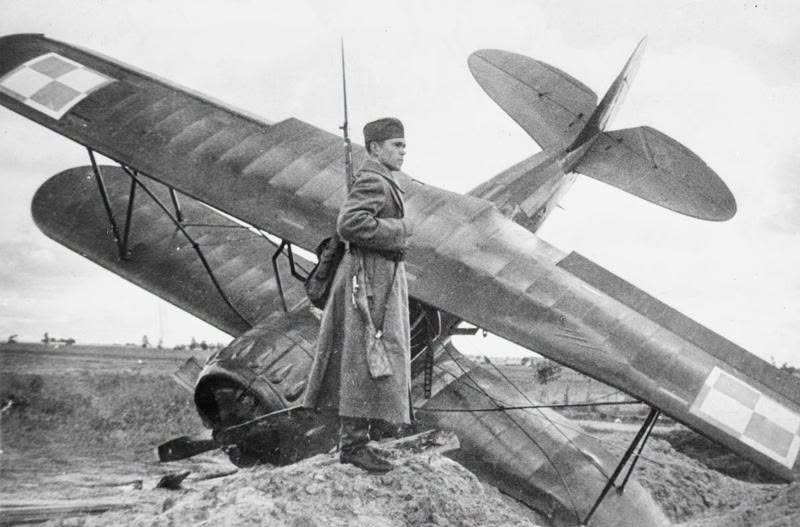
On 17 September 1939, hundreds of thousands of Red Army troops crossed Poland’s eastern frontier.
Poland was already fighting for its survival. Nazi Germany had invaded from the west sixteen days earlier, launching the war in Europe that would become the Second World War.
The Soviet attack opened a second front against the Polish state and sealed the military defeat of the Second Polish Republic. But its consequences went far beyond the battlefield.
- Find more news from Poland on our Homepage .
Eastern Poland was occupied and annexed by the Soviet Union. Hundreds of thousands of Polish citizens would experience arrest, imprisonment, deportation or other forms of Soviet repression. Thousands of Polish officers and members of the country’s pre-war elite would later be murdered by the Soviet secret police, including in the Katyń massacres.
For decades afterwards, the story of 17 September was also politically difficult to discuss openly inside communist Poland.
Understanding what happened that morning requires going back less than a month — to an agreement between Adolf Hitler’s Germany and Joseph Stalin’s Soviet Union.
The Molotov-Ribbentrop Pact and the secret plan for Poland
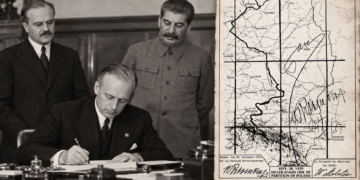
On 23 August 1939, Nazi Germany and the Soviet Union signed a non-aggression treaty in Moscow.
Named after German foreign minister Joachim von Ribbentrop and Soviet foreign minister Vyacheslav Molotov, the Molotov-Ribbentrop Pact publicly committed the two powers not to attack one another.
But attached to it was a secret protocol dividing parts of Eastern Europe into German and Soviet spheres of influence.
Poland was among the countries affected. The initial protocol envisaged the division of Polish territory along the Narew, Vistula and San rivers, although the eventual German-Soviet boundary was subsequently altered.
The agreement gave Hitler greater freedom to attack Poland without fearing immediate Soviet military intervention against Germany. On 1 September 1939, German forces invaded Poland from the west, north and south.
Britain and France declared war on Germany on 3 September.
The Soviet Union initially remained outside the fighting. That changed before dawn on 17 September.
Why did the Soviet Union invade Poland?
Shortly before Soviet troops crossed the border, Polish ambassador Wacław Grzybowski was summoned to the Soviet foreign ministry in Moscow.
He was presented with a note claiming that the Polish state and government had effectively ceased to exist and that the Soviet Union therefore needed to protect Ukrainians and Belarusians living in eastern Poland.
Grzybowski refused to accept it.
The argument that Poland had ceased to exist was false. The Polish government was still functioning, Polish forces were continuing to fight and Warsaw itself did not surrender to German forces until 28 September.
The Soviet Union did not formally declare war.
Its invasion nevertheless implemented the territorial arrangements agreed with Nazi Germany weeks earlier. It also violated the existing Polish-Soviet non-aggression agreement.
An estimated 600,000 to 650,000 Soviet troops participated in the invasion, supported by thousands of tanks and armoured vehicles.
Poland caught between Germany and the Soviet Union
The Polish military was already under immense pressure by 17 September.
Many formations had suffered heavy losses against the Germans, while Polish commanders were attempting to reorganise forces in the south-east of the country and maintain routes towards Romania and Hungary.
The Soviet attack made prolonged organised resistance dramatically more difficult.
Polish commander-in-chief Marshal Edward Rydz-Śmigły ordered troops generally not to engage Soviet forces unless they attacked or attempted to disarm Polish units, while directing soldiers towards Romania and Hungary where possible.
There was nevertheless significant fighting.
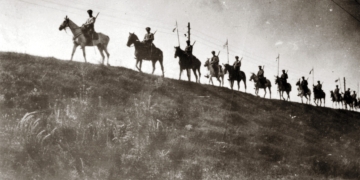
Polish forces resisted Soviet troops at several locations, including Grodno — today Hrodna in Belarus — where soldiers and civilian volunteers fought the Red Army for several days.
Units of Poland’s Border Protection Corps, known by its Polish abbreviation KOP, also fought Soviet forces in the eastern borderlands.
Meanwhile, German and Soviet armies advanced towards one another across Polish territory.
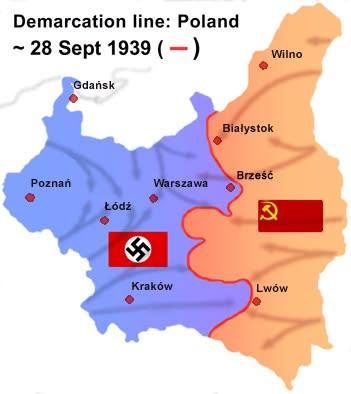
On 28 September 1939, Germany and the Soviet Union signed the German-Soviet Boundary and Friendship Treaty, revising the division of occupied Poland between them.
For the Polish state, conventional military defeat soon followed.
But Poland did not simply cease to exist politically. Its government continued in exile, first in France and later in Britain, while an underground state and resistance structures developed inside occupied Poland.
What happened in Soviet-occupied eastern Poland?
The territory occupied by the Soviet Union had formed the eastern part of the Second Polish Republic, the Polish state that existed between the two world wars.
These lands were ethnically, linguistically and religiously diverse. They were home to Poles, Ukrainians, Belarusians, Jews and other communities.
Many of the cities involved no longer lie within Poland’s modern borders.
Lwów, for example, is today Lviv in Ukraine. Wilno is modern Vilnius, the capital of Lithuania. Much of the remaining territory seized by the Soviet Union in 1939 is now in Belarus and Ukraine.
Soviet authorities incorporated the occupied territories into the Soviet Union and began dismantling the institutions of the pre-war Polish state.
Arrests targeted military officers, police, state officials, political figures, landowners, members of the intelligentsia and others regarded by the authorities as actual or potential opponents.
Mass deportations followed.
Between 1940 and 1941, Soviet authorities carried out several large deportation operations in which Polish citizens were transported to remote regions of the USSR, including Siberia, Kazakhstan and northern parts of the Soviet Union.
Conditions varied, but deportees could face overcrowded transport, forced labour, hunger, disease and extreme climates.
Exact totals remain debated because historians have used different records and definitions when calculating deportations and wider Soviet repression. For that reason, responsible estimates should be treated as ranges rather than as a single undisputed figure.
From the invasion to the Katyń massacre
One of the most consequential outcomes of the Soviet invasion was the capture of large numbers of Polish military personnel and other representatives of the Polish state.
In spring 1940, the Soviet NKVD secret police executed almost 22,000 Polish officers, policemen, officials and other prisoners and detainees.
The killings took place at several sites.
Katyń Forest near Smolensk became the best-known and gave its name to the wider crime, but executions were also carried out elsewhere, including at Kalinin — now Tver — and Kharkiv.
When German forces discovered mass graves at Katyń in 1943, the Soviet Union denied responsibility and blamed Nazi Germany.
Moscow did not formally acknowledge Soviet responsibility until 1990.
Katyń therefore became important in Polish historical memory for two reasons: as a mass killing of members of the country’s pre-war elite and as an example of a historical truth that communist authorities attempted to suppress for decades.
What happened to the Soviet occupation after 1941?
The German-Soviet partnership did not last.
On 22 June 1941, Nazi Germany launched Operation Barbarossa and invaded the Soviet Union.
German troops rapidly occupied territories in eastern Poland that had been under Soviet control since 1939.
The geopolitical relationship changed almost overnight.
The Polish government-in-exile and the Soviet Union temporarily restored diplomatic relations, and Polish forces began forming in the USSR under General Władysław Anders.
Relations deteriorated again and were broken in 1943 after the Germans announced the discovery of the mass graves at Katyń and the Polish government called for an international investigation.
By the end of the Second World War, the Soviet Union had again taken control of Poland’s pre-war eastern territories.
Poland’s borders shifted westwards. Cities that had been part of interwar Poland, including Lwów and Wilno, became part of Soviet Ukraine and Soviet Lithuania respectively, while Poland acquired former German territory in the west and north.
Why was 17 September difficult to discuss in communist Poland?
After the war, Poland became a communist state within the Soviet sphere of influence.
The official historical narrative emphasised the Soviet Union’s role in defeating Nazi Germany and bringing the war to an end.
That made some aspects of the events of 1939 politically sensitive.
The secret protocol to the Molotov-Ribbentrop Pact, the character of the Soviet invasion, the Katyń massacre and the experiences of many deportees could not be discussed freely in the way they could after the collapse of communist rule.
Families nevertheless preserved their own memories of arrest, exile, disappearance and deportation.
The subject returned openly to public life as communist rule ended in 1989 and archival research expanded.
Why 17 September 1939 remains important in Polish history
The German invasion of 1 September and the Soviet invasion of 17 September are distinct events, but together they explain the destruction of the Second Polish Republic in 1939.
The first began the war in Poland. The second placed the country between two invading powers that had already secretly discussed the division of its territory.
The Soviet invasion also began a separate history of occupation and repression that affected hundreds of thousands of Polish citizens and reshaped the eastern half of the country.
Its consequences can still be seen on a modern map.
Cities once inside Poland are today in Lithuania, Belarus and Ukraine. Families were scattered across borders and continents. Memories suppressed during the communist period later returned to public discussion.
In Poland, 17 September is also observed as World Sybirak Day, commemorating people deported to Siberia and other parts of the Russian Empire and Soviet Union.
More than eight decades after Red Army troops crossed the border, 17 September 1939 remains one of the essential dates for understanding Poland’s experience of the Second World War — not because it was simply a second invasion, but because of the occupation, deportations, executions, territorial changes and contested memory that followed.