

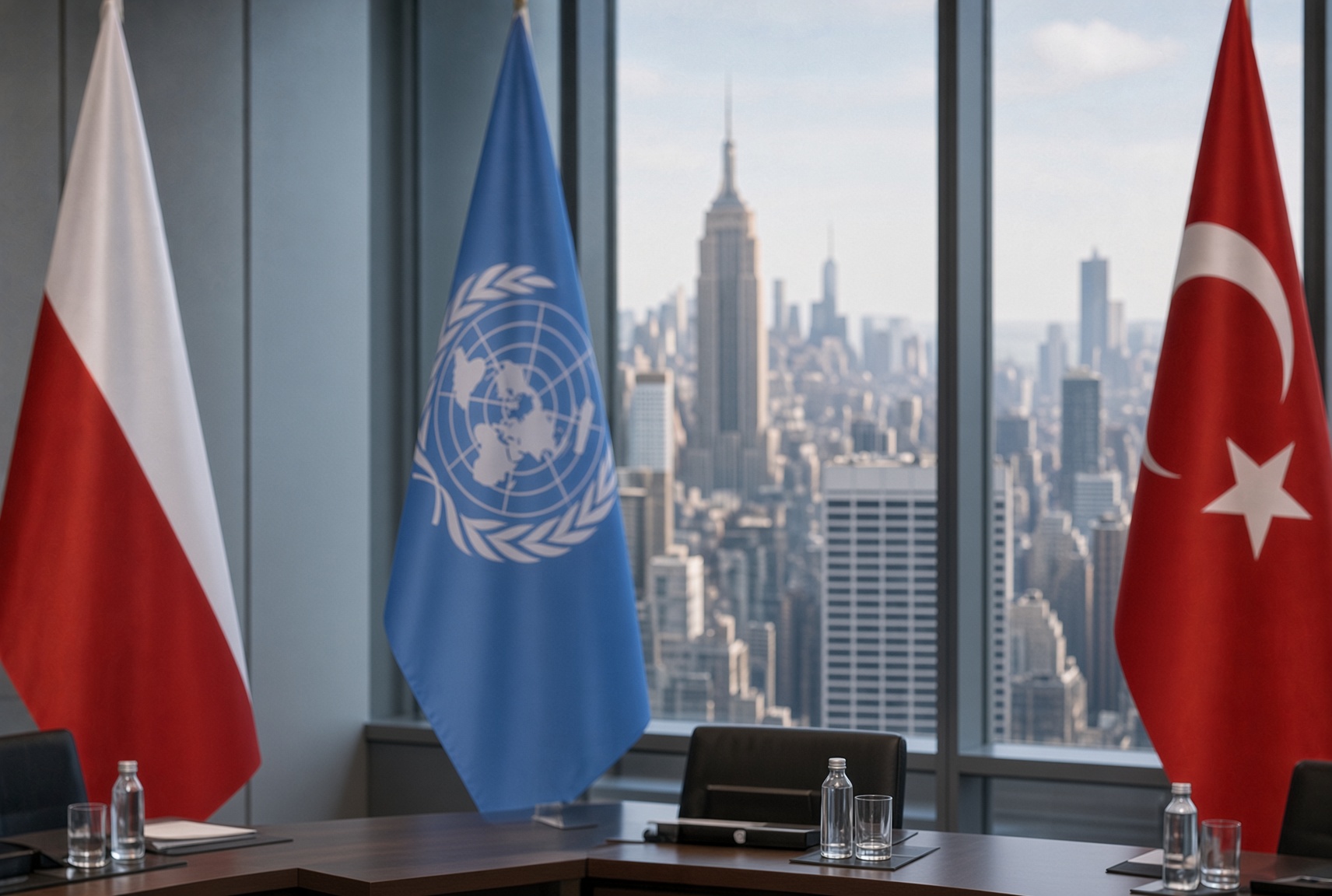
Polish President Karol Nawrocki is expected to meet Turkish President Recep Tayyip Erdoğan in New York, adding another high-level NATO security discussion to a United Nations visit already dominated by concerns over Russia, air defence and the future of Europe’s eastern flank.
The meeting was first reported on Sunday by Interia, citing people from Nawrocki’s entourage. According to the report, the two presidents are expected to discuss security during the 81st session of the UN General Assembly.
The Erdoğan meeting was not included in the Polish presidency’s original public schedule for Nawrocki’s 19–23 September visit. As of Sunday morning, the official programme listed meetings with Baltic leaders, the chair of the African Union, Kuwait’s crown prince and attendance at a reception hosted by US President Donald Trump, but did not name Erdoğan.
- Find more news from Poland on our Homepage .
That means the meeting should for now be treated as a reported addition to the diplomatic programme rather than a formally announced bilateral engagement.
If it goes ahead, however, it would fit closely with the central theme of Nawrocki’s visit: how Poland positions itself within NATO as Russian military activity intensifies close to the alliance’s borders.
Poland and Turkey meet again after a busy summer
A New York meeting would continue a period of unusually frequent contact between Nawrocki and Erdoğan.
The Polish president travelled to Ankara in June for an official visit and met Erdoğan for talks covering NATO, European security, bilateral trade and defence cooperation. Nawrocki described Turkey at the time as one of Poland’s most important partners and a “proven ally in NATO”, with particular importance for security in the Black Sea region.
The two countries then met again around the NATO summit in Ankara in July, where Poland’s priorities included strengthening transatlantic relations, increasing European defence spending and treating Russia as a direct security threat.
That existing relationship makes Erdoğan a particularly relevant counterpart during Nawrocki’s New York visit.
Poland sits on NATO’s northeastern flank bordering Belarus and Russia’s Kaliningrad region, while Turkey controls access between the Black Sea and Mediterranean and has maintained working relations with both Ukraine and Russia.
The two countries therefore approach the war from different geographical and diplomatic positions while remaining important military powers inside the same alliance.
Security is already at the centre of Nawrocki’s US visit
The Erdoğan meeting would come at a time when Poland is placing increasingly heavy emphasis on military preparedness and NATO credibility.
Before flying to New York, Nawrocki engaged in Poland’s security discussions with Defence Minister Władysław Kosiniak-Kamysz and Chief of the General Staff Gen Wiesław Kukuła concerning the current security situation, recent incidents near Poland’s border, and NATO planning.
The presidency has said the US visit will focus particularly on security in Central and Eastern Europe, alongside the Middle East and energy-market instability.
That agenda has become more urgent after a succession of Russian missile and drone attacks on western Ukraine prompted repeated Polish military alerts.
Polish fighter aircraft have been scrambled several times, while radar and ground-based air-defence systems have been placed on heightened readiness.
Prime Minister Donald Tusk has also warned publicly that allied intelligence points to a risk of Russia using drones or missiles against countries supporting Ukraine while attempting to present such incidents as accidental.
Why Erdoğan matters to Poland
Turkey occupies a distinct position within NATO.
It has one of the alliance’s largest armed forces, a rapidly expanding defence industry and strategic control over the Turkish Straits linking the Black Sea with the Mediterranean.
It has also maintained diplomatic and economic channels with Moscow while simultaneously supporting Ukraine and selling military equipment to Kyiv.

For Poland, that makes Ankara relevant on several fronts: Black Sea security, NATO force posture, Ukraine, air defence and defence-industrial cooperation.
During Nawrocki’s June visit, both sides discussed moving beyond a simple buyer-seller relationship between their defence industries and towards deeper industrial cooperation.
Nawrocki also visited Turkish defence electronics group Aselsan during that trip, underlining Warsaw’s interest in Turkey’s military-industrial capabilities.
Poland and Turkey also cooperate directly within NATO military structures.
In June, Nawrocki extended the deployment of up to 95 Polish personnel serving under NATO measures supporting Turkey, including operations in Turkish territory, the eastern Mediterranean and the Black Sea.
That gives the relationship an operational military dimension beyond diplomatic contacts.
A wider NATO conversation in New York
Erdoğan would join a growing list of leaders with whom Nawrocki is expected to discuss security during UN week.
The presidency has already confirmed planned talks with the presidents of Lithuania, Latvia and Estonia — Poland’s closest partners on NATO’s northeastern flank.
Those four countries share many of the same concerns: Russian military pressure, air defence gaps, drone incursions and the need for stronger allied infrastructure.
Nawrocki is also expected to attend the annual reception hosted by Trump.
The Polish presidency has said it hopes that event will provide an opportunity for at least a brief conversation between the two leaders, although no formal bilateral meeting has been announced.
That matters because Trump said last week that “major progress” had been made towards establishing a permanent US Army base in Poland and credited Nawrocki’s “bold leadership”. No final basing agreement has been announced.
The result is an unusually security-heavy UN week for the Polish president.
Poland’s UN week is becoming a network of security talks
Nawrocki’s visit was initially framed around the UN General Assembly, meetings with the Polish diaspora and a Polish-American economic summit.
It is increasingly looking like a series of overlapping bilateral security consultations.
The official programme already includes leaders from the Baltic region and the Middle East, while the reported Erdoğan meeting would add one of NATO’s most militarily significant members.
Interia reported that security will be the subject of the Nawrocki-Erdoğan discussion.
The precise agenda has not yet been published, and the Polish presidency had not formally added the meeting to its public programme as of Sunday morning.
But the broader context is clear.
Nawrocki arrives at the UN at a moment when Poland is seeking stronger NATO deterrence, a larger American military footprint and closer coordination with states that can influence security both on the alliance’s eastern flank and around the Black Sea.
A meeting with Erdoğan would connect all three.