

Something has changed in the way the international travel press talks about Poland.
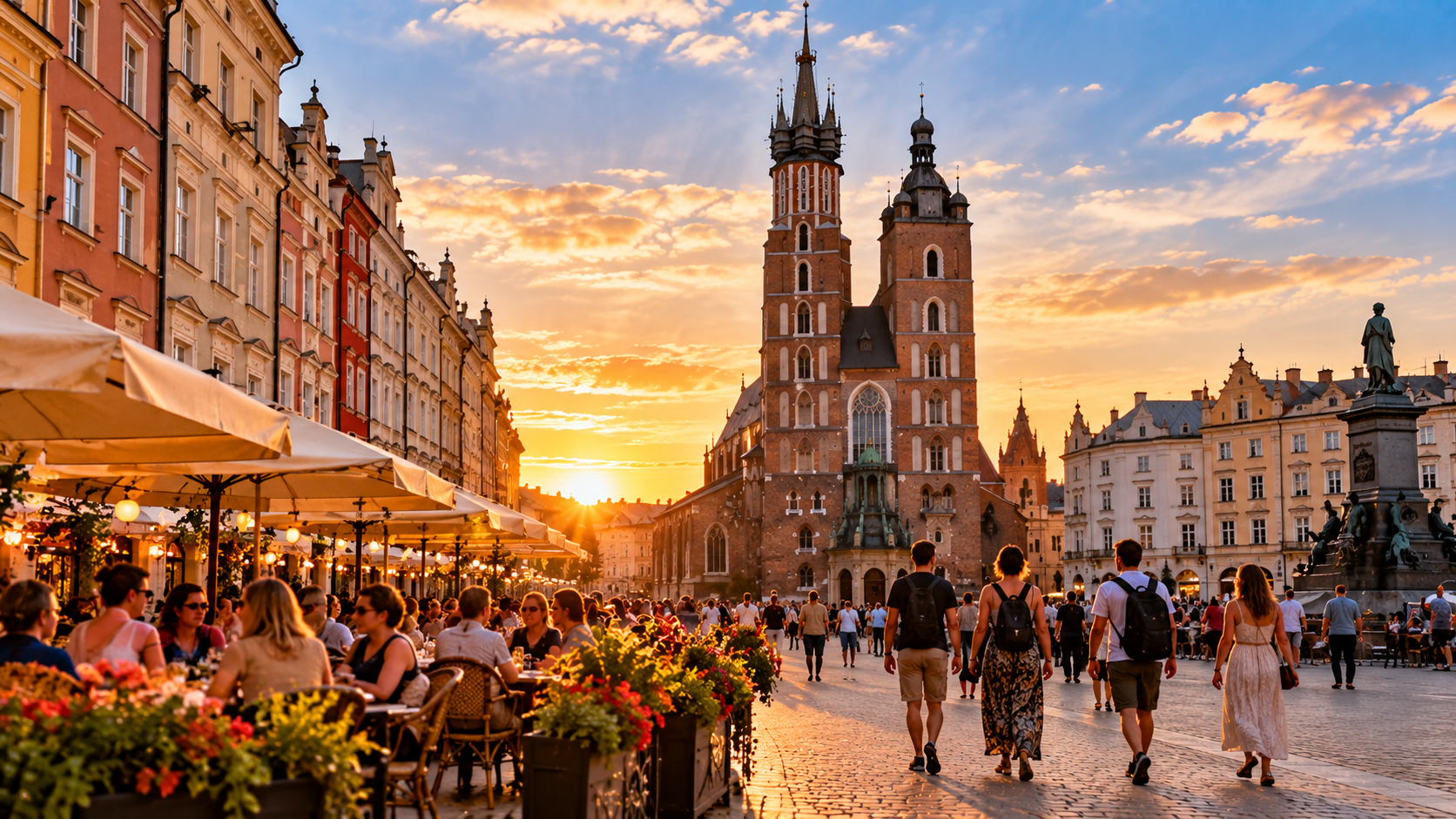
For years, foreign travel coverage of the country tended to revolve around a familiar circuit: Kraków, Warsaw, Auschwitz-Birkenau and perhaps Gdańsk. Those places remain important, but look at what major publications have been writing recently and a much broader Poland is emerging.
The Telegraph has called it “Europe’s vibrant all-rounder” and declared: “There’s never been a better time to visit Poland.” National Geographic has sent summer travellers to Sopot. The BBC has presented the Polish Tatras as an affordable rival to the Alps. The Independent has discovered luxury in Łódź. Le Figaro now describes Poland as “une destination incontournable d’Europe” — an essential European destination. And The New York Times has placed a changing Warsaw near the very top of its global travel agenda.
- Find more news from Poland on our Homepage .
Taken separately, they are travel stories. Taken together, they point to something more interesting: international travellers are beginning to notice that Poland is not one destination at all.
And the numbers suggest that the enthusiasm is not confined to newspaper travel desks. Poland’s tourism ministry says 2025 brought 21.4 million foreign tourists, around 9% more than a year earlier. From January to April 2026, the number of foreign tourists using registered accommodation rose another 12.2% year on year.
The Telegraph: Poland has become an ‘all-rounder’
Perhaps the clearest expression of the changing mood came from The Telegraph.
Its 2026 guide described Poland as “Europe’s vibrant all-rounder”, highlighting not one star attraction but the unusual range available within the same country: historic cities, mountains, affordable skiing and Baltic beaches.
That description gets to the heart of Poland’s emerging advantage.
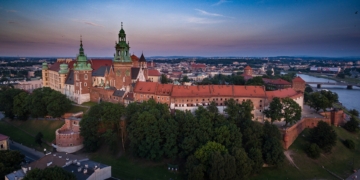
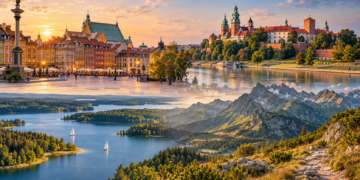
A traveller can spend a weekend among Kraków’s medieval streets, explore Warsaw’s increasingly contemporary centre, head north to Gdańsk and the Baltic or south into genuinely alpine terrain without crossing a national border.
And the newspaper’s emphasis on value is not simply a traveller’s impression. Eurostat calculated Poland’s overall household consumer price level in 2025 at 73% of the EU average, the third-lowest level in the bloc. That does not mean every hotel or restaurant is cheap, particularly in the most popular destinations, but it helps explain why visitors from more expensive Western and Northern European countries can still encounter a striking difference in what their money buys.
See why The Telegraph believes there has “never been a better time” to visit Poland — and why it calls the country Europe’s “vibrant all-rounder” here.
National Geographic: the Baltic becomes a summer advantage
National Geographic Traveller approached Poland from another direction: climate.
In an article about the rise of the European “coolcation”, it selected Sopot as one of six destinations for travellers looking beyond increasingly hot traditional summer resorts.
Its description is simple but revealing: Sopot offers “long stretches of golden sand with a cooler summer climate.”
For anyone accustomed to thinking of a European beach holiday as Spain, Greece or Italy, that might still sound unexpected. Yet Sopot has been a resort since the 19th century. Its official tourism organisation traces its spa development to 1823, while its 511.5-metre wooden pier is described by the city as the longest of its kind in Europe.
Climate change may now be making that geography more attractive rather than less. National Geographic noted a growing appetite for cooler-weather holidays in which walking, cycling and exploring remain comfortable during summer.
In that context, Poland’s Baltic coast stops looking like an eccentric substitute for the Mediterranean and begins looking like an increasingly logical alternative.
Explore why National Geographic sees Sopot and Poland’s Baltic coast as a perfect fit for Europe’s growing “coolcation” trend here.
BBC: Alpine landscapes without Alpine prices
Then there are the mountains.
The BBC’s August 2026 feature on the Tatras opened with a combination that tourism boards spend fortunes trying to communicate: “Breathtaking alpine scenery and budget prices.” It went on to describe the region as one of Europe’s most affordable hiking areas.
The scenery part of that argument does not require much embellishment.
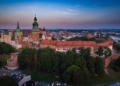
UNESCO describes the Tatras as the highest range in the Carpathians, with alpine meadows, glacial lakes, rocky peaks, waterfalls, canyons and extensive karst landscapes. The Polish side forms part of a transboundary biosphere reserve shared with Slovakia.
The BBC reporter travelled without a hire car, using local minibuses and taxis between Zakopane and the trailheads, and contrasted the costs directly with better-known Alpine destinations.
That combination matters. Poland is not simply being praised because it is cheaper. The more interesting proposition is that landscapes which can compete visually with much more famous European mountain regions remain comparatively accessible financially.
Take a closer look at the BBC’s case for Poland’s Tatra Mountains as an affordable alternative to the Alps here.
The Independent: Łódź proves the story is bigger than Kraków
The changing perception becomes even clearer in Łódź.
When The Independent‘s travel writers chose their favourite trips of 2024, Simon Calder selected a city that not long ago would have been a difficult sell to many foreign holidaymakers.
His verdict on the wider country was memorable: “Poland is the land of luxury for less.” He also singled out the restored Grand Hotel and the city’s transformed industrial heritage.
Łódź is important to this story precisely because it is not Kraków.
Its attraction is built partly around reuse rather than preservation in place. Manufaktura occupies Izrael Poznański’s former textile complex, where extensive restoration turned historic factories into museums, restaurants, shops and public spaces. The city’s tourism authority describes it as Poland’s first industrial-space revitalisation project on such a scale.
When international travel writers begin recommending Łódź, they are no longer simply discovering Poland’s established attractions. They are responding to the transformation of places that once sat well outside the standard international itinerary.
Discover why The Independent singled out Łódź — and found what it called Poland’s “luxury for less” — in our closer look here.
Le Figaro: history, but not trapped in history
French newspaper Le Figaro goes broader still.
Its Poland travel guide describes the country as “une destination incontournable d’Europe” and presents a journey stretching from Warsaw and Kraków to the Baltic, Carpathians and the lakes of Warmia and Masuria.
The language is enthusiastic, but its most interesting observation concerns the balance between history and contemporary life.
Warsaw’s reconstruction, Kraków’s monuments, Łódź’s industrial architecture and Poland’s complicated 20th-century history provide extraordinary depth. But today’s strongest travel story is not a country preserved as a museum.
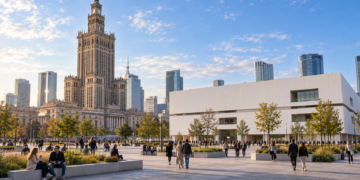
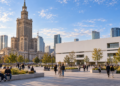
Warsaw alone demonstrates the point. Its new Museum of Modern Art opened beside the Palace of Culture and Science in October 2024, while Plac Centralny opened in June 2025 after a section of the formerly concrete-dominated Plac Defilad was redesigned with trees, planting and pedestrian space.
Poland’s history has not disappeared. What has changed is what travellers find alongside it.
Read how Le Figaro presents Poland as an essential European destination, from its historic cities to the Baltic, lakes and mountains, here.
The New York Times: Warsaw ‘demands to be seen anew’
No publication captured that transformation more directly than The New York Times.
Warsaw was placed second on the newspaper’s 52 Places to Go in 2026 list. Revisiting the city during the year, the Times highlighted its Museum of Modern Art, transformed central public space and increasingly international electronic-music scene.
Its original assessment was sharper still:
“For decades, the Polish capital has been seen as pragmatic rather than magnetic. In 2026, it demands to be seen anew.”
That may also be a useful description of the wider country.
What stands out across these articles is not that six publications all discovered the same beautiful square or mountain. It is that they are praising entirely different versions of Poland.
National Geographic found a Baltic summer resort. The BBC found serious mountain country. The Independent found reinvention and affordable luxury in Łódź. Le Figaro found historic cities, lakes and landscapes. The Telegraph saw a country with enough variety to be an all-round European destination. And The New York Times saw a capital whose identity is visibly changing.
That diversity is why the current attention feels more significant than another flattering travel ranking.
Poland is no longer being presented merely as somewhere worth visiting instead of a more famous European destination because it costs less.
Increasingly, it is being presented as somewhere worth visiting because of what is already there.
And judging by both the international headlines and the rising number of people arriving to see it for themselves, the rest of Europe is catching on.