

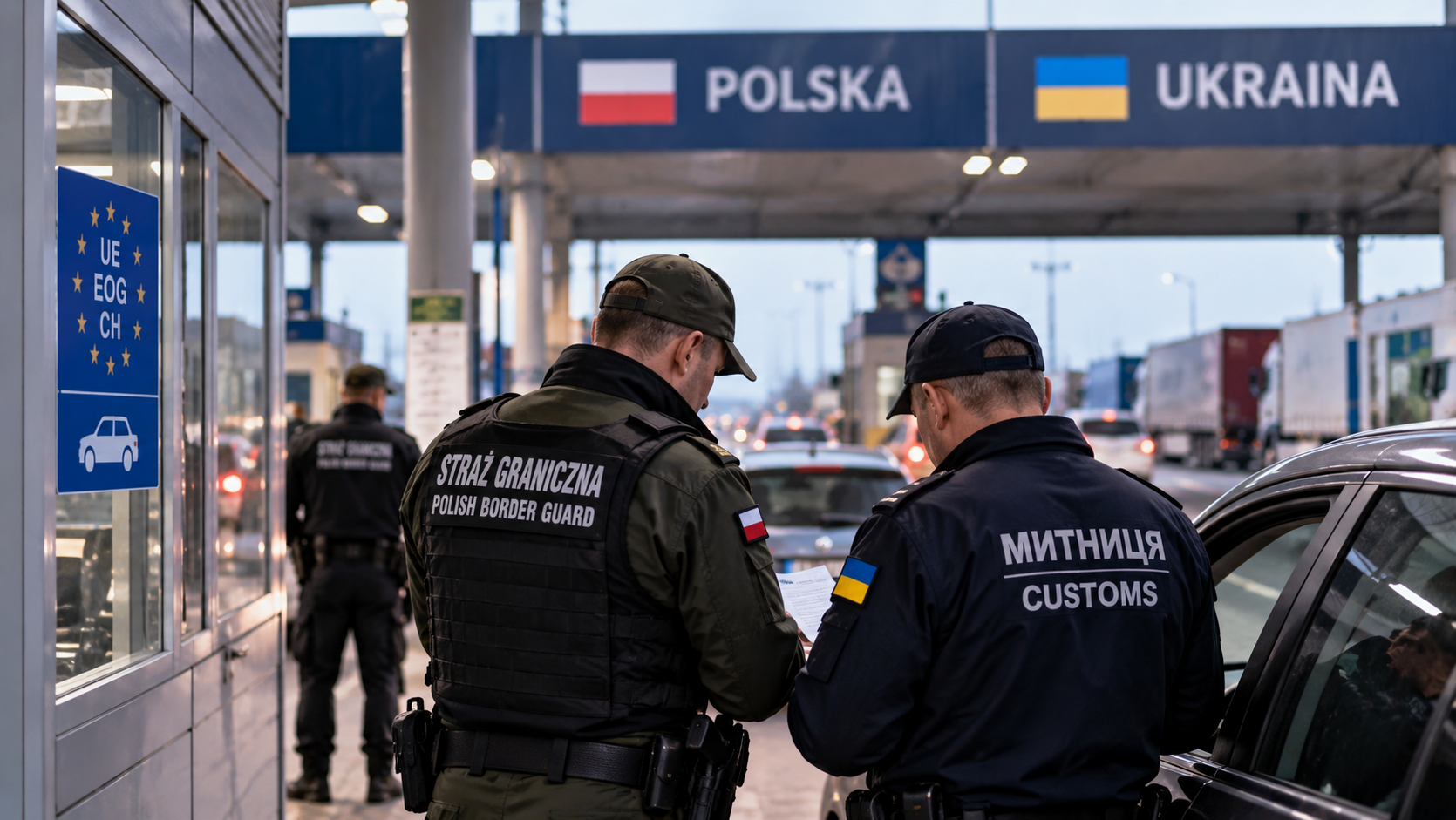
Poland and Ukraine are working on a bilateral agreement that could allow Ukrainian border guards and customs officers to carry out controls on Polish territory, a potentially significant change intended to make their shared border more efficient and more resilient to Russian attacks on Ukrainian frontier infrastructure.
The proposal was discussed during a Polish-Ukrainian meeting at the Yahodyn-Dorohusk crossing, one of the main road connections between the two countries.
Representatives included Polish regional authorities, the interior and finance ministries and the border and customs services of both countries. The talks focused on maintaining the security and stable operation of the frontier as Russian strikes increasingly affect areas close to Ukraine’s western borders.
- Find more news from Poland on our Homepage .
A central part of the discussions was an agreement governing joint border and customs controls.
Under that model, Polish and Ukrainian services conduct their respective checks at the same location rather than travellers and vehicles completing separate procedures at facilities on both sides of the frontier.
Ukraine’s ministry says forms of joint control are already used at five crossings on the Polish-Ukrainian border, while a similar system operates between Ukraine and Moldova.
What the proposed agreement would add is a clearer bilateral legal basis for Ukrainian officers to perform their official duties inside Poland.
In a ministry statement reported by Onet, the Ukrainian side said concluding the agreement would create the legal conditions for further development of joint controls, including the work of Ukrainian border and customs services on Polish territory.
The negotiations have not yet reached the signing stage.
That distinction is important. Poland has not announced that Ukrainian officers are about to take over border checkpoints in Poland, nor has a final agreement specifying where and how the arrangement would operate been published.
Instead, the two countries are working on a legal framework under which officials from both sides could perform their own national procedures at a single location.
That could reduce duplication at the border, but the proposal has acquired greater significance because of the security situation on the Ukrainian side.
Russian attacks have repeatedly struck transport and other infrastructure close to Ukraine’s frontier with Poland.
🇵🇱🇺🇦 Ukraine and Poland are working on an agreement that could allow Ukrainian border and customs officers to carry out joint controls on Polish territory.
— Poland 24 🇵🇱 (@poland24com) September 27, 2026
The move comes as repeated Russian attacks near border crossings raise concerns over keeping the Poland–Ukraine frontier… pic.twitter.com/f8JppUMeSD
On 13 September, a Russian attack damaged a petrol station near the Yahodyn crossing and set parked lorries on fire. A locomotive on the Kyiv-Warsaw railway route was also struck in Volyn region, around two kilometres from the Polish border.
The two sides have consequently been discussing procedures for what should happen if an air alert or Russian attack threatens a crossing, including suspending processing, moving people away from exposed areas and restoring operations once the threat has passed.
Poland has already strengthened protection on its own side of the border.
During a visit to Dorohusk on 22 September, Defence Minister Władysław Kosiniak-Kamysz and Interior Minister Marcin Kierwiński said military and Border Guard protection had been reinforced around crossings, including additional engineering works and air, missile and counter-drone defence measures.
The Polish Defence Ministry said the border-crossing infrastructure had previously been designated as critical infrastructure, giving the authorities wider options for responding to security incidents.
Kierwiński said Polish services had strengthened six crossings on the Lubelskie and Podkarpackie sections of the Ukrainian border, while Kosiniak-Kamysz pointed specifically to recent Russian attacks close to the frontier.
The proposed joint-control agreement would address a related but distinct problem: how to keep the border-processing system itself operating if facilities or infrastructure on the Ukrainian side are threatened.

Allowing Ukrainian personnel to carry out their part of the procedure on Polish territory could give the two governments greater flexibility over where controls take place.
It could also help reduce waiting times by allowing Polish and Ukrainian checks to be completed in one place rather than sequentially.
Joint controls are not a new idea on this border. Poland and Ukraine have worked for years on extending and standardising the system, including adapting arrangements to EU and Schengen requirements. What is new is the renewed effort to establish a bilateral framework that explicitly supports Ukrainian border and customs operations on Polish soil at a time when physical security has become a central concern.
The Yahodyn-Dorohusk route is particularly important for freight and passenger traffic between Ukraine and the European Union, while Poland more broadly remains a major logistical corridor for Ukraine during the war.
Poland’s Defence Ministry said this week that the country continues to function as the principal transport hub for international assistance moving towards Ukraine.
The proposal should therefore not be understood simply as Ukraine “moving its border into Poland”.
It is an attempt to develop joint Polish-Ukrainian processing in one location, with each country’s officers retaining responsibility for their respective procedures under a bilateral legal framework that is still being negotiated.
If the agreement is concluded, the next key questions will be which crossings it covers, what powers Ukrainian officers will exercise while physically present in Poland, and how the arrangement will operate under Polish and EU law.