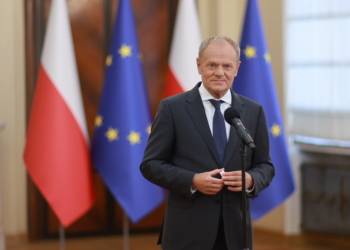
Poland has called for Europe to develop a new deterrence strategy against artificial intelligence-powered cyberattacks, with Deputy Prime Minister Krzysztof Gawkowski warning that increasingly sophisticated digital weapons could threaten critical infrastructure and fundamentally change the nature of modern warfare.
Gawkowski, who also serves as Poland’s minister of digital affairs, argued that European countries need a credible strategy for responding to hostile cyber operations, comparing the challenge to the deterrence doctrines that shaped international security during the Cold War.
In remarks published by Euronews on Saturday, 7 November, he predicted that the number of cyberattacks targeting Poland could increase tenfold in 2027 as advanced artificial intelligence systems become more powerful and widely available.
- Find more news from Poland on our Homepage .
The minister identified hostile states, including Russia and Belarus, as particular concerns and warned that cyber operations capable of disrupting electricity networks, healthcare and other essential services should not be treated as less serious than conventional military attacks.
His comments represent a call for a stronger European security response, rather than the announcement of a new policy formally adopted by Poland, NATO or the European Union.
Poland warns cyberattacks could increase tenfold in 2027
According to Euronews journalist Jorge Liboreiro, who attended the discussion, Gawkowski believes the rapid development of sophisticated AI systems will significantly increase the scale and complexity of cyber threats.
The minister described artificial intelligence as a technology capable of multiplying the effectiveness of hostile operations.
He warned that the problem extends beyond conventional cybercrime, with governments increasingly facing threats from foreign states capable of conducting coordinated digital attacks.
Gawkowski characterised the current security environment as a form of digital warfare, arguing that Poland is already among the countries most directly exposed.
His prediction of a tenfold increase in cyberattacks during 2027 is particularly striking, but it remains an estimate.
Euronews did not identify a specific statistical model or baseline supporting the projection, nor establish whether it refers to attempted intrusions, confirmed security incidents or a narrower category of hostile operations.
There is nevertheless independent evidence that the number of recorded cybersecurity incidents in Poland has increased sharply.
According to the Polish Ministry of Digital Affairs’ cybersecurity report for 2025, Poland’s national computer security incident response teams handled 272,941 incidents last year, an increase of 144.4% compared with 2024.
The same report recorded more than 682,000 cybersecurity notifications.
These figures include different categories of incidents, including criminal fraud and other malicious activity. They should not be interpreted as evidence that hundreds of thousands of attacks were carried out by foreign governments.
They also do not independently validate Gawkowski’s forecast for 2027.
Minister calls for a Cold War-style deterrence strategy
Gawkowski’s central argument is that Europe’s existing approach to cyber defence must evolve to match the potentially destructive consequences of modern digital attacks.
During the Cold War, the United States and Soviet Union relied heavily on deterrence: the knowledge that a major attack would provoke a potentially devastating response.
The doctrine of mutually assured destruction helped shape strategic calculations during the nuclear confrontation between the two superpowers.
Gawkowski drew on that historical comparison to argue that hostile governments must understand they could face serious consequences for launching destructive cyber operations.

Referring to Russia, Belarus and other potential adversaries, he said Europe should communicate a clear message: “if you attack us, we will strike back.”
His proposal concerns credible retaliation and deterrence in cyberspace. He did not announce a plan to use nuclear weapons against cyberattackers.
The precise nature of the response he envisages, and whether it would include cyber operations, economic measures, conventional military action or a combination of tools, has not been defined in a formal policy proposal.
Such decisions would also have to comply with international law and any applicable collective-defence commitments.
Could a cyberattack trigger NATO’s Article 5?
The minister’s intervention raises an important question about how European countries should classify digital attacks capable of causing physical disruption or serious economic harm.
Gawkowski challenged the tendency to categorise such operations as hybrid warfare, arguing that some should be recognised as acts of war.
He compared the consequences of destructive cyber operations with conventional attacks against electricity infrastructure and other essential facilities.
However, NATO’s existing doctrine already recognises that cyberattacks can, in sufficiently serious circumstances, amount to armed attacks.
Under NATO’s official explanation of Article 5, significant cyberattacks and other hybrid operations may qualify for the alliance’s collective-defence provisions.
The North Atlantic Council would assess the circumstances of a particular attack individually, including its scale, consequences and attribution.
Article 5 does not automatically apply whenever a government describes a cyber incident as an act of war.
Nor does invoking collective defence necessarily require a military response. NATO members determine what assistance they consider necessary, which can include non-military measures.
The distinction is significant: Gawkowski is calling for a more explicit and credible deterrence strategy, rather than for NATO to recognise cyberattacks as security threats for the first time.
The alliance has developed cyber-defence policies over several years, while its revised artificial intelligence strategy, published in July 2024, specifically addresses threats arising from adversaries’ use of AI.
Supermarket cyberattacks highlight risks to everyday life
Gawkowski’s warning follows a series of cybersecurity incidents affecting European businesses and essential services.
On 2 November, supermarkets across several European countries reported disruptions to electronically controlled refrigeration systems.
Attackers were suspected of manipulating temperature settings, causing some refrigerators and freezers to warm up and forcing retailers to discard food.
According to Euronews’ reporting on the incidents, businesses in countries including Belgium, Sweden, Luxembourg and Ireland were affected.
Some stores remained open despite the refrigeration failures, while authorities investigated the attacks.
Poland’s Chief Sanitary Inspectorate also issued a public warning about cybersecurity threats to food refrigeration systems on 3 November.
Gawkowski cited the supermarket incidents as evidence of how digital attacks can increasingly affect physical infrastructure and ordinary economic activity.
However, investigators have not publicly established that Russia or Belarus was responsible for the refrigeration attacks, or that artificial intelligence was used to conduct them.
The distinction matters because AI-enabled cyberwarfare and conventional hacking can produce similar consequences, even though their methods and capabilities may differ.
Poland strengthens protection of critical infrastructure
The minister’s warnings come as Poland expands its own cybersecurity arrangements for strategically important sectors.
On 30 October, the government announced plans for a specialist cybersecurity incident response team dedicated to the energy industry.
The new unit, CSIRT Energia, will be established within Polish electricity transmission operator Polskie Sieci Elektroenergetyczne.
According to the Ministry of Digital Affairs’ official announcement, the team will support energy companies in identifying threats, coordinating responses and managing incidents that could affect the continuity of electricity supplies.
Gawkowski said at the announcement that effective coordination between technical specialists and the energy industry would be important when attacks affected multiple operators.
The initiative forms part of Poland’s national cyber-defence arrangements, but it does not constitute the international deterrence doctrine proposed in his latest remarks.
Poland’s concerns also reflect a wider European assessment of the risks posed by increasingly interconnected systems.
The European Union Agency for Cybersecurity, ENISA, warned in its September 2026 threat assessment that dependence on digital technologies was creating new vulnerabilities and that emerging AI models were expected to be used increasingly in malicious operations.
The agency identified cybercrime, cyberespionage, ransomware and politically motivated attacks as continuing challenges across the European Union.
What happens next?
Gawkowski’s intervention places Poland among the governments calling for a stronger international response to the changing character of cyberwarfare.
His argument goes beyond improving technical defences against individual attacks.
He wants European governments to make clear that hostile cyber operations capable of causing serious damage could provoke a coordinated response.
However, no new NATO collective-defence doctrine or European retaliation mechanism has been adopted as a result of his remarks.
The minister has not presented a publicly verified timetable for negotiating such arrangements or identified a detailed package of measures for European governments to approve.
The immediate significance of the warning is therefore political and strategic: a senior Polish government minister is arguing that artificial intelligence could make existing cyber threats considerably more dangerous, and that European deterrence must develop accordingly.
Whether those warnings translate into formal policy changes will depend on subsequent decisions by Poland, its NATO allies and European partners.