Passengers arriving at Szczecin’s main railway station might never suspect that an extraordinary piece of twentieth-century history lies beneath their feet.
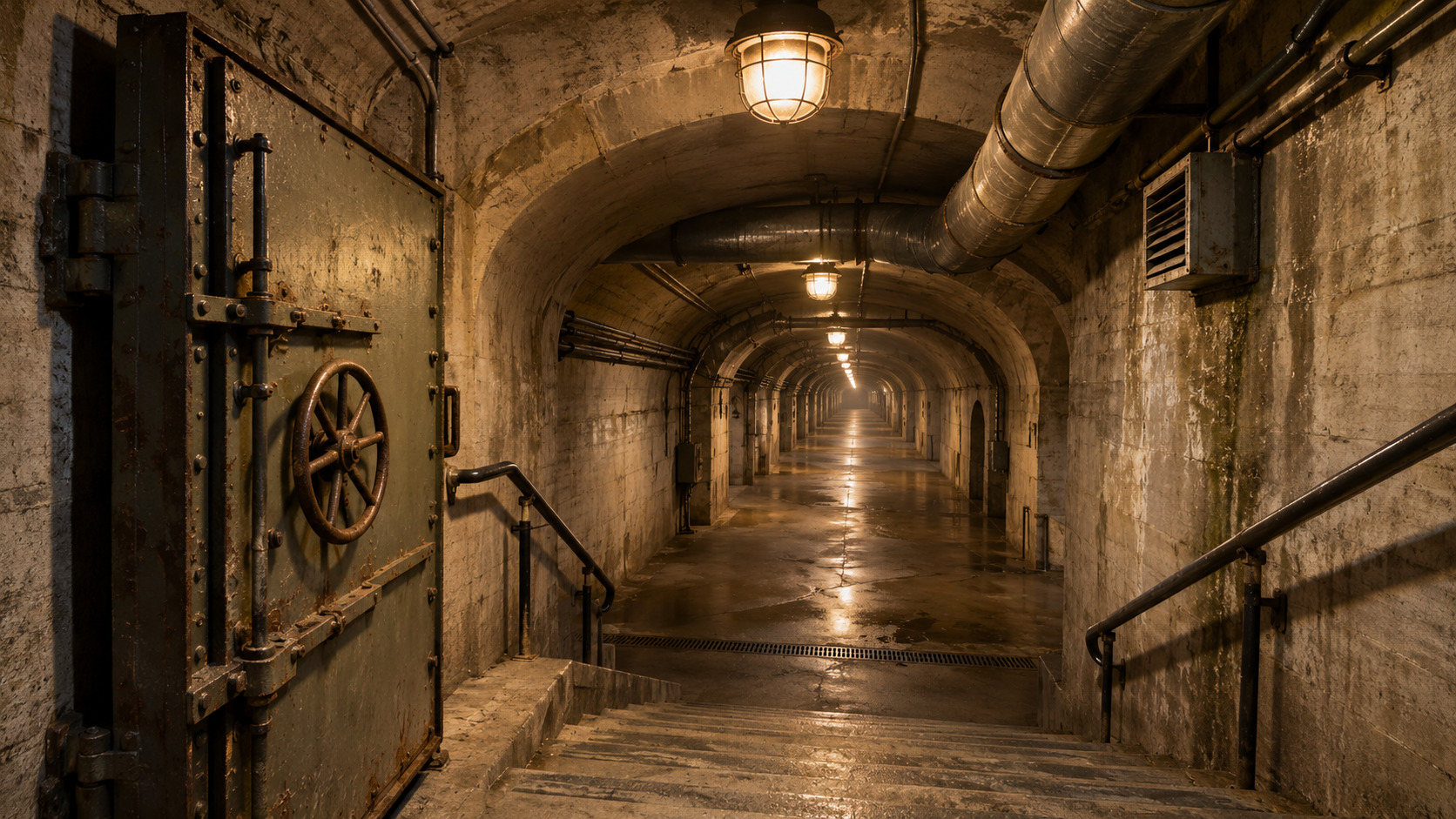
Hidden below the platforms and extending into a neighbouring hillside is an extensive network of reinforced-concrete corridors, staircases and chambers originally built to protect civilians from bombing raids during the Second World War.
The shelter descends approximately five storeys underground, with massive concrete walls and passageways designed for large numbers of people seeking protection.
- Find more news from Poland on our Homepage .
But its story did not end with Germany’s defeat in 1945.
After Szczecin became part of Poland, the underground complex was adapted for a very different threat: the possibility of nuclear war.
Today, visitors can explore sections of the former shelter through Szczecin Underground Routes, an unusual historical attraction directly beneath Szczecin Główny railway station.
It is a place where the history of German Stettin, postwar Polish Szczecin and the Cold War can be explored within the same underground structure.
A hidden world beneath the railway station
From street level, Szczecin Główny looks like a railway station serving a modern Polish city.
Beneath it, however, is an underground structure whose origins are connected with both eighteenth-century fortifications and the destruction of the Second World War.
The shelter was constructed under German administration during the war, when Szczecin was known as Stettin and formed part of Germany.
According to the Polish Tourist Organisation, the facility dates to 1941, when German authorities were developing protection against air raids.
The builders incorporated elements of older underground fortifications dating from the eighteenth century.
The resulting complex extended beneath the station and into the nearby embankment.
Its design included reinforced-concrete walls, heavy ceilings, lengthy corridors and stairways descending through several underground levels.
Some passages extend for approximately 100 metres, while the lowest sections lie roughly five storeys beneath the surface.
The facility’s original German designation was Stettin HBF-Kirchplatz, reflecting its location near the city’s main railway station.
The complex was intended to shelter civilians during air attacks, which became an increasingly serious threat as the war progressed.
When Szczecin was a German city
Understanding the shelter also means understanding Szczecin’s complicated twentieth-century history.
Before 1945, Szczecin was the German city of Stettin, an important Baltic port and industrial centre.
During the Second World War, its maritime infrastructure, industrial facilities and transport connections made it an important target for Allied bombing raids.


The city suffered extensive wartime destruction.
Large air-raid shelters were among the measures intended to protect civilians from those attacks.
The station complex was particularly important because a major railway hub brought together passengers, railway workers and people travelling through the city.
The underground shelter offered protected space behind thick reinforced-concrete walls.
According to the current operator of Szczecin Underground Routes, the facility could accommodate thousands of people during wartime air raids.
The present-day exhibitions explore how shelters were organised, the conditions experienced by people inside them and the wider history of Stettin during the war.
They also examine wartime industries, forced labour and the destruction of the city.
The underground structure is therefore more than an engineering curiosity. It is a reminder of the experiences of civilians living under the threat of aerial bombardment.
From German air-raid shelter to Polish nuclear shelter
In 1945, the political and geographical identity of the city changed.
Following the Second World War, Szczecin came under Polish administration, becoming part of Poland as Europe’s borders were redrawn.
The city’s population also changed dramatically, with German inhabitants displaced or departing and Polish settlers arriving, including people uprooted from territories Poland lost in the east.
The shelter, meanwhile, remained beneath the railway station.
Rather than abandoning the structure, postwar authorities adapted it for civil-defence purposes.
During the Cold War, the principal military threat imagined by civil-defence planners was no longer limited to conventional bombing.
The development of nuclear weapons and the confrontation between the United States and the Soviet Union created new fears about attacks on cities.
Poland, as a member of the Soviet-led Warsaw Pact, developed civil-defence arrangements intended to prepare civilians and institutions for emergencies.
The former German shelter was modified for use as a nuclear or fallout shelter.
It also became a facility for civil-defence training.
According to the site operator’s historical account, the underground complex continued to be used for training connected with railway civil defence until the early 1990s.
The same tunnels therefore served two successive political systems facing different military threats.
First, they provided protection during the Allied bombing of German Stettin.
Later, they formed part of communist Poland’s preparations for a possible nuclear confrontation.
That transformation is central to the site’s historical importance.
Three routes through wartime and Cold War history
The underground complex has since been transformed into a visitor attraction known as Podziemne Trasy Szczecina, or Szczecin Underground Routes.
The project opened to visitors in 2006 and has developed into a gallery of historical exhibitions.
Its organisers say the attraction now contains more than 60 displays organised across three interconnected routes.
The first, marked in red, explores the Second World War.
Visitors encounter material relating to the construction of shelters, wartime life in Stettin, air raids and the city’s eventual transition to Polish administration.
The exhibitions include historical photographs, recreated settings, sound effects and interpretations of everyday life during the conflict.
The second route, marked in blue, examines the Cold War.
It explores how wartime shelters were adapted for nuclear-era civil defence and how people in communist Poland were instructed to respond to the threat of attack.
The displays also address propaganda, civil-defence exercises and the atmosphere of anxiety surrounding nuclear weapons.
The third route, marked in yellow, is called Selfie with the PRL, referring to the Polish People’s Republic.
It offers a more accessible exploration of everyday life during the communist period, including reconstructed interiors, period objects, artistic installations and displays intended for photography.
Although the exhibitions use modern lighting, sound and reconstructed scenes, they are housed within a genuine historical underground complex.
This combination allows visitors to experience the architecture while learning about the changing political and social circumstances surrounding its use.
A remarkable place to visit in Poland
One of the most unusual aspects of Szczecin Underground Routes is its location.
Visitors do not need to travel to a remote fortress or abandoned military installation.
The entrance is within Szczecin Główny railway station itself.
According to the official visitor information, access is through the glass-covered stairway on platform 1, descending towards the former passenger tunnel.
An individual admission ticket provides access to all three exhibition routes.
Visitors can explore independently without joining a guided group, while information is available in Polish, English and German.
The operator estimates that a visit takes approximately one to one and a half hours.
The underground temperature stays around 14–15°C, so comfortable closed-toe shoes and an additional layer of clothing are recommended.
The attraction remains open to individual visitors on designated days, while group visits can be arranged separately.
Prospective visitors should consult the operator’s current timetable and ticket information before travelling, as opening arrangements can change.
An extraordinary reminder of Szczecin’s changing history
Many European cities have wartime bunkers, Cold War shelters or preserved military installations.
What makes Szczecin’s railway-station shelter particularly compelling is the way its history crosses different national and political eras.
Its construction belongs to the period when the city was German.
Its later adaptation reflects Poland’s place within the Soviet-led Eastern Bloc.
And its present-day role as a tourist attraction belongs to a city seeking to preserve and explain the complicated history of the buildings and infrastructure it inherited.
Above ground, trains continue to arrive and depart from Szczecin Główny.
Below, the concrete corridors preserve evidence of a time when the railway station was also a place where civilians sought protection from war.
The shelter’s transformation into a historical attraction has given those underground spaces a new purpose: helping visitors understand the extraordinary changes experienced by Szczecin over the past century.
For travellers looking to discover a less familiar side of Poland, it is one of the city’s most unexpected places to explore.