Every Christmas Eve, millions of Polish families share a thin white wafer known as opłatek, exchanging wishes before sitting down to their festive meal.
But in some parts of Poland, those same delicate wafers have another extraordinary purpose.
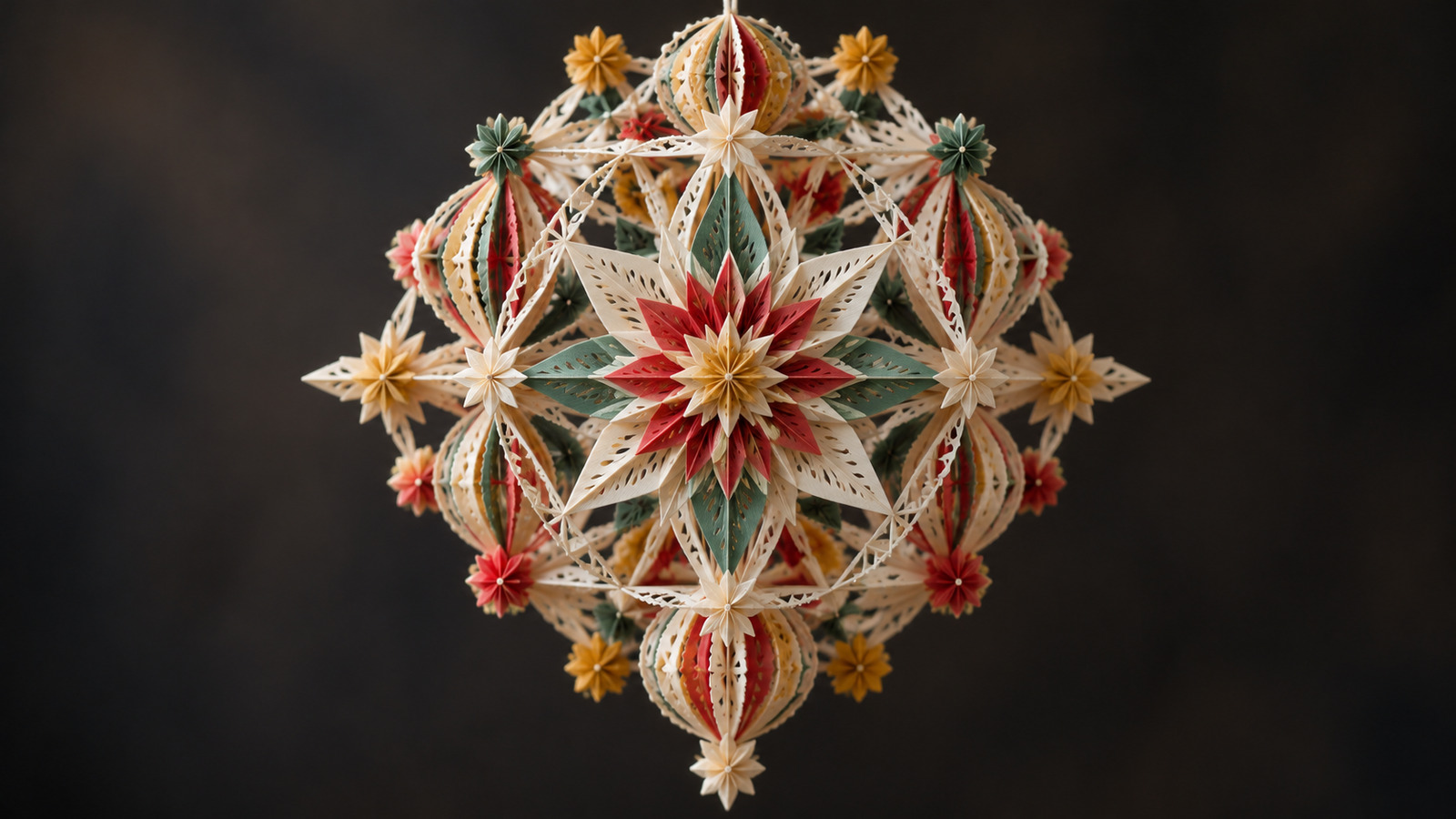
With careful cutting, folding and joining, traditional artisans transform them into intricate stars, geometric spheres, rosettes and miniature nativity scenes. Some are so light that they move in the slightest breeze.
- Find more news from Poland on our Homepage .
The most distinctive decorations are called światy — literally, “worlds”.
Once suspended above Christmas tables and beneath the ceiling beams of traditional rural homes, these fragile creations represent an unusual form of Polish Christmas folk art.
In 2026, the tradition received renewed recognition when Poland added wafer Christmas ornaments from the Lublin region to its National List of Intangible Cultural Heritage.
It followed a separate listing in 2024 recognising the same broad craft tradition in the Liwiec Valley, where one remarkable artisan has played a particularly important role in preserving it.
How a Christmas wafer becomes a miniature world
The starting material is deceptively simple.
Opłatek is made from wheat flour and water, producing the thin, brittle sheets familiar from Polish Christmas Eve celebrations.
In skilled hands, the wafers become the building blocks of elaborate three-dimensional decorations.
Artisans cut out circles, semicircles, stars and other geometric shapes before carefully connecting the individual pieces.
Traditional techniques include moistening the wafer edges so the pieces bond together. Some makers use saliva, a method documented in Polish ethnographic accounts.
The finished ornaments may consist of numerous delicate components joined into symmetrical patterns.
Spherical forms are especially characteristic, but more complex designs include geometric structures, miniature chapels, flowers, cradles and representations of the Nativity.
The word świat reflects the symbolism traditionally associated with these creations.
According to Poland’s National Heritage Institute, the spherical shapes connect with Christian imagery of Christ as ruler of the world and the completeness of creation.
Yet the ornaments were more than expressions of religious belief.
They also formed part of the traditional decoration of Polish homes, often displayed on podłaźniczki — arrangements of evergreen branches suspended indoors before Christmas trees became widespread.
Wafer stars and spheres could also hang from ceiling beams or near the święty kąt, the devotional corner where religious images were displayed.
In older folk beliefs, wafers were associated with blessings, prosperity and protection. Some communities believed they could safeguard the home against fire and lightning.

These were traditional beliefs rather than any established protective properties.
A craft preserved by generations of women
Historical references place wafer ornament-making in Poland at least as far back as the eighteenth century, although the precise beginnings differ between regions and are difficult to establish.
Their popularity gradually declined during the twentieth century as rural household customs changed and mass-produced decorations became increasingly common.
In the Liwiec Valley, near Węgrów in eastern Mazovia, Małgorzata Pepłowska has been central to keeping the tradition alive.
A folk artist from the village of Ruchna, she inherited knowledge from her grandmother, mother and the experienced craftswoman Czesława Rowicka.
According to the Polish Ministry of Culture, Pepłowska is the only active bearer of this particular tradition in her region identified in the heritage documentation.
Her creations include traditional światy, elaborate rosettes and stars, as well as miniature nativity scenes and Christmas cards incorporating wafer decorations.
The importance of her work lies not simply in the beauty of the finished pieces but in the continued survival of the techniques used to make them.
In August 2024, wafer Christmas decorations from the Liwiec Valley were added to Poland’s National List of Intangible Cultural Heritage.
This formal recognition acknowledged a living practice sustained through direct transmission of knowledge.
A second Polish region receives recognition
The story continued in July 2026, when Poland’s Ministry of Culture announced the national heritage listing of światy and wafer decorations traditionally made in the Lublin region.
Although closely related to the Liwiec Valley craft, the Lublin tradition has its own documented regional history.
The ministry notes that the earliest surviving references to this regional practice date from the nineteenth century, while the custom may be older.
One of the artisans preserving the Lublin tradition is Małgorzata Bandosz from Wola Żulińska.
Bandosz produces traditional Christmas decorations, including intricate światy, and is among the relatively few practitioners who still prepare their own wafer sheets before assembling the ornaments.
Her work illustrates the continuing importance of practical knowledge: understanding how the wafer behaves, how its pieces fit together and how to construct a decoration without breaking the fragile material.
The 2026 national heritage announcement also highlights the role of workshops, folk artists and educational activities in maintaining the tradition.
The two regional listings demonstrate that wafer ornament-making is not the property of one village or community. Related customs survived in different parts of Poland, often through the work of individual artisans.
The fragile art of preserving Christmas
National intangible-heritage recognition does not mean these decorations have been inscribed on UNESCO’s international heritage lists.
Instead, it acknowledges that the knowledge and skills involved deserve documentation and safeguarding.
That distinction matters for a craft whose physical creations are particularly vulnerable.
Unlike wooden ornaments or glass baubles, a wafer decoration can easily be damaged by moisture, careless handling or simple deterioration.
The objects themselves may not survive for generations.
The knowledge required to make them, however, can.
As Poland prepares for another Christmas, the tradition offers a reminder that some of the country’s most distinctive festive decorations began not in factories or shops, but with a few thin sheets of flour and water.
From that simplest of materials, generations of Polish artisans have created miniature worlds — and kept an extraordinary Christmas tradition alive.
Featured image: AI-generated editorial illustration inspired by traditional Polish wafer ornaments. It is not a photograph of an actual heritage object or a named craftsperson’s work.