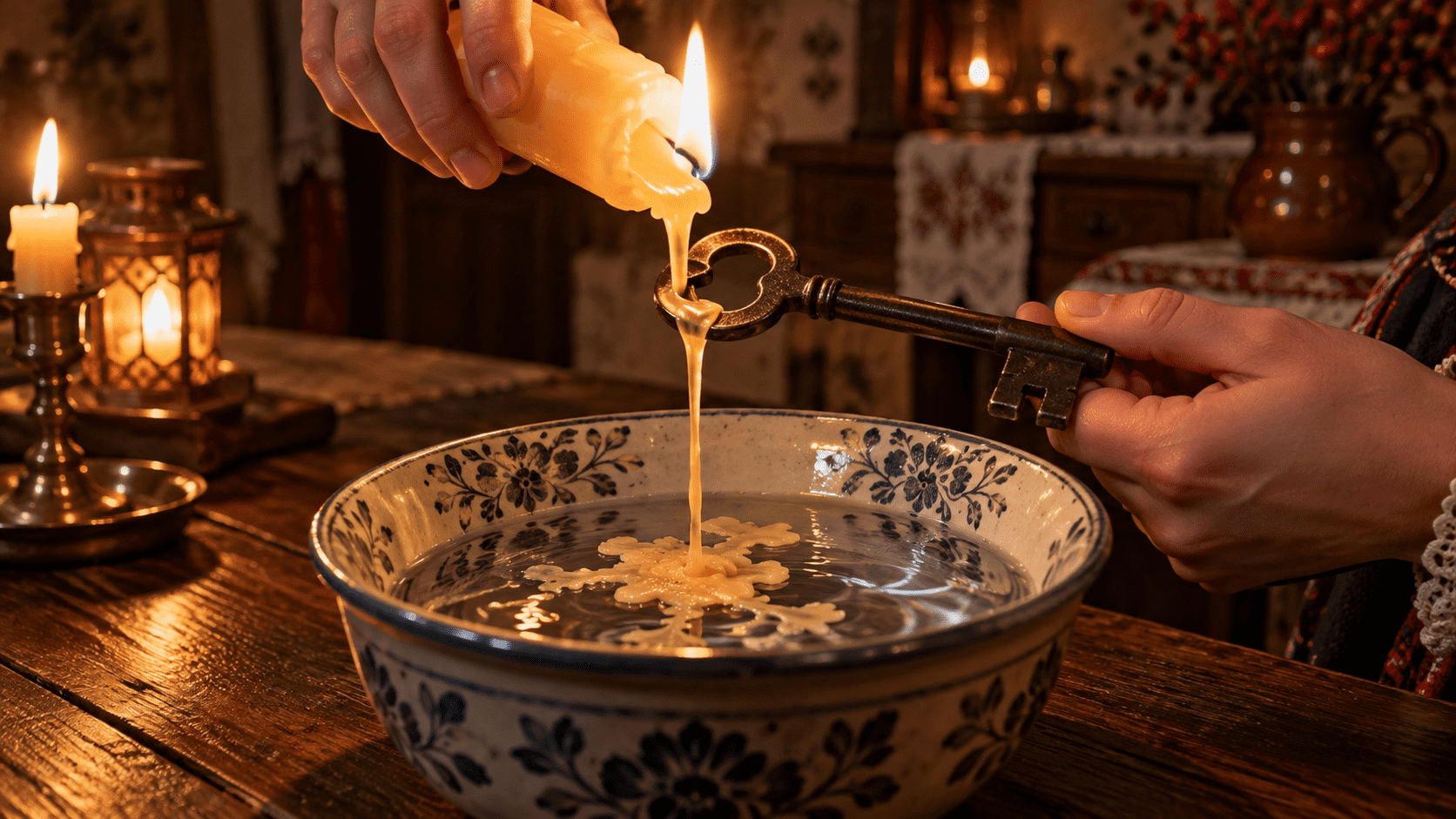
A key is held above a bowl of cold water. Melted wax is poured carefully through its opening. Within seconds, the liquid hardens into a strange, irregular shape.
Then comes the important part.
The wax is held near a candle or lamp so that its shadow falls across a wall — and everyone tries to decide what the shape might mean.
- Find more news from Poland on our Homepage .
This is one of the best-known customs of Andrzejki, the Polish tradition associated with the night of 29–30 November, immediately before St Andrew’s Day.
Today it is usually an excuse for a party, particularly among children, families and groups of friends. Historically, however, Andrzejki belonged to a much more serious world of folk belief in which young women attempted to discover something about their future marriages.
What could a lump of wax tell you?
According to the Museum of Polish History, pouring wax was among the most popular Andrzejki divinations in earlier Poland.
Wax — and sometimes other molten materials — was poured through the hole of a key into cold water. Once it had hardened, the resulting object was removed and its shadow examined.
The interpretation depended on what people believed they could see.
A shape resembling a windmill, for example, might suggest that a future husband would be a miller. Other forms could be interpreted as people, objects or symbols offering clues about the profession, character or circumstances of a future spouse.
There was no scientific logic behind the practice. It was fortune-telling rooted in folklore and belief.
But wax was only one way of seeking answers.
Young women might hide symbolic objects beneath plates and choose one without looking. Different objects were assigned different meanings for their future.
Another familiar game involved shoes. Participants placed one shoe each in a line and repeatedly moved the last shoe to the front until one reached the doorway. The owner of the shoe that arrived first was supposedly the person most likely to marry next.
Other customs involved cherry branches, burning fibres, floating objects and even animals selecting food placed by different participants.
For people living in a society where marriage could determine much of a young person’s social and economic future, such questions carried considerably more weight than they generally do at an Andrzejki party today.
Andrzejki was originally a women’s tradition
Older forms of Andrzejki were particularly associated with unmarried women.
The Museum of Polish History records that, according to old custom, married women might assist with preparations or interpretations, while men were excluded from the women’s divination sessions.
Young unmarried men had a corresponding tradition of their own.
Known as Katarzynki, it was associated with St Catherine’s Day and its eve in late November. Young men performed marriage-related divinations in the hope of learning something about their future wives.
That distinction has largely disappeared.


Poland’s State Ethnographic Museum now presents Andrzejki and Katarzynki together in educational programmes about seasonal customs — an indication of how traditions once divided by sex have become part of a shared cultural vocabulary.
Modern Andrzejki celebrations commonly involve women and men together, and the fortune-telling is generally understood as entertainment rather than a reliable glimpse of the future.
A tradition that changed meaning
The precise origins of individual Andrzejki rituals are difficult to establish.
Older European societies had numerous traditions of divination, particularly around seasonal turning points, and later folk customs became intertwined with Christian feast days.
In Poland, St Andrew became particularly associated with unmarried women and hopes for a suitable marriage. His feast falls on 30 November, making the previous evening the natural setting for the tradition that became known as Andrzejki.
It is sometimes said that Andrzejki represented the final opportunity for revelry before Advent.
That description works for many historical calendars, but it needs care in 2026. Sunday, 29 November 2026 is itself the First Sunday of Advent, so this year’s Andrzejki evening already falls after the liturgical season has begun.
The calendar may shift, but the custom has proved remarkably durable.
Poland’s museums still use Andrzejki to introduce younger generations to historical beliefs and seasonal traditions. Parties continue to feature wax, keys and bowls of water, even when nobody expects the resulting shadow to reveal the identity of a future husband or wife.
The ritual survives because its meaning has changed.
What was once an anxious attempt to uncover an uncertain marital future has become something lighter: an excuse to gather around a bowl of water, turn a piece of wax towards the wall and argue over whether its shadow looks like a ship, a dog, a crown — or absolutely nothing at all.