In northern Poland, Christmas has a name of its own.
Among the Kashubians, a community with its own language and centuries of cultural traditions, the festive period is known as Gòdë. Traditionally spanning the days between Christmas and Epiphany on 6 January, it is a season rooted in religious celebrations, regional food, rural customs and local folklore.
While many Kashubian families today celebrate Christmas in ways familiar across Poland, the region’s historical traditions reveal a distinctive festive world — one in which a sheaf of rye once stood where a Christmas tree might be today, fish reflected the livelihoods of nearby lakes and the Baltic coast, and groups of masked visitors brought music and mischief to village homes.
- Find more news from Poland on our Homepage .
These customs offer a glimpse into the cultural identity of Kashubia, a region of northern Poland where local language and heritage remain important parts of community life.
A Christmas table shaped by land and sea
For generations, Christmas Eve was one of the most important moments in the Kashubian festive calendar.
Traditionally, families observed a fast during the day before gathering for their evening meal after sunset. The supper included the sharing of opłatek, a thin Christmas wafer exchanged with good wishes — a custom familiar throughout much of Poland.
But the food on the table reflected the region’s particular geography.
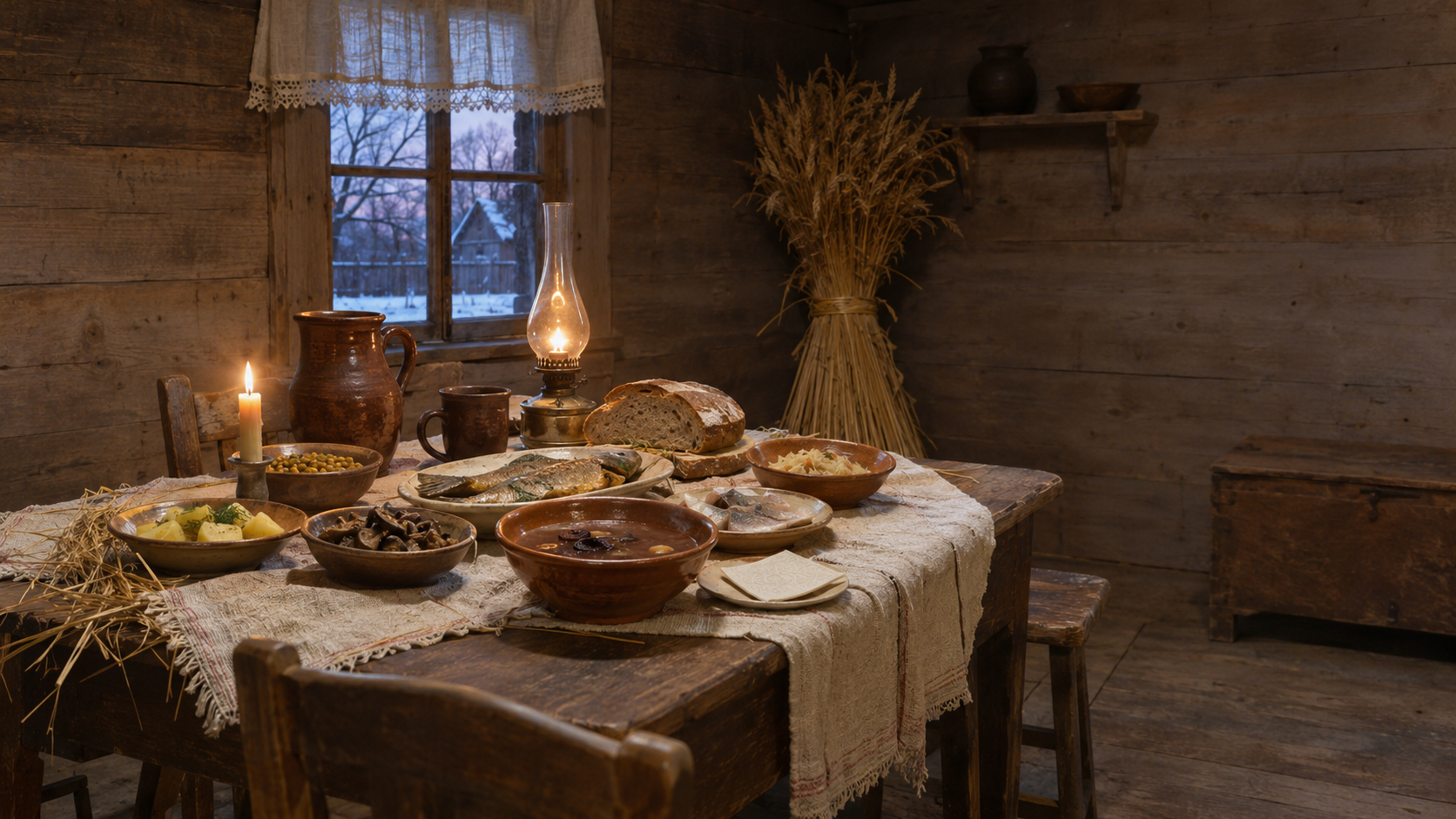
According to an ethnographic account published by Poland’s Ministry of Agriculture, traditional Kashubian Christmas Eve dishes included peas, beans, potatoes, cabbage, dried mushrooms and fruit.
Fish occupied a particularly important place. Herring, carp, perch, burbot and pike appeared in regional preparations, while some communities developed dishes closely associated with their local waters.
Among fishing families on the Hel Peninsula, for example, one documented Christmas Eve dish combined boiled eel with noodles and plums.
In Kashubia’s lake districts, freshwater fish played a prominent role, while coastal communities drew upon their access to the Baltic Sea.
Another regional speciality was brzadowô zupa, a soup made with dried fruit, sometimes combined with mushrooms. Its ingredients reflected a time when winter meals depended heavily on foods preserved during the warmer months.
Not every household enjoyed the same menu, and the number of dishes could vary according to local custom and family circumstances.
That diversity is part of the story: Kashubian Christmas food was shaped as much by occupation, geography and household resources as by religious tradition.
Before Christmas trees, there were sheaves of rye
One of the most striking differences between historical Kashubian Christmas celebrations and their modern counterparts concerns the decorations.
Today, a decorated Christmas tree is a familiar sight in Kashubian homes. But the custom became established comparatively late.
Historical material compiled by the Ministry of Agriculture, drawing on research from the Kashubian Ethnographic Park Museum in Wdzydze Kiszewskie, places the arrival of Christmas trees in the region around the beginning of the twentieth century.
Earlier rural households used different festive decorations. A sheaf of rye might be placed in the corner of the room as a symbol of hoped-for agricultural prosperity. Hay was also traditionally placed on the Christmas Eve table.
These objects connected the religious celebration with the agricultural rhythms that governed everyday life.
The sheaf of grain was more than decoration. It represented the household’s dependence on the land and the hope that the coming year would produce a good harvest.


As Christmas trees spread through Kashubia, families decorated them with apples, homemade biscuits and ornaments fashioned from materials such as paper and straw.
The change illustrates how Christmas traditions evolved over time, incorporating newer customs without entirely erasing older ones.
The masked visitors who brought Christmas to life
Kashubian Christmas was not confined to the family table.
Another distinctive element was the appearance of groups of costumed carollers who travelled between homes.
Known by regional names including Gwiôzdka and Gwiżdże, these groups combined Christmas songs, theatrical performances and traditional disguises.
Their costumes could represent animals, supernatural figures and familiar members of village society. A goat, bear, horse, stork or chimney sweep might appear alongside an angel, devil or personification of death.
The visits were both festive entertainment and a means of maintaining relationships between neighbours.
The tradition was not uniform across Kashubia, and its names, characters and timing differed between communities.
Barbara Kąkol, director of the Kashubian Museum in Kartuzy, described the historical importance of these visiting groups in a 2023 interview with regional publication Kartuzy.info.
Some forms of Kashubian carolling continue today, while museums and cultural organisations help document and revive customs that have become less common.
When animals were believed to speak
Kashubian folklore also attached special significance to Christmas Eve night.
One traditional belief held that domestic animals could speak with human voices during this extraordinary time.
Animals were sometimes given particularly good food before Christmas, while portions of festive food could be shared with livestock, birds or fish.
Such practices connected Christian celebrations with older rural beliefs about nature, the household and the changing year.
They are best understood as elements of historical folklore rather than descriptions of what all Kashubian families practise today.
Together with the agricultural symbolism of grain and hay, they reveal how closely the festive season was once tied to rural life.
A living part of Poland’s regional identity
Kashubia’s Christmas customs form part of a wider cultural heritage distinguished by language, music, folklore and regional traditions.
Although the historical practices described in ethnographic records have changed considerably, elements remain visible in local celebrations, cultural events and educational programmes.
The Kashubian Ethnographic Park Museum in Wdzydze Kiszewskie, for example, has organised activities introducing visitors to traditional Christmas decorations, carolling and festive customs.
For Polish families with Kashubian roots — including those living abroad — such traditions can also provide a connection to the places and communities from which earlier generations came.
They demonstrate something easily overlooked when Christmas is presented as a single national tradition: Poland’s festive customs have never been entirely uniform.
From regional dishes to the songs of masked carollers, Kashubia preserves its own contribution to that wider heritage.
And at the centre of it remains one distinctive word: Gòdë.