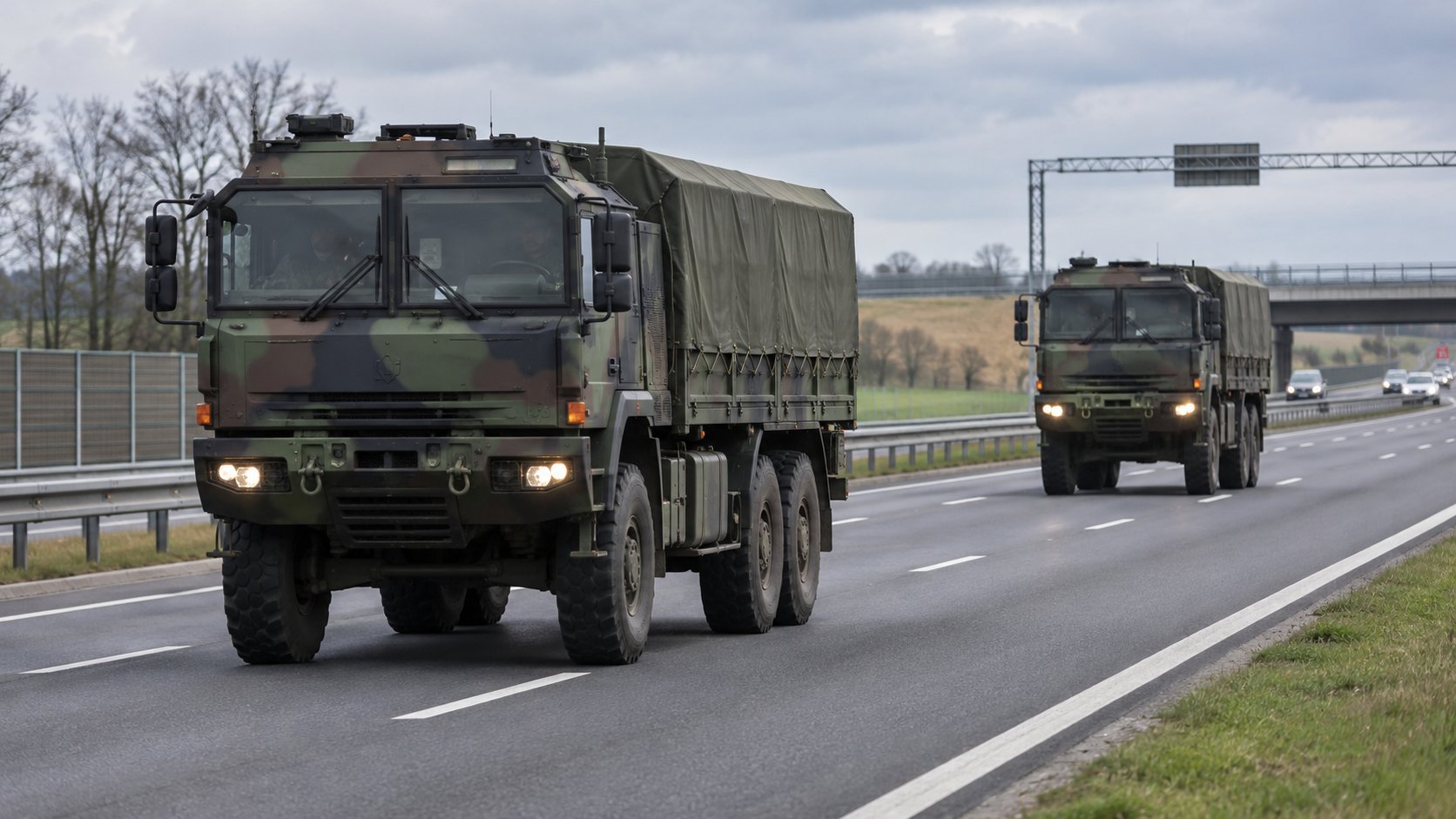
Three German soldiers were taken to hospital after two military trucks belonging to Germany’s armed forces collided on a motorway in western Poland. Polish military police have confirmed that the vehicles were travelling through the country on an authorised transit journey when the accident occurred.
The collision happened at approximately noon on Wednesday, 4 November, on the A4 motorway near Kostomłoty, around 27 kilometres west of Wrocław in Poland’s Lower Silesia region.
The trucks were part of a German military convoy travelling towards Wrocław when the vehicles collided, disrupting traffic on one of Poland’s principal east–west motorways.
- Find more news from Poland on our Homepage .
All three injured soldiers were taken to hospital with bruising and other minor injuries. Polish authorities subsequently confirmed that none had suffered life-threatening injuries.
Military police identify cause of collision
According to a statement issued by Poland’s Military Gendarmerie on the evening of 4 November, investigators established that the collision occurred because the vehicles had not maintained an adequate distance from each other.
The statement, issued by Lieutenant Colonel Dariusz Rozkosz, spokesman for the commander of the Military Gendarmerie, confirmed that two German military trucks were involved.
The drivers were tested for alcohol, and both were found to be sober.
Initial reports from the scene had suggested that three military vehicles were involved. The subsequent military police statement clarified that two trucks had collided.
Officers from the Środa Śląska district police headquarters secured the scene, while emergency medical personnel and firefighters attended the accident.
The precise sequence of events leading to the collision was not described in further detail.
Crash causes eight-kilometre traffic jam
The collision occurred at approximately the 124th kilometre of the A4 motorway, between the Gościsław and Kostomłoty interchanges.
The accident blocked the right-hand lane towards Wrocław, forcing traffic into the remaining lane.
According to Wrocław’s official municipal news service, the disruption also affected traffic travelling in the opposite direction, towards Zgorzelec and the German border.
Queues reached approximately eight kilometres.
Emergency crews from Kąty Wrocławskie, Kostomłoty, Jarosław and Środa Śląska were dispatched, alongside medical responders and military police.
Polish media also reported that the military vehicles were transporting containers holding approximately 150 litres of diesel fuel.
According to Polish Radio’s German-language reporting, citing information from firefighters, the fuel container remained intact during the collision.
The disruption lasted for several hours as emergency personnel secured the location and the damaged vehicles were dealt with.
Poland’s General Directorate for National Roads and Motorways (GDDKiA) confirmed that the accident-related restrictions had ended at approximately 5.40pm, allowing traffic to gradually return to normal.
Why were German military vehicles travelling through Poland?
The presence of German military trucks on a Polish motorway prompted questions about their destination and whether the convoy required an escort.

Poland’s Military Gendarmerie addressed the issue directly in its statement.
The service confirmed that Poland was being used as a transit country and that the German vehicles were travelling under an appropriate movement permit.
The permit did not require the convoy to be escorted by Polish military personnel.
Military vehicles belonging to NATO allies regularly travel through Poland for authorised movements between bases, training facilities and other locations across Europe.
Poland’s geographical position makes it an important transit country for allied military transport, particularly between Western Europe and NATO’s eastern members.
However, Polish authorities did not identify the specific German military unit involved in Wednesday’s collision or disclose the convoy’s intended destination.
There is therefore no confirmed basis for linking the vehicles involved in the accident to a particular military exercise, deployment or operation.
German soldiers escaped serious injuries
The collision attracted attention because of the military vehicles involved and the disruption caused on a heavily used motorway.
Nevertheless, the injuries reported by Polish authorities were comparatively minor.
The Military Gendarmerie’s statement confirmed that the three soldiers taken to hospital had suffered general bruising that did not threaten their lives or health.
No civilian injuries were reported in the official account.
By Wednesday evening, the damaged vehicles had been dealt with sufficiently for the motorway restrictions to be lifted.
The latest publicly confirmed information establishes the collision’s immediate cause, the number of injured personnel and the authorised transit status of the convoy.
The German military has not been reported as announcing any additional serious injuries arising from the incident.