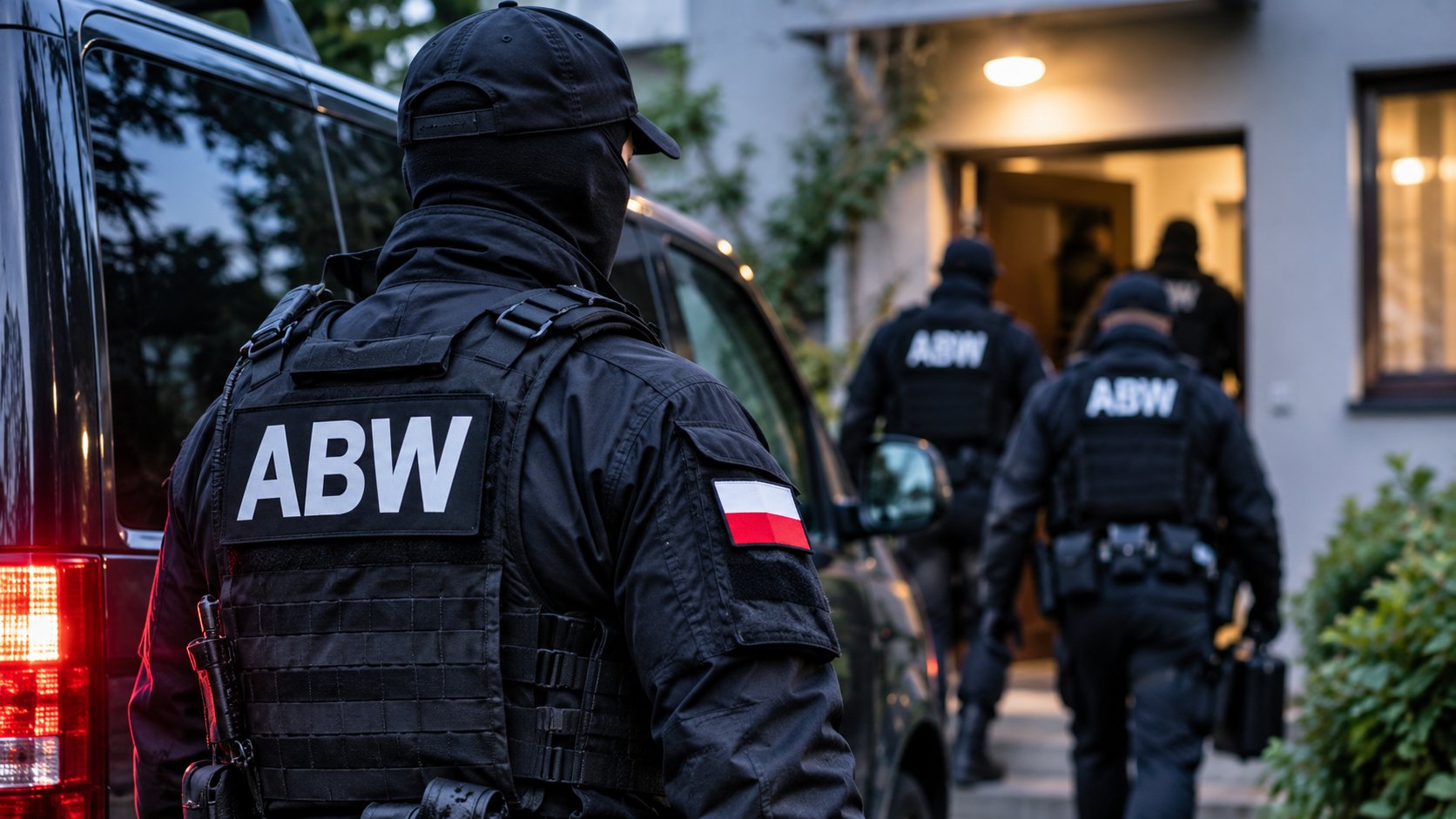
Poland’s Internal Security Agency (ABW) has detained six people suspected of operating a network that illegally supplied ammunition components worth more than PLN 2 million to Russia, allegedly on behalf of Russian intelligence services. Four suspects, including a Russian woman, have been charged with espionage and remanded in custody for three months. Investigators say the group transported military-related components into Russia’s Kaliningrad exclave over more than two years, using vehicles with concealed compartments and repeatedly crossing international borders.
The arrests were announced on Thursday, 5 November, following a counterintelligence operation conducted between 21 October and 2 November.
According to an official statement released by Poland’s Internal Security Agency, the six suspects comprise five Polish citizens aged between 25 and 52 and a 37-year-old Russian woman.
- Find more news from Poland on our Homepage .
All six face charges relating to participation in an organised criminal group. Four also face accusations of acting on behalf of Russian intelligence against Poland.
A court in Białystok ordered the four espionage suspects held in pretrial detention for three months, while the remaining two were placed under non-custodial preventive measures.
The investigation remains ongoing, and none of the suspects has been convicted.
Ammunition components allegedly smuggled into Kaliningrad
Polish investigators believe the group operated from at least June 2023 until December 2025, with activities spanning Poland, Lithuania and Russia.
According to details provided by National Prosecutor’s Office spokesman Przemysław Nowak and reported by Polish Radio, the alleged operation involved purchasing components, organising their collection and arranging transport into Russia’s Kaliningrad region.
The components included cartridge cases and projectiles, items that can be used in the manufacture of ammunition.
Investigators allege that the suspects acquired goods through various channels, including online retailers, before transporting them across borders.
The group allegedly used vehicles equipped with concealed compartments to transport restricted materials.
Prosecutors say members repeatedly crossed the Polish-Russian border and that Polish border authorities intercepted some shipments.
According to the prosecutor’s assessment, the total value of ammunition components purchased and illegally exported to Russia exceeded PLN 2 million.
This represents the estimated value of goods involved in the alleged operation, not a confirmed financial loss to Poland or an amount of money transferred directly to Russian intelligence.
Authorities have not established publicly where all the components were manufactured or which specific Russian facilities ultimately received them.
Four suspects accused of working for Russian intelligence
The allegations extend beyond the unauthorised export of controlled military-related goods.
Prosecutors accuse four of the suspects of acting on behalf of Russian intelligence services against Poland.
The alleged intelligence-related activity involved exporting ammunition components to Russia for financial gain and, according to investigators, supporting the country’s military capabilities.
In remarks reported by Radio Gdańsk, prosecutor Przemysław Nowak described the alleged activities as serving both financial interests and Russia’s military potential.
All six suspects have been charged with participating in an organised criminal group allegedly established to export weapons-related components without the required authorisations.
You May Also Be Interested In

The proceedings also concern suspected violations of Polish rules governing international trade in goods and technologies considered strategically important for national defence and international security.
The distinction between the accusations matters.
All six face organised-crime allegations, but only four have been charged with espionage. The two others have not been publicly identified as facing the same intelligence-related charges.
The court’s decision to remand four suspects in custody does not establish that the alleged offences occurred.
ABW searched 21 locations across northern and western Poland
The arrests followed coordinated operations carried out by ABW officers between 21 October and 2 November.
During that period, officers searched 21 locations across three provinces: Warmia-Masuria, Pomerania and Greater Poland.
The search operations were confirmed in the agency’s official announcement.
The arrests themselves were carried out on 21 October and 2 November, according to the prosecution details reported on 5 November.
The investigation is being conducted by ABW’s regional delegation in Olsztyn under the supervision of the National Prosecutor’s Office’s organised-crime and corruption division in Białystok.
Officials have not released the suspects’ identities.
They have also not disclosed all the evidence gathered during the searches or whether additional individuals are expected to face charges.
The agency described the investigation as continuing, with further work intended to establish the full circumstances of the alleged operation.
EU restrictions prohibit military exports to Russia
The alleged network operated against the background of extensive European restrictions on supplying Russia with military goods and sensitive technologies.
The European Union has progressively expanded sanctions on Russia since 2014, with major additional measures following Moscow’s full-scale invasion of Ukraine in February 2022.
Under the EU’s sanctions framework explained by the Council of the European Union, restrictions prohibit exports to Russia of various military and dual-use goods, including arms, ammunition, weapons components and technologies that could support military production.
These measures aim to restrict Russia’s access to equipment and industrial inputs that might strengthen its military capabilities.
The alleged activities identified by Polish prosecutors involve ammunition-related components, making the case particularly relevant to the enforcement of military export controls.
However, the precise legal charges in this investigation arise from Polish criminal law and rules governing strategically sensitive international trade.
The existence of EU sanctions should not be taken as proof that any individual suspect breached those restrictions. That remains a matter for the criminal proceedings.
The prosecution’s allegations concern the acquisition and transfer of components rather than the sale of complete weapons systems.
Polish officials warn of wider Russian intelligence activity
The case comes amid continuing concern in Poland about Russian intelligence operations, suspected sabotage and other activities that officials say threaten national security.
Tomasz Siemoniak, the minister responsible for coordinating Poland’s special services, said that nearly 100 people had acquired suspect status in ABW investigations involving espionage and sabotage since 1 January 2024.
That figure covers a wider range of investigations and does not refer to the six people detained in the current case.
Siemoniak linked the broader pattern of suspected hostile activity to Russia’s war against Ukraine and Poland’s role in supporting Kyiv.
He also warned that Russian intelligence services were increasingly making use of individuals and criminal networks motivated by financial gain.
These assessments are the Polish government’s account of the security environment; they do not establish criminal responsibility in every case under investigation.
The latest arrests concern an alleged supply operation that investigators believe ran for more than two years.
That differs from separate incidents involving suspected sabotage, surveillance or provocations along Poland’s borders.
Poland has also recently reported heightened security activity near its border with Kaliningrad. Earlier this week, Prime Minister Donald Tusk said Polish forces had responded to suspicious overnight activity in the region.
Authorities have not established any connection between that border incident and the ammunition-component investigation announced on Thursday.
Investigation continues as four remain in custody
The ABW investigation is continuing under prosecutorial supervision in Białystok.
Four suspects are currently subject to court-ordered pretrial detention lasting three months, while the other two remain subject to preventive restrictions outside custody.
Further investigative work will seek to establish the full extent of the alleged operation, including the movement of goods and any additional participants.
Several important questions remain unanswered.
Authorities have not disclosed a complete inventory of the components, their manufacturing origins or the ultimate recipients of every shipment.
The extent to which the alleged exports contributed to Russia’s military production has also not been independently established.
What is confirmed is that Polish prosecutors have brought criminal charges against six individuals following a substantial counterintelligence investigation.
Whether the allegations are proven will depend on the evidence presented and the outcome of legal proceedings.