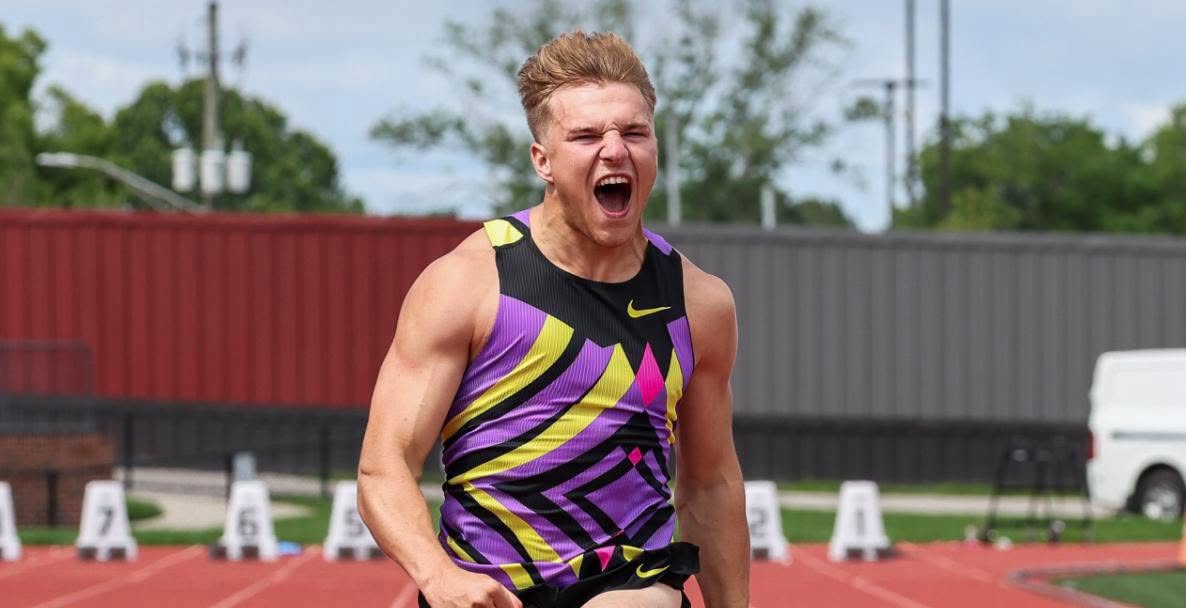
American sprint star Sam Blaskowski has submitted an application for Polish citizenship at Poland’s Consulate General in Chicago, according to reports published on Wednesday, 25 November. The 24-year-old, whose personal best over 100 metres is faster than Poland’s national record, hopes to represent his ancestral homeland, but the citizenship decision rests with President Karol Nawrocki.
Polish athletics journalist Tomasz Spodenkiewicz reported that Blaskowski’s application had been accepted and registered at the consulate.
Polish national sprint coach Piotr Maruszewski was reportedly present when the documents were submitted.
- Find more news from Poland on our Homepage .
The development follows months of efforts by the athlete, his family and representatives of the Polish athletics community to establish his eligibility for Polish citizenship.
In a recent interview with Interia Sport, Maruszewski confirmed that he was travelling to Chicago for a consular appointment scheduled for 24 November.
The coach said he had assembled supporting documentation and letters from organisations including the Polish Athletics Association (PZLA), Polish university sports representatives and local authorities in Sompolno, the town associated with Blaskowski’s family history.
An American sprinter faster than Poland’s national records
Blaskowski’s possible move would be a significant development for Polish athletics.
According to his official World Athletics profile, the American achieved a personal best of 9.89 seconds over 100 metres on 30 May 2026.
He subsequently ran 19.93 seconds over 200 metres on 20 June.
Both performances are faster than Poland’s existing men’s national records.
The Polish Athletics Association’s official statistics list the country’s 100-metre record as 10.00 seconds, set by Marian Woronin in 1984.
The Polish 200-metre record stands at 19.98 seconds, achieved by Marcin Urbaś in 1999.
Blaskowski’s personal bests are therefore 0.11 seconds faster over 100 metres and 0.05 seconds faster over 200 metres.
Those performances remain American results, however. They do not become Polish national records simply because he may acquire citizenship.
His potential arrival could strengthen Poland’s individual sprinting prospects and its men’s 4×100-metre relay squad.
PZLA president Sebastian Chmara has publicly supported efforts to secure Blaskowski’s citizenship, describing the athlete as a potentially important addition to the national team.
Polish family roots led to the citizenship bid
Blaskowski’s interest in representing Poland is linked to his family history.
His great-grandparents came from Sompolno and the surrounding area in Greater Poland before emigrating to the United States.
The athlete visited the town in August 2026, meeting people connected with his family’s history.
However, establishing his Polish ancestry has not automatically resolved the question of citizenship.


Maruszewski explained that Blaskowski’s ancestors had emigrated before Poland regained independence in 1918.
As a result, the team pursuing his citizenship concluded that it could not establish an existing claim to Polish citizenship through the documentation initially available.
Instead, it chose to pursue a presidential grant of citizenship, a separate legal process.
Why the decision rests with President Nawrocki
Under Polish law, the president has the authority to grant Polish citizenship to a foreign national.
The Polish Interior Ministry’s official guidance explains that applicants living abroad submit their requests through a Polish consulate.
The documents then proceed through the appropriate administrative channels for presidential consideration.
Importantly, the president is not bound by a statutory deadline for deciding citizenship applications.
This means that although Blaskowski’s application has reportedly been accepted at the consulate, there is no confirmed date by which Nawrocki must make his decision.
Nor has there been an announcement that the president has already approved the request.
Could Blaskowski represent Poland in international competition?
Receiving Polish citizenship would be a major step, but it would not automatically complete the process of representing Poland internationally.
World Athletics maintains separate rules governing nationality and transfers of sporting allegiance.
Depending on an athlete’s previous international representation and eligibility circumstances, a change may require approval under those rules.
Blaskowski is still listed as representing the United States in the World Athletics database.
The Polish Athletics Association has indicated that it hopes the sprinter could strengthen the national team, but no completed transfer of sporting allegiance has been announced.
For now, the confirmed significance of the latest development is procedural: Blaskowski has reportedly completed the formal submission of his citizenship application, bringing the decision-making process another step forward.
Whether one of America’s fastest sprinters will eventually compete in Polish colours now depends on the citizenship process and the applicable international athletics regulations.