Every year on Poland’s Independence Day, small white-and-red rosettes appear on the jackets of politicians, schoolchildren, teachers and ordinary citizens.
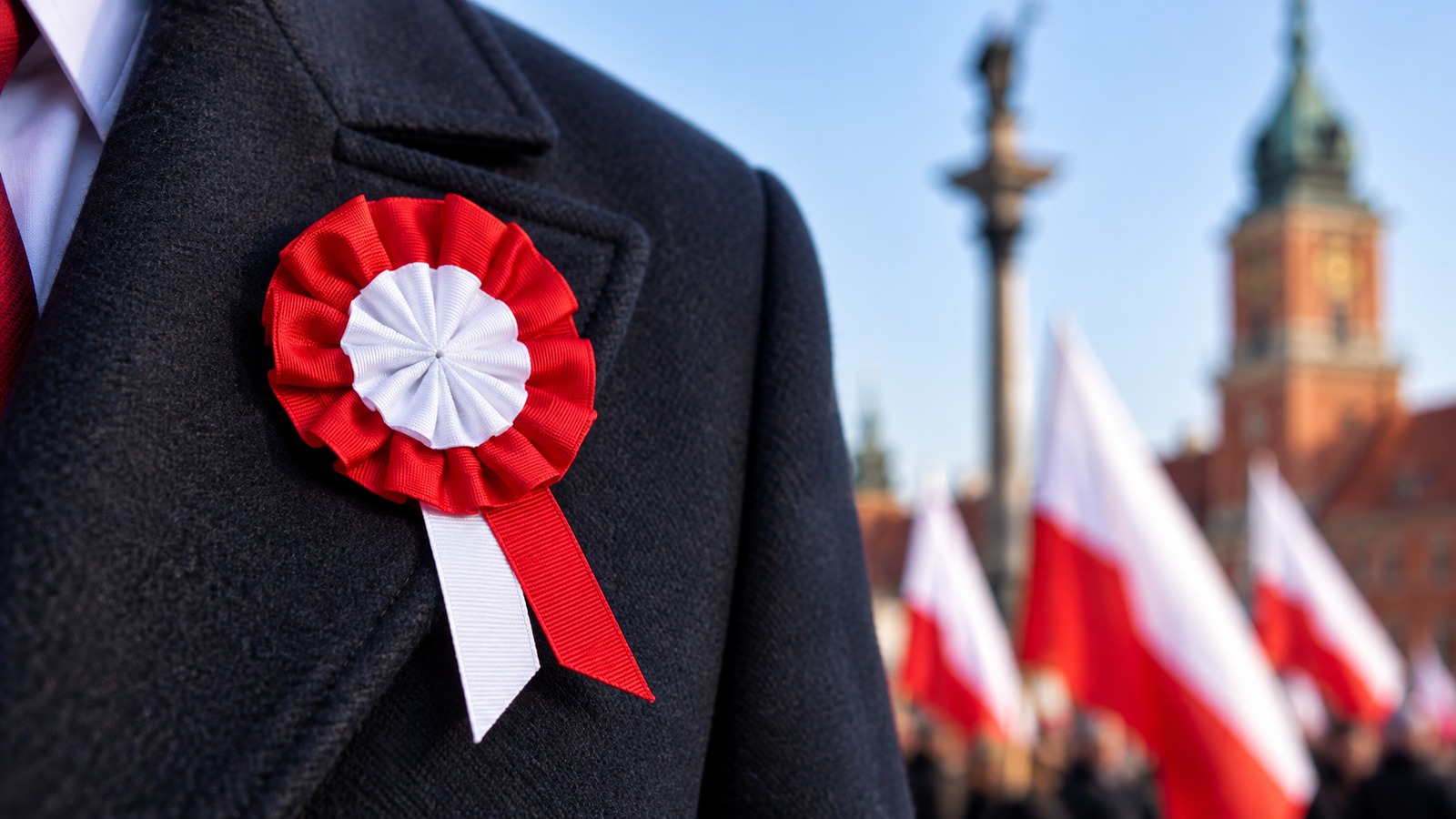
They are simple decorations, usually made from two circles of folded ribbon and pinned over the heart. Yet behind these modest symbols lies almost two centuries of Polish history.
Known as the kokarda narodowa, or national cockade, the rosette traces its formal origins to 7 February 1831, when the parliament of the Kingdom of Poland adopted a resolution establishing white and red as the colours of the national cockade.
- Find more news from Poland on our Homepage .
The decision came during the November Uprising, when Poles were fighting to end Russian domination.
Today, the same colours are worn during national commemorations, particularly Independence Day on 11 November and Constitution Day on 3 May.
But the origins of this small symbol are more complicated — and more interesting — than many people realise.
How white and red became Poland’s national colours
The Polish national colours have their roots in the heraldry of the medieval Polish state.
The White Eagle, Poland’s historic emblem, appears on a red shield. The coat of arms of the Grand Duchy of Lithuania, which formed a political union with Poland, likewise featured a white mounted knight known as the Pogoń on a red background.
These symbols provided the historical foundation for the combination of white and red.
Yet the colours were not always displayed according to today’s familiar conventions.
Before the nineteenth century, Polish military and patriotic symbols appeared in various colours and arrangements.
White cockades were particularly common among Polish soldiers, while other designs incorporated red or additional colours.
During the November Uprising, which began in Warsaw in November 1830, this variety became a practical problem.
Different groups fighting for the Polish cause wore different cockades.
Some supported retaining the traditional white design, while others favoured combining white and red.
The revolutionary parliament decided that a common national symbol was needed.
On 7 February 1831, both chambers of the Sejm of the Kingdom of Poland adopted a resolution establishing the national cockade in the colours of the coats of arms of Poland and Lithuania: white and red.
The Polish State Archives’ account of the original resolution identifies it as the first Polish legal act formally regulating national colours.
The resolution was adopted by a parliament operating during an uprising, not by the institutions of today’s Republic of Poland.
It nevertheless established a symbolic combination that would survive the uprising’s defeat and remain associated with Polish independence.


A symbol carried through generations of uprisings
The November Uprising ended unsuccessfully in 1831, but the white-and-red cockade continued to appear in Polish patriotic movements.
During the nineteenth century, when Poland remained partitioned between neighbouring powers, national colours provided a visible expression of political identity.
They appeared in demonstrations, on clothing and among participants in subsequent independence struggles.
The tradition continued into the twentieth century.
According to the Institute of National Remembrance’s study of the Greater Poland Uprising, white-and-red cockades and ribbons were worn by participants in the 1918–1919 uprising against German rule.
These symbols appeared on military headgear and civilian clothing, alongside white-and-red armbands and flags.
For people living under foreign rule, displaying Polish colours was a way of making their national identity visible.
When Poland regained independence in 1918, the colours that had accompanied generations of independence movements became symbols of the restored state.
The newly independent Polish parliament formally established white and red as the national colours in legislation adopted on 1 August 1919.
Is it a cockade or a kotylion?
In everyday Polish, the white-and-red rosette is frequently called a kotylion.
However, heraldic specialists distinguish the two terms.
A kokarda narodowa is a national cockade — a circular badge displaying national colours.
A kotylion, in its traditional meaning, is a decorative ornament associated with social dances and festivities.
The names have become blurred in popular usage, especially when children make paper or ribbon rosettes at school.
But the Institute of National Remembrance’s illustrated publication Polska kokarda narodowa emphasises the distinction.
There is also a lesser-known detail about the colours themselves.
In the contemporary heraldic arrangement, the Polish national cockade normally has a white centre surrounded by red.
This places the white of the national emblem at the centre and the red of the heraldic shield around it.
Historical examples, however, were not always arranged that way.
During the 1831 uprising, soldiers sometimes added a red central disc to an existing white cockade, producing a red centre surrounded by white.
That early arrangement is documented in historical accounts of the uprising.
The IPN’s heraldic guidance also notes that a red centre with a white outer ring can be appropriate when an additional White Eagle emblem is placed on the cockade.
These distinctions explain why historical illustrations and modern school-made cockades sometimes appear to show the colours in different orders.
The familiar contemporary form remains white in the middle and red around the outside.
Why the tradition continues today
The cockade is now most closely associated with national commemorations.
During Independence Day celebrations, it can be seen on the jackets of officials, schoolchildren and people attending ceremonies.
It is traditionally worn on the left side of the chest, close to the heart.
Schools across Poland and Polish communities abroad also organise activities in which children make their own white-and-red cockades.
Such workshops give younger generations an opportunity to learn about Polish national symbols and their historical origins.
One example comes from the Polish school attached to the Consulate General in Toronto, which has organised children’s cockade-making activities using the traditional white-centre, red-outer-ring arrangement.
For families living outside Poland, the symbol offers a particularly accessible connection to Polish heritage.
It requires no elaborate costume or ceremony. A small piece of folded ribbon is enough to display the same colours that generations of Poles carried through struggles for independence.
This year, Poland’s Independence Day falls on Wednesday, 11 November 2026.
When white-and-red cockades appear once again on jackets and school uniforms, they will carry a history that reaches back to an uprising almost 200 years ago.
What looks like a simple ribbon decoration is, in fact, one of Poland’s enduring symbols of national identity.