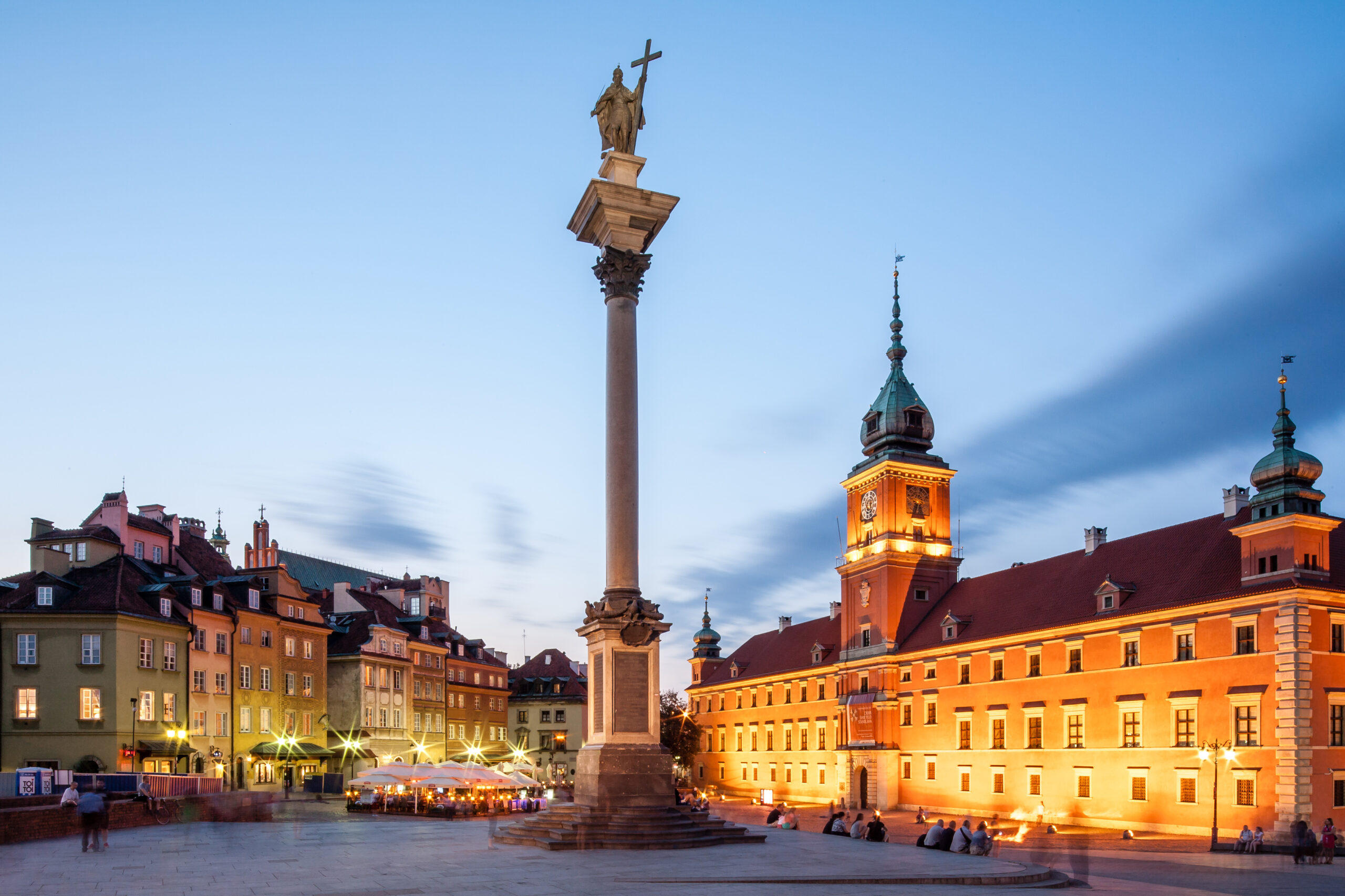
On 24 November 1644, Warsaw unveiled something extraordinary: a king standing high above the city on a monumental stone column.
Today, Sigismund’s Column is such a familiar part of Warsaw’s skyline that its original boldness is easily overlooked. Yet when it appeared 382 years ago, the monument challenged a tradition that had shaped European public art for centuries.
According to the Museum of Warsaw, it was the first monumental column in early modern Europe erected to honour a secular individual.
- Find more news from Poland on our Homepage .
The figure at its summit was King Sigismund III Vasa, who had died in 1632. The man responsible for placing him there was his son and successor, King Władysław IV.
What began as a demonstration of royal prestige would eventually become one of Poland’s most recognisable monuments.
Why putting a king on a column was so unusual
Monumental columns were hardly a new invention.
Ancient Rome had used them to celebrate emperors and military victories. In Christian Europe, however, the practice of placing figures high above public spaces had become strongly associated with religious imagery.
Columns topped with the Virgin Mary, Christ or saints were familiar features of the Catholic world.
Warsaw’s new monument departed from that convention.
Instead of a religious figure, its summit carried the image of a deceased monarch: an earthly ruler presented on a scale normally associated with sacred subjects.
The statue depicted Sigismund III wearing armour, a royal crown and a ceremonial cloak. He held a sabre in one hand and a large Latin cross in the other.
The combination was deliberate. It presented the king as both a military leader and a defender of the Catholic faith.
The choice was also politically significant.
Sigismund III had ruled the Polish-Lithuanian Commonwealth, a vast state encompassing territories across much of present-day Poland, Lithuania, Belarus and Ukraine.
His son Władysław IV inherited the family’s dynastic ambitions, but Poland’s monarchy was elective: successive rulers had to secure the support of the political elite rather than automatically inherit the throne.
The column helped strengthen the prestige of the Vasa dynasty in a political system where royal authority could not simply be taken for granted.
There was also a religious dimension to the monument’s unconventional design.
Traditional accounts connect the project with objections from the papal nuncio, Mario Filonardi. However, historians have questioned how important the column actually was in the wider dispute between the nuncio and the Polish royal court.
The monument’s artistic innovation is much less disputed than the precise extent of the controversy surrounding it.
An engineering achievement involving four artists
Creating the column required an unusually ambitious combination of sculpture, architecture and engineering.


The project brought together specialists associated with the Polish royal court.
Agostino Locci the Elder, an Italian-born architect and designer, was responsible for the monument’s placement within Warsaw’s urban landscape.
Constantino Tencalla developed its architectural form and oversaw the demanding technical work.
The sculptor Clemente Molli created the figure of Sigismund III, while Daniel Tym cast the statue and decorative elements in bronze.
Even the stone itself had a remarkable history.
Decades earlier, Sigismund III had ordered enormous stone shafts from quarries near Chęciny, in southern Poland, for a monument celebrating his own military achievements.
The original project failed after one of the shafts fractured during preparation.
Following Sigismund’s death, Władysław IV revived the idea, using a surviving section of stone for the memorial to his father.
Transporting the enormous shaft to Warsaw was a major undertaking.
Measuring nearly nine metres, the stone was hauled by oxen towards Kraków before being carried along the River Vistula on a raft.
It arrived in Warsaw in June 1643.
Raising such a heavy monolith required specially constructed scaffolding, lifting equipment and considerable engineering expertise.
The finished monument was approximately 24 metres high, with a striking combination of reddish stone, dark architectural elements and gilded bronze.
Its appearance was markedly different from the predominantly grey monument seen today.
The royal court also understood the publicity value of the achievement.
In 1646, engraver Wilhelm Hondius produced an elaborate print depicting the column and illustrating aspects of its construction.
The engraving helped present the project beyond Poland as evidence of the artistic and technical capabilities of Władysław IV’s court.
A monument designed to project royal power
The column occupied one of Warsaw’s most prominent locations, near the Royal Castle and the former Kraków Gate.
This was an important entrance to the city and a meeting point of major routes.
The monument was designed to be seen.
Its commanding position made Sigismund III a permanent presence above the streets, reminding visitors of the dynasty’s achievements and ambitions.
The bronze plaques attached to its pedestal reinforced that message.
Their Latin inscriptions celebrated the king’s reign, military victories and claim to the Swedish crown.
Sigismund had inherited the Swedish throne but lost effective control of it following political and religious conflict. His descendants nevertheless continued to assert their dynastic rights.
The inscriptions therefore did more than commemorate a deceased ruler. They publicly promoted the political identity and ambitions of the Vasa family.
For a monument ostensibly dedicated to remembrance, it was also an unusually direct statement about power.
Destruction, reconstruction and survival
Over the following centuries, Sigismund’s Column survived wars, political upheaval and major changes to Warsaw’s appearance.
Its surroundings were transformed as buildings and gates were demolished, gradually creating the open Castle Square familiar today.
The monument itself underwent several restorations, including the replacement of its original stone shaft in the nineteenth century.
Its most dramatic destruction came during the Second World War.
On 2 September 1944, during the Warsaw Uprising, German shellfire brought down the column.
The stone shaft shattered, and the bronze statue of Sigismund III fell to the ground.
Although damaged, the statue survived and was subsequently repaired.
The column was reconstructed after the war as part of the wider rebuilding of Warsaw.
The restored monument was unveiled on 22 July 1949, this time with a new shaft made from grey granite quarried near Strzegom.
It was also moved slightly from its previous position.
Today, much of the monument’s bronze work survives from the seventeenth century, while its stone structure reflects later rebuilding campaigns.
Fragments of its earlier shafts can still be seen near Castle Square.
They offer a tangible reminder that the landmark has repeatedly changed, even as its symbolic importance has endured.
For visitors walking through Warsaw’s Old Town, Sigismund’s Column is an almost unavoidable sight.
But the king standing above the square represents far more than a familiar meeting point.
In 1644, the monument introduced an exceptionally ambitious form of secular royal commemoration to early modern Europe.
Nearly four centuries later, that architectural experiment remains central to the image of Poland’s capital.