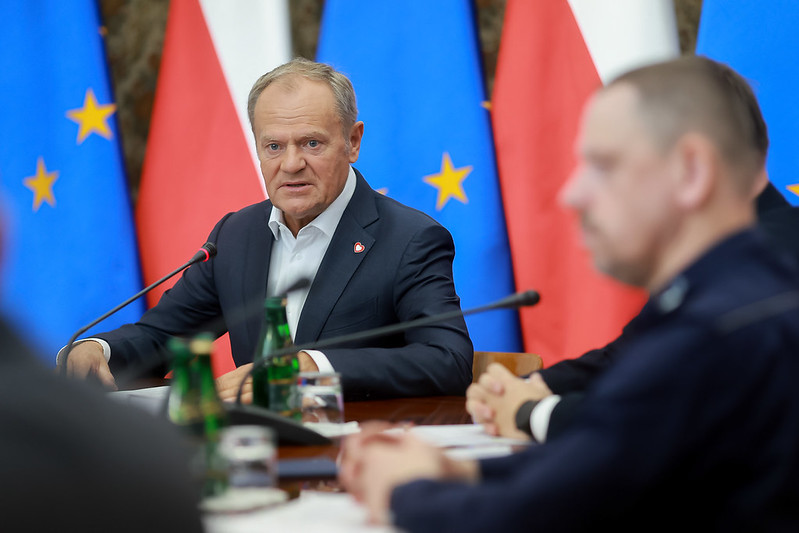
Nearly half of respondents in a new Polish opinion poll believe Prime Minister Donald Tusk’s governing coalition will lose power after the country’s parliamentary election in 2027. According to a survey conducted by the Instytut Badań Pollster for the newspaper Super Express, 47% of those questioned expect the current government to leave office, while 30% believe it will remain in power. Another 23% said they were unable to predict the outcome, highlighting considerable uncertainty about Poland’s political future.
The findings were published by Super Express on 3 November, drawing on polling carried out on 26–27 October.
The survey involved 1,029 adult respondents across Poland.
- Find more news from Poland on our Homepage .
Participants were asked whether they believed the current governing coalition, led by Tusk, would retain power following the parliamentary election scheduled for 2027.
The results show a 17-percentage-point difference between those expecting the coalition to lose office and those expecting it to continue governing.
However, the largest group of respondents did not constitute an absolute majority, and almost one-quarter were unable to offer an assessment.
Crucially, the findings concern public expectations rather than intended votes.
They therefore do not establish how respondents would vote, which parties would win seats or what government could eventually be formed.
What the latest poll shows
According to the Pollster survey, 47% of respondents believed the current coalition would not remain in power after the next parliamentary election.
A further 30% expected Tusk’s government to secure another term.
The remaining 23% said they did not know what would happen.
The results suggest that more respondents anticipated a change of government than expected the current administration to continue.
Yet predicting an election outcome and expressing a voting preference are different exercises.
Someone who supports the governing coalition may still believe it will lose the next election. Equally, an opposition supporter may expect the current government to remain in office.
As a result, the survey should not be interpreted as showing that 47% of voters support removing Tusk’s government.
Nor does it demonstrate that 47% intend to vote for opposition parties.
The distinction is particularly important in Poland’s parliamentary system, where several parties may need to negotiate a governing majority after an election.
Another October survey found similar expectations
The Pollster findings follow another survey examining public expectations for the 2027 election.
A separate poll conducted by United Surveys by IBRiS for Wirtualna Polska on 16–18 October found that 61.7% of respondents expected Tusk and his political camp to lose power.
In that survey, 29.6% believed they would remain in office, while 8.7% were unsure.

Those results were published by Wirtualna Polska on 23 October.
Although both surveys found substantial scepticism about the coalition remaining in power, they were conducted by different polling organisations and used differently structured questions.
Their results therefore cannot be treated as a direct measure of changing public opinion between the two dates.
The difference between the percentages does not, by itself, establish that the government’s electoral prospects improved or deteriorated.
Nevertheless, both studies indicate that expectations of a change of government are present among sizeable sections of the electorate.
Why some respondents expect a change of government
Political analyst Sergiusz Trzeciak, interviewed by Super Express about the Pollster findings, identified several issues that he believes may contribute to doubts about the coalition’s ability to remain in office.
He pointed to economic pressures, concerns about public finances and healthcare, tensions within the governing coalition and dissatisfaction with the pace of promised reforms.
Trzeciak also referred to the visibility of right-wing opposition parties and criticism of the government on social media.
These were the analyst’s interpretations of the political situation, rather than factors independently established as causes of respondents’ answers by the survey.
The published results do not provide a detailed breakdown showing which individual issues most influenced those questioned.
Tusk’s coalition has faced disagreements among its constituent parties, while its relations with President Karol Nawrocki have also been marked by disputes over legislation and institutional authority.
Poland’s ongoing Constitutional Tribunal crisis has introduced further tension into the country’s political environment.
However, the latest Pollster survey was completed on 27 October, before the dispute over the Tribunal’s leadership escalated at the end of the month.
It would therefore be inaccurate to attribute the survey’s findings to those subsequent events.
What separate voting-intention polls show
A different picture emerges when voters are asked which parties they currently support rather than who they expect to govern after 2027.
A separate party-support survey conducted by Pollster for Super Express during the same period, 26–27 October, put Tusk’s Civic Coalition (KO) on approximately 33.4%.
The opposition Law and Justice (PiS) party received approximately 22.4%.
Confederation was recorded at around 12.2%, while Confederation Crown of Poland received approximately 7.8%.
The New Left was on approximately 7.1%.
The figures appear in Pollster’s October polling data, which also records support for several smaller parties.
These figures measure party preferences and should not be confused with the separate survey of expectations about the next government.
They also underline an important feature of the Polish electoral system: the party attracting the most votes does not necessarily form the next government.
That depends on the distribution of seats in parliament and the alliances that parties are prepared to establish.
Why coalition arithmetic matters in Poland
Poland’s current government emerged after the October 2023 parliamentary election, when PiS won the largest number of seats but did not secure a majority.
According to the official results published by Poland’s National Electoral Commission, PiS obtained 194 seats in the 460-member Sejm.
Civic Coalition secured 157 seats, the Third Way alliance of Poland 2050 and the Polish People’s Party won 65, and the New Left gained 26.
These latter groupings formed the parliamentary majority that enabled Tusk to become prime minister in December 2023.
The result demonstrated how multiple parties can form a government even when none wins the largest number of seats individually.
For the next election, the ability of parties to cross electoral thresholds, secure parliamentary representation and negotiate agreements will again be central to the formation of a government.
A party-support poll does not automatically translate into a parliamentary majority.
Likewise, a survey asking whether the present coalition will remain in office cannot establish which parties might govern in its place.
Different coalition arrangements could produce different parliamentary outcomes.
That uncertainty helps explain why the 23% of respondents who could not predict the next government’s composition are an important part of the Pollster findings.
Poland’s next parliamentary election is due in 2027
Poland’s parliamentary term normally lasts four years, placing the next general election in autumn 2027.
The election will determine the composition of the Sejm and Senate, although the formation of a government will depend on the parliamentary balance following the vote.
Between now and the election, parties may change their strategies, alliances and campaign priorities.
Public opinion can also shift in response to economic developments, government decisions, political disputes and other events.
Trzeciak himself cautioned in his comments to Super Express that the political situation remains fluid and that the eventual outcome is not predetermined.
The latest survey provides a snapshot of expectations among respondents in late October 2026.
Its clearest finding is that more people expected the governing coalition to lose office than believed it would remain in power.
But the poll does not establish who will win the election, which parties might form a majority or whether Donald Tusk will continue as prime minister after 2027.
Those questions remain unresolved.