Poland’s national police chief has defended the deployment of officers at the Constitutional Tribunal after a police trade union questioned the legality of their actions and warned that individual officers could face consequences for their involvement in the escalating constitutional crisis.
Inspector General Marek Boroń issued a letter to police personnel on Sunday, 1 November, insisting that the operation around the tribunal’s Warsaw headquarters had been conducted lawfully.
His intervention followed an open letter from Policyjna Solidarność, a police trade union whose representatives said officers were concerned about being drawn into a political and institutional dispute.
- Find more news from Poland on our Homepage .
Boroń rejected suggestions that police had taken sides in the confrontation between Prime Minister Donald Tusk’s government, President Karol Nawrocki and the tribunal’s disputed leadership.
He also denied that a separate nationwide police-readiness order, issued two days before the confrontation, had been connected to preparations for the operation.
The disagreement highlights the difficulties facing law enforcement when public safety operations take place amid competing claims about the authority of a constitutional institution.
Police chief insists officers acted within the law
In his letter published by Poland’s National Police Headquarters, Boroń said officers had been deployed because of the risk of violence and disorder around the Constitutional Tribunal.
The operation took place on Friday, 30 October, and continued during the early hours of Saturday as demonstrators gathered outside the institution’s headquarters on Aleja Szucha in Warsaw.
Boroń argued that the police had a responsibility to protect both people inside the tribunal and those participating in demonstrations outside.
He maintained that officers had acted in accordance with the law and applicable professional standards.
Their responsibility, he said, was to carry out the duties established by the Police Act rather than determine who should lawfully control the Constitutional Tribunal.
Boroń also assured officers that he accepted responsibility for directing the police response and would support personnel who had carried out their duties lawfully.
In one of his central statements, he declared that “the police are never a party to any dispute”, describing their function instead as maintaining public safety.
He rejected suggestions that the force should be used to advance political interests.
However, the chief’s assurance that the operation was lawful represents the position of police leadership.
It is not an independent judicial ruling on every decision made during the deployment.
The tribunal’s leadership dispute remains unresolved, and questions about particular operational decisions have not been conclusively settled.
Police union warns officers fear legal consequences
Boroń’s intervention followed a letter dated Saturday, 31 October, from the Policyjna Solidarność trade union.
The union’s chairman, Jacek Łukasik, called on police leadership to explain the force’s position following the extraordinary events at the tribunal.
Policyjna Solidarność, established in 2024 and affiliated with the OPZZ trade union federation, is one of the organisations representing police personnel.
It should not be confused with a statement representing every police officer or police union in Poland.
In the union’s open letter, reproduced in full by Pressmania, Łukasik said the organisation had received reports of serious concerns from officers serving in different parts of the country.
Some questioned whether actions taken around the Constitutional Tribunal could amount to unlawful interference with a constitutional institution.
The letter referred to Articles 127, 128 and 231 of Poland’s Criminal Code, which concern offences including attempts to undermine the constitutional order, certain forms of interference with constitutional bodies and abuses of official authority.
Those references were part of the union’s expression of concern. They were not findings that police officers had committed offences under those provisions.
The union also questioned whether sufficient protection was being provided to officers carrying out instructions from their commanders.
It warned that police personnel could find themselves facing allegations about actions over which they had limited operational control.
Another concern involved the experience of officers deployed to Warsaw.
Łukasik said some were relatively young personnel undertaking practical service following their initial police training.
The union argued that these officers might lack experience of particularly sensitive public-order operations.
It also reported receiving questions from officers’ families about their safety and possible legal exposure.
The letter called for clearer leadership, public reassurance and an explanation of the legal basis for police activity.
Union raises concerns about morale and political pressure
Beyond the immediate legal questions, Policyjna Solidarność warned that the confrontation could damage morale within the force.
It argued that officers should not be left feeling responsible for resolving disputes between political and judicial institutions.
The union described concerns that police were being placed in the middle of decisions made by others.
It also referred to previous periods of discontent within the service and warned that uncertainty could worsen relations between frontline officers and senior command.
These statements represent the union’s assessment of the situation.
There is no verified evidence that police units have collectively refused orders, withdrawn from duty or begun an organised rebellion against their commanders.
Nor does the union’s letter establish that a majority of Polish officers believe the tribunal deployment was unlawful.
Nevertheless, its publication shows that the confrontation has generated a formal response from an organisation representing police personnel.
That response prompted Boroń to address the force publicly.
His letter sought to reassure officers while also rejecting claims that the operation had crossed the line between policing and political involvement.
Why was police readiness increased before the confrontation?
A separate controversy concerns an internal police communication dated 29 October, the day before the main tribunal confrontation.
The document was signed by Deputy Police Chief Tomasz Michułka and sent to regional commanders.
It instructed specified public-order units forming part of the national police reserve to maintain readiness for immediate deployment between 2 and 8 November 2026.
According to reporting that reproduced passages of the document, the instructions included requirements for protective equipment, communications equipment and firearms.
Some equipment listed, including submachine guns, bulletproof vests and night-vision devices, prompted questions about the nature of the anticipated operation.
Because the readiness instruction was issued shortly before police were deployed at the Constitutional Tribunal, speculation emerged that the two developments were connected.
Boroń rejected that suggestion.
He said the earlier communication had “nothing to do with events concerning the Constitutional Tribunal” or other public demonstrations.
According to the police chief, the readiness arrangements were connected to security threats facing Poland, including possible sabotage, destabilisation and hostile activity originating beyond the country’s eastern border.
The National Police Headquarters had already publicly denied a connection with the tribunal on 30 October.
That statement described the order as a response to current sabotage and diversion threats.
The document’s timing is confirmed, as is the existence of the readiness instruction.
However, timing alone does not prove that it was prepared for the Constitutional Tribunal operation.
Equally, the police leadership’s denial is its official explanation, not independent evidence of the complete operational planning behind the order.
No verified information establishes that the reserve units covered by the 2–8 November instruction were specifically intended for the tribunal confrontation.
What happened at the Constitutional Tribunal?
The police operation took place during an escalating dispute over the management of Poland’s Constitutional Tribunal.
On 30 October, judge Anna Korwin-Piotrowska announced measures intended to interrupt the official duties of tribunal president Bogdan Święczkowski and vice-president Bartłomiej Sochański.
She subsequently assumed responsibility for directing the institution’s work.
Święczkowski, Sochański, President Nawrocki and opposition politicians dispute the legality of those measures.
The government’s supporters argue that action is necessary to restore the functioning of the constitutional court following years of contested appointments and disagreements about judicial independence.
The police deployment followed communications from Korwin-Piotrowska and Prosecutor General Waldemar Żurek concerning possible threats to people working at the tribunal.
According to the Warsaw police’s explanation reported at the time, officers were initially stationed on the tribunal’s grounds rather than inside its building.
Police said their task was to protect public safety and respond to disturbances.
During the demonstrations, clashes took place near security barriers.
The Associated Press reported that three protesters were detained after incidents involving the tribunal’s perimeter and objects being thrown at police.
President Nawrocki interrupted a journey to Senegal and returned to Warsaw.
He visited the tribunal during the night and subsequently accused those seeking to change its leadership of acting unlawfully.
Prime Minister Tusk offered the opposing interpretation in a nationally televised address on Saturday evening.
He defended the measures intended to allow newly elected judges to carry out their duties and argued that the police had acted to protect the institution.
Poland-24 has published a detailed report on Tusk’s address and his defence of the government’s position.
Neither political leader’s interpretation settles the underlying constitutional questions.
Why police neutrality matters in a constitutional crisis
Poland’s Police Act establishes the force as an institution responsible for protecting people’s safety and maintaining public order.
The legislation sets out duties including protecting life, health and property, maintaining order in public places and preventing criminal offences.
Those responsibilities continue to apply during political demonstrations and disputes between state institutions.
However, their exercise must remain within the limits of the law.
The challenge in the Constitutional Tribunal confrontation is that the authorities involved disagree about the legitimacy of the decisions governing the institution.
This creates a distinction between providing security at a public building and determining who is lawfully entitled to exercise authority inside it.
Boroń’s letter emphasises the first responsibility.
He argues that police were protecting people and responding to public-order risks rather than deciding the constitutional dispute.
The trade union’s letter raises concerns about whether particular actions might nevertheless expose officers to accusations of interfering with a constitutional institution.
Those competing positions do not automatically establish wrongdoing on either side.
Determining whether a particular police action was lawful would require examining the instructions given, the circumstances officers encountered and the legal powers under which they acted.
It would also require distinguishing the responsibilities of commanders who authorised an operation from those of officers carrying out specific tasks.
Have prosecutors opened proceedings against police officers?
As of 2 November, no formal investigation specifically into alleged criminal conduct by officers during the 30–31 October tribunal deployment had been independently confirmed.
That does not mean the broader confrontation is free of legal consequences.
On Monday, spokesperson Piotr Antoni Skiba of the Warsaw Regional Prosecutor’s Office confirmed that prosecutors had received several notifications concerning recent events at and around the Constitutional Tribunal.
The Polish Radio report on his statement said the notifications concerned conduct associated with different sides of the political dispute.
Prosecutors were assessing the submissions.
The identities of everyone named in those notifications and the specific conduct under examination had not been fully established in the reporting available at the time.
Receiving a notification also does not mean prosecutors have formally opened an investigation or established that a crime occurred.
The president’s office has separately announced plans for criminal complaints concerning a confrontation between Nawrocki and people elected as tribunal judges.
Poland-24 has covered those allegations and the competing accounts of the incident.
That is a separate matter from the questions raised by the police trade union about officers’ responsibilities.
For now, the police chief has defended the operation and promised support for officers, while the union’s concerns about accountability and legal certainty remain on the public record.
The dispute illustrates a wider challenge created by Poland’s Constitutional Tribunal crisis: how police can maintain safety and public order without becoming entangled in competing claims to constitutional authority.
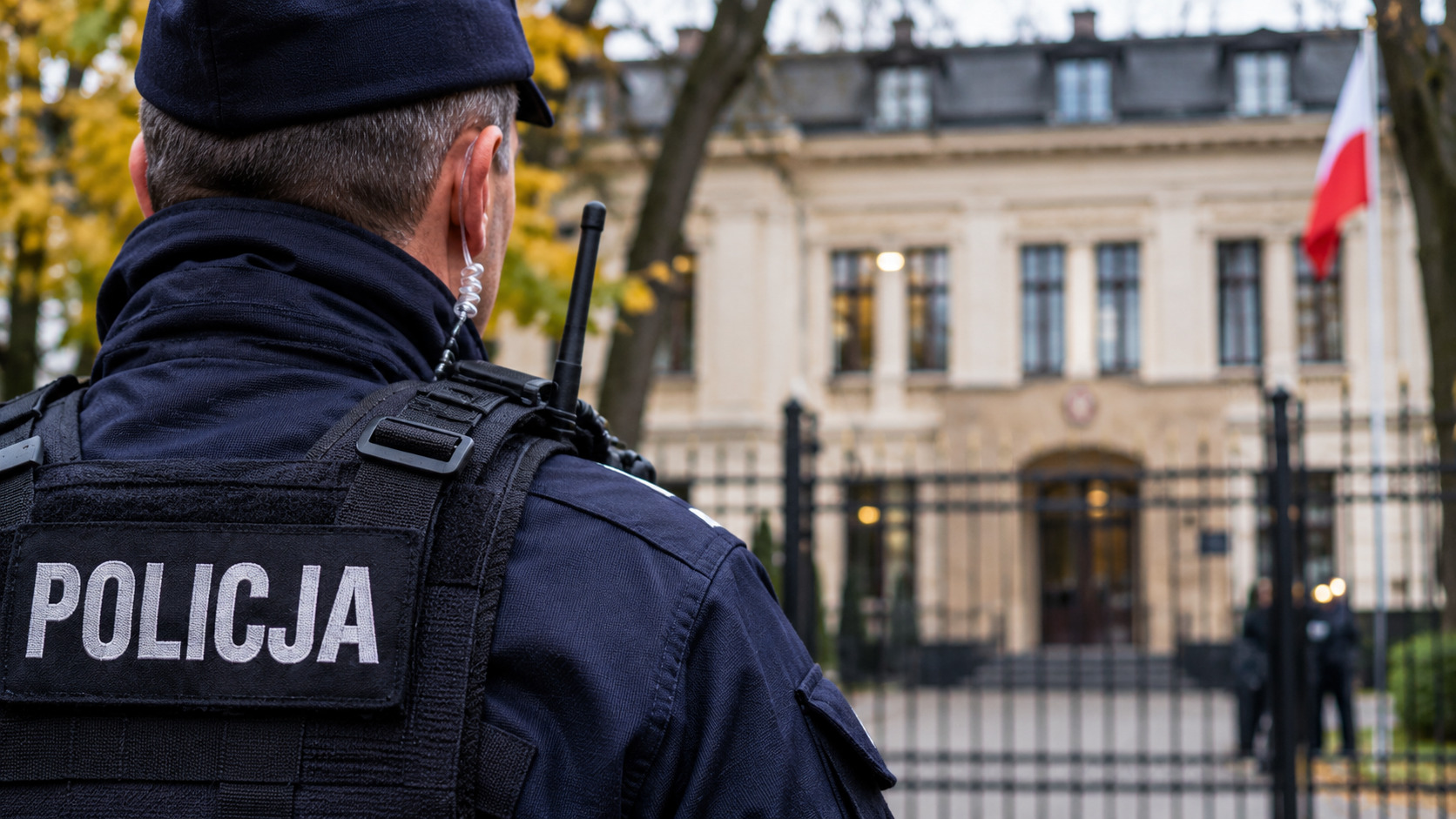
Featured image: Image created digitally for illustrative purposes. The visual is a conceptual depiction of a police officer, not a photograph of the Constitutional Tribunal operation.