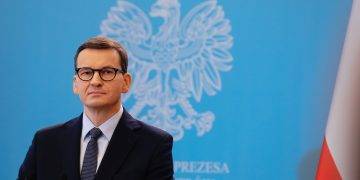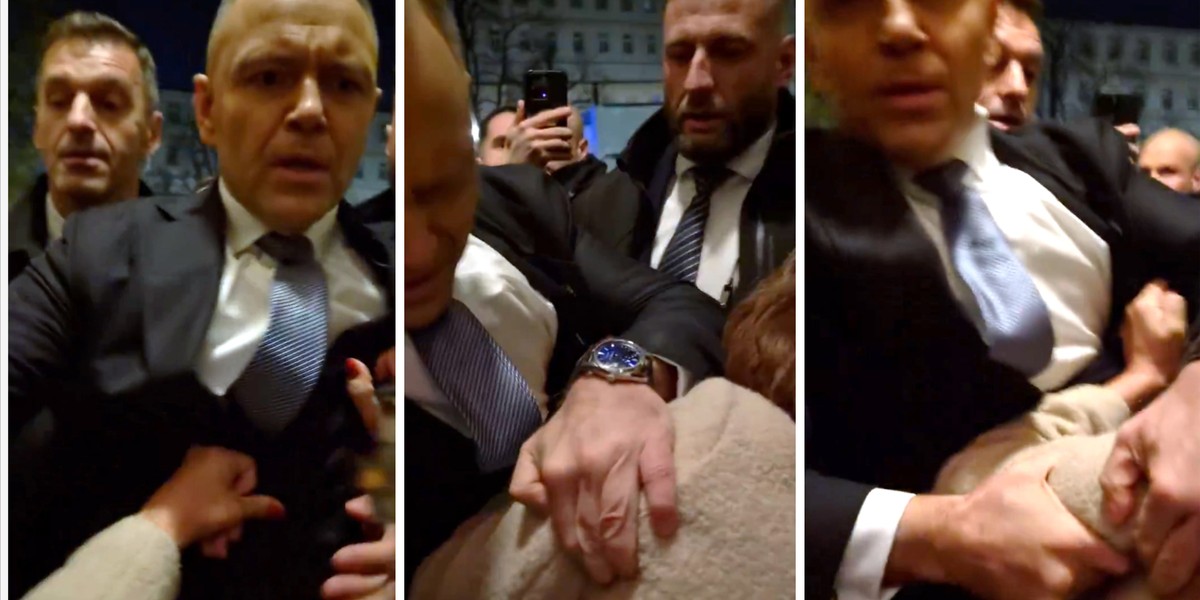
The office of Polish President Karol Nawrocki has announced plans to file criminal complaints against three people elected as judges of the Constitutional Tribunal, alleging that the president was physically assaulted during an overnight confrontation at the court’s Warsaw headquarters.
Presidential spokesperson Rafał Leśkiewicz announced the intended legal action on Sunday, 1 November, naming Anna Korwin-Piotrowska, Maciej Berek and Krystian Markiewicz.
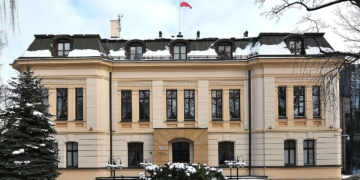
The announcement follows a confrontation during Nawrocki’s visit to the Constitutional Tribunal shortly after midnight on Saturday, 31 October, when the president attempted to enter the building amid a dispute over the institution’s leadership.
- Find more news from Poland on our Homepage .
Video recordings show physical contact between the president and people standing near the entrance. However, those involved have given conflicting accounts of the incident, with each side accusing the other of initiating the confrontation.
The Presidential Chancellery has not announced when its complaints will be submitted. As of Monday morning, 2 November, no completed filing or resulting criminal proceedings had been independently confirmed.
The development introduces the prospect of criminal investigations into events at the centre of Poland’s escalating constitutional crisis.
Presidential spokesperson names three people in planned complaints
Speaking during a Radio Wnet interview on Sunday, Leśkiewicz said the president’s office intended to take formal steps over what it regarded as unlawful interference with Nawrocki’s entry into the Constitutional Tribunal.
He identified Korwin-Piotrowska, Berek and Markiewicz as people whose behaviour could give rise to criminal liability.
The three were elected to the Constitutional Tribunal by the current Sejm, Poland’s lower house of parliament, but the president’s office disputes their authority to act as judges because of disagreements over the required oath-taking procedure.
Leśkiewicz accused them of preventing the president from entering the building and making unlawful physical contact with him.
The spokesperson said the Chancellery would take steps towards submitting notifications to prosecutors concerning suspected criminal offences.
He also rejected allegations that Nawrocki himself had acted aggressively.
According to Leśkiewicz, the recording published by Berek showed conduct that the president’s office considered criminal.
However, the spokesperson did not specify a date for submitting the complaints or identify the precise provisions that would be cited in the planned filings.
The Presidential Chancellery subsequently published its own account of statements made by presidential officials, confirming the office’s position that the alleged physical obstruction of the head of state was unlawful.
Those statements constitute allegations by the presidency. They do not establish that any of the three named individuals committed an offence.
What happened during Nawrocki’s overnight visit?
The incident followed an extraordinary sequence of events at the Constitutional Tribunal on Friday, 30 October.
Anna Korwin-Piotrowska had announced measures intended to suspend the official duties of tribunal president Bogdan Święczkowski and vice-president Bartłomiej Sochański.
She also assumed responsibility for directing the institution’s work.
The changes were challenged by Święczkowski, opposition politicians and the Presidential Chancellery, which disputed their legal validity.
You May Also Be Interested In

Nawrocki, who had been travelling to Senegal, interrupted his journey and returned to Warsaw after learning of the confrontation.
He subsequently went to the tribunal with members of his entourage, including senior judicial and presidential officials.
As the president approached the entrance, several people elected to the tribunal by the current parliament stood in the doorway.
The encounter resulted in physical jostling.
Maciej Berek published video recordings on X showing Nawrocki moving through the group, with people using their hands and bodies as he passed.
The recordings were widely reported in Polish media during the early hours of Saturday morning.
They provide evidence that physical contact occurred. However, the footage alone does not determine criminal responsibility or settle the disputed legal authority of those involved.
Judges and president give opposing accounts
Korwin-Piotrowska has accused Nawrocki of using force against her and the other people waiting at the entrance.
In an interview with TVN24, she said she had been standing near the door intending to greet the president and invite him to discussions.
According to her account, Nawrocki showed no willingness to speak and instead pushed his way through those assembled.
She described the president as forcing his way past the group before entering the building and challenging their authority to be there.
Berek also accused the president of physically attacking Korwin-Piotrowska and other judges.
In his account accompanying the published recordings, Berek said Nawrocki had chosen physical confrontation rather than the opportunity for a meeting.
The president’s representatives reject that interpretation.
Leśkiewicz maintained that Nawrocki had a right to enter the tribunal and that the people standing in the doorway had no authority to obstruct him.
The Presidential Chancellery also disputes Korwin-Piotrowska’s status as acting head of the institution.
The disagreement therefore extends beyond the immediate question of physical contact.
It includes whether the individuals involved had authority to control access to the tribunal, whether the president was lawfully exercising his powers and whether any force used during the encounter was legally justified.
According to Polityka’s reporting on Korwin-Piotrowska’s response, she is herself considering legal action over Nawrocki’s conduct.
There is no independently confirmed filing arising from that consideration either.
What criminal law could apply?
The presidential office’s announcement raises questions about the protection afforded to the head of state under Polish criminal law.
Article 135(1) of Poland’s Criminal Code addresses an active assault on the President of the Republic.
The provision carries a potential prison sentence of between three months and five years.
A consolidated text of the Criminal Code is available through Poland’s official legislation database.
Presidential minister Adam Andruszkiewicz referred to Article 135 in remarks published by the Chancellery on 1 November, alleging that attempts to physically block Nawrocki amounted to an offence under that provision.
However, the relevant legal classification has not been established.
It would be for prosecutors, and ultimately a court if a case proceeded, to determine whether the evidence supported any particular offence.
The fact that a person touched the president during a disputed encounter does not, by itself, establish every element required for criminal liability.
Equally, an allegation that a head of state used unjustified physical force does not establish that he committed an offence.
The precise circumstances, sequence of events, intent and applicable legal protections would all require examination.
In his Radio Wnet interview, Leśkiewicz also raised separate allegations concerning the broader confrontation over control of the Constitutional Tribunal.
Those claims involved the actions of public officials and the possible application of more serious constitutional offences.
They should not be confused with the specific alleged violation of the president’s bodily integrity.
Why the confrontation matters beyond the alleged assault
The dispute arises from a long-running conflict over the composition and authority of Poland’s Constitutional Tribunal.
The court reviews whether legislation and other legal acts comply with the Polish Constitution.
Its independence and the legality of judicial appointments have been contested since 2015.
Successive governments, presidents and judicial authorities have taken conflicting positions on appointments, court leadership and the status of some rulings.
The current government argues that reforms are necessary to restore lawful and independent constitutional review following changes introduced under the previous Law and Justice (PiS) administration.
The president and opposition politicians reject aspects of the government’s approach, accusing it of disregarding constitutional procedures in the name of restoring the rule of law.
These competing positions have intensified since parliament elected additional tribunal judges earlier in 2026.
The government maintains that the judges can lawfully perform their duties, while the presidency disputes the validity of the procedures by which some attempted to take office.
The conflict reached a new stage on 30 October, when the tribunal’s leadership arrangements were challenged and police were deployed around its headquarters.
Nawrocki’s overnight intervention brought the president personally into the confrontation.
Prime Minister Donald Tusk subsequently used a televised national address to defend the government’s position and argue that the state had a responsibility to protect judges and maintain order.
Poland-24 has reported on Tusk’s address and his accusations against PiS and the presidency.
A separate Poland-24 explainer traces the Constitutional Tribunal crisis from its origins to the present dispute.
The announcement of possible criminal complaints adds another layer to a confrontation that has already involved the executive branch, presidency, parliament and judiciary.
Have the criminal complaints been filed?
The immediate legal question is whether the Presidential Chancellery has formally submitted the notifications announced by Leśkiewicz.
The distinction is important.
A public declaration that criminal complaints will be filed is not the same as prosecutors receiving them.
It also does not mean that an investigation has been opened, anyone has been charged or a court has determined that a crime occurred.
The spokesperson did not provide a filing date during his Sunday interview.
Although a prosecutor was present at the Constitutional Tribunal during the original confrontation, that presence does not establish that the president’s subsequently announced complaints have been submitted or accepted.
As of the morning of 2 November, there was no independently verified confirmation of such a filing.
The next questions are whether the complaints will be lodged, how prosecutors will assess the evidence and whether the competing accusations by those involved result in separate legal proceedings.
Meanwhile, the institutional dispute continues.
Korwin-Piotrowska has announced plans for further action concerning the tribunal’s leadership and disciplinary arrangements, while the Presidential Chancellery maintains that the existing leadership remains legally entitled to exercise its functions.
For now, the president’s office has announced its intention to seek prosecutorial action against three people at the centre of the confrontation. Whether the incident leads to criminal proceedings — and against whom — remains unresolved.