A judge who has assumed control of Poland’s Constitutional Tribunal has announced plans to appoint disciplinary panels to examine the conduct of the court’s disputed president and vice-president, introducing another procedural confrontation into the country’s constitutional crisis.
Anna Korwin-Piotrowska said on Sunday, 1 November, that she intends to issue an order expanding the agenda of the tribunal’s General Assembly scheduled for Tuesday, 3 November.
The additional item would involve drawing the names of judges to sit on disciplinary panels dealing with allegations concerning tribunal president Bogdan Święczkowski and vice-president Bartłomiej Sochański.
- Find more news from Poland on our Homepage .
Korwin-Piotrowska previously ordered both men to stop performing their official duties for up to one month, citing alleged breaches of their responsibilities and the need to restore the institution’s functioning.
Święczkowski and Sochański reject those decisions and dispute Korwin-Piotrowska’s authority to issue them.
The next step therefore raises a central question: can a disciplinary procedure proceed when the people expected to organise it and those subject to it disagree over who lawfully controls the court?
As of Monday morning, 2 November, the new order extending Tuesday’s agenda had not been independently confirmed as issued.
Disciplinary panels planned for 3 November
Korwin-Piotrowska outlined her intentions in an interview with TVN24 on Sunday evening.
She said the allegations described in her earlier orders concerning Święczkowski and Sochański should form the basis for disciplinary proceedings.
According to the Polish Press Agency’s account of her interview, Korwin-Piotrowska said the tribunal’s disciplinary procedures require panels composed exclusively of Constitutional Tribunal judges.
She explained that a disciplinary court would consist of three judges at first instance and five judges on appeal.
The members would be selected by drawing lots, rather than appointed through an ordinary discretionary nomination.
Korwin-Piotrowska said she wanted the selection to take place under conditions of “absolute transparency”, so that the process itself could not be challenged for a lack of openness.
Her proposed order would add the drawing of panel members to Tuesday’s meeting.
However, an announcement of intended proceedings is not equivalent to a completed disciplinary hearing.
No panel has yet been independently confirmed as selected, and no disciplinary ruling against either man has been established.
What Polish law says about disciplinary proceedings
Poland’s 2016 law governing the status of Constitutional Tribunal judges sets out a system of disciplinary accountability within the tribunal itself.
Under Article 25 of the legislation, the tribunal acts as a disciplinary court, with three judges hearing cases at first instance and five judges sitting at the second instance.
The law also states that the tribunal president selects the members of those panels by drawing lots.
Judges who participated in the first-instance decision are excluded from the draw for the appellate panel.
You May Also Be Interested In


These provisions are significant because the planned selection of judges is taking place during a dispute over the identity and legal authority of the tribunal’s president.
Korwin-Piotrowska maintains that her earlier decisions temporarily removed Święczkowski and Sochański from their official functions, allowing her to direct the institution’s work.
Święczkowski rejects that interpretation and maintains that he remains the lawful president.
The existence of statutory disciplinary procedures is not itself disputed.
What remains contested is whether Korwin-Piotrowska is entitled to initiate and administer them in the present circumstances.
The distinction matters for the legitimacy of any subsequent disciplinary decision.
Why the tribunal’s leadership was ordered to stop working
On Friday, 30 October, Korwin-Piotrowska announced orders requiring Święczkowski and Sochański to stop performing their official duties for a period of up to one month.
She cited alleged misconduct in the management of the tribunal.
Among the accusations against Święczkowski was that he had prevented judges elected by the Sejm from participating in the court’s work.
Korwin-Piotrowska also alleged irregularities in the assignment of cases to judicial panels.
Another central concern was the tribunal’s failure to adopt a draft budget for 2027.
She argued that excluding judges from the General Assembly could prevent the institution from meeting its statutory obligations and threaten its ability to operate in the following financial year.
Those allegations are set out in the 30 October orders, which were reported in detail by Rzeczpospolita following their publication.
Święczkowski disputes the accusations and maintains that Korwin-Piotrowska lacks the authority to direct the tribunal.
The two sides also disagree about the status of judges elected by the current parliamentary majority.
Some of those judges were not sworn in before President Karol Nawrocki, who declined to receive their oaths.
Instead, they took their oaths through an alternative procedure.
The government regards the judges as lawfully elected and entitled to serve.
The president and Święczkowski challenge the legitimacy of that procedure.
That disagreement underpins the wider struggle over the tribunal’s management.
The 30-day deadline does not mean a final verdict
Korwin-Piotrowska said the disciplinary court would have 30 days to review the immediate interruption of Święczkowski’s and Sochański’s official duties.
This deadline concerns the temporary measure imposed against them.
It should not be understood as a requirement to complete every aspect of a substantive disciplinary case within that period.
The legal provision cited in connection with their removal is Article 130 of Poland’s Law on the Organisation of Common Courts, applied through provisions governing the status of Constitutional Tribunal judges.
Under the statutory procedure for an immediate interruption of judicial duties, a disciplinary court must decide whether the temporary measure should be replaced by a suspension or revoked.
The law imposes a maximum duration of one month on the initial interruption.
Korwin-Piotrowska maintains that the relevant provisions can be used in the tribunal’s present circumstances.
That interpretation is disputed, particularly because Article 130 describes powers held by the president of a court or the justice minister in the ordinary court system.
The question of how those powers apply to the Constitutional Tribunal and its president has prompted disagreement among constitutional lawyers.
Former Constitutional Tribunal president Jerzy Stępień told Rzeczpospolita that he could see a potential legal basis for Korwin-Piotrowska’s action but considered that a more detailed analysis was necessary.
Constitutional law professor Jacek Zaleśny, by contrast, argued that the procedure she had used lacked a valid legal foundation.
Former Constitutional Tribunal judge Ewa Łętowska described the situation as an exceptionally difficult legal problem without a straightforward solution.
The competing interpretations underscore why the proposed panel selection cannot be presented as a settled disciplinary process.
Rival orders threaten Tuesday’s meeting
The General Assembly planned for Tuesday, 3 November, was originally called to consider the tribunal’s proposed income and expenditure for 2027.
Order No. 1/2026, dated 30 October and published on the tribunal’s website on 31 October, identifies the budget as the meeting’s principal business.
Korwin-Piotrowska now intends to expand that agenda to include the disciplinary-panel draw.
But the meeting may face practical as well as legal obstacles.
On Saturday, Święczkowski issued a competing administrative order designating 3, 4, 5 and 6 November as days off for tribunal employees, with pay preserved.
He also challenged Korwin-Piotrowska’s instructions concerning the organisation of work inside the tribunal.
According to PAP’s reporting on Święczkowski’s order, he maintained that staff were not obliged to comply with instructions issued by people he considered unauthorised.
Korwin-Piotrowska, meanwhile, has imposed her own restrictions on access to the building.
She has stated that Święczkowski and Sochański are not entitled to enter the tribunal during the period covered by her orders.
Other judges have been told to work outside the premises or arrange access with her.
Those directions are also disputed.
Korwin-Piotrowska told TVN24 that she intended to contact judges personally on Monday to invite them to the General Assembly.
It remains unclear how many will attend, whether the required participation thresholds can be satisfied and whether any decisions taken will be recognised by both sides.
The rival administrative orders illustrate how the dispute has developed into a conflict over the tribunal’s day-to-day operation.
A separate dispute over criminal immunity
The disciplinary-panel proposal comes as the tribunal also faces requests from Prosecutor General Waldemar Żurek concerning the criminal immunity of Święczkowski and Sochański.
On 30 October, Żurek announced five applications to the Constitutional Tribunal.
Four concern Święczkowski and one concerns Sochański.
The applications seek permission to pursue potential criminal proceedings, rather than disciplinary sanctions.
They are legally distinct from the proposed disciplinary review of the temporary interruption of the two judges’ duties.
Korwin-Piotrowska has identified the General Assembly as the body responsible for considering immunity applications.
However, the validity of any proceedings would again depend on the disputed composition and authority of the tribunal.
A request to lift judicial immunity does not establish that an offence has been committed, nor does it mean that criminal charges have necessarily been brought.
These parallel procedures add to the institutional challenges facing the court.
A constitutional crisis with no agreed resolution
The latest announcement follows several days of confrontation involving judges, police, political parties and President Nawrocki.
After Korwin-Piotrowska’s initial orders on Friday, the president interrupted an overseas trip and returned to Warsaw.
He subsequently visited the tribunal during the night.
His office has accused those seeking to change the tribunal’s leadership of acting unlawfully.
Prime Minister Donald Tusk, meanwhile, defended the government’s position during a televised national address on Saturday evening.
Tusk argued that judges elected by parliament should be allowed to fulfil their responsibilities and pledged that the state would protect the tribunal’s independence.
Poland-24 has reported on Tusk’s televised address and the competing political claims.
The dispute also has a longer institutional history involving appointments to the court, contested rulings and the competing constitutional roles of parliament and the president.
Our Constitutional Tribunal crisis explainer examines that background and the reasons the court’s legitimacy has remained disputed for years.
The immediate question now concerns Tuesday’s proposed General Assembly.
Korwin-Piotrowska wants it to establish disciplinary panels capable of reviewing the measures taken against Święczkowski and Sochański.
Both men reject her authority, and the practical conditions for holding a valid meeting remain uncertain.
The planned disciplinary-panel selection marks a new stage in Poland’s Constitutional Tribunal confrontation. Whether the procedure can proceed — and whether any resulting decisions will be legally effective — remains unresolved.
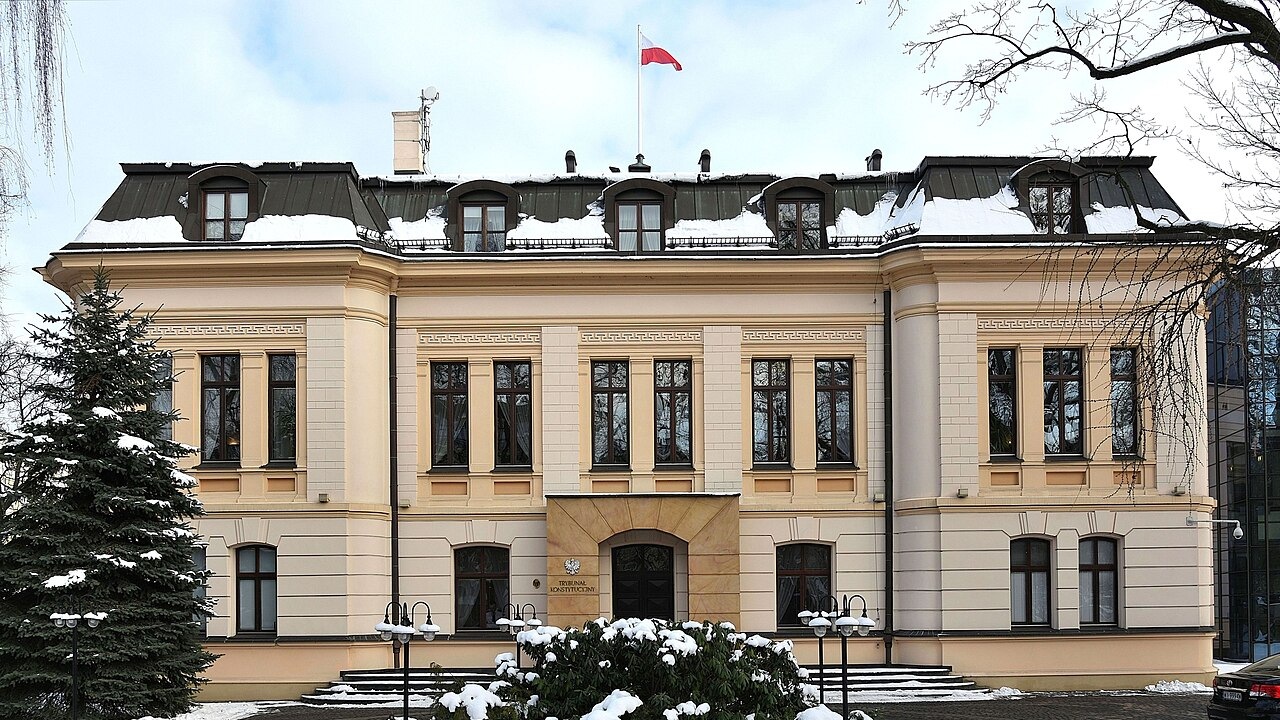
Featured image: Archival photograph of Poland’s Constitutional Tribunal headquarters, taken on 22 January 2016 by Adrian Grycuk / Wikimedia Commons. Licensed under CC BY-SA 3.0 Poland; cropped to 16:9.