

Poland is holding large-scale civil-protection drills across two eastern regions on Saturday, with residents being taught how to recognise air-attack warnings, respond to emergency messages and find a safe place to shelter.
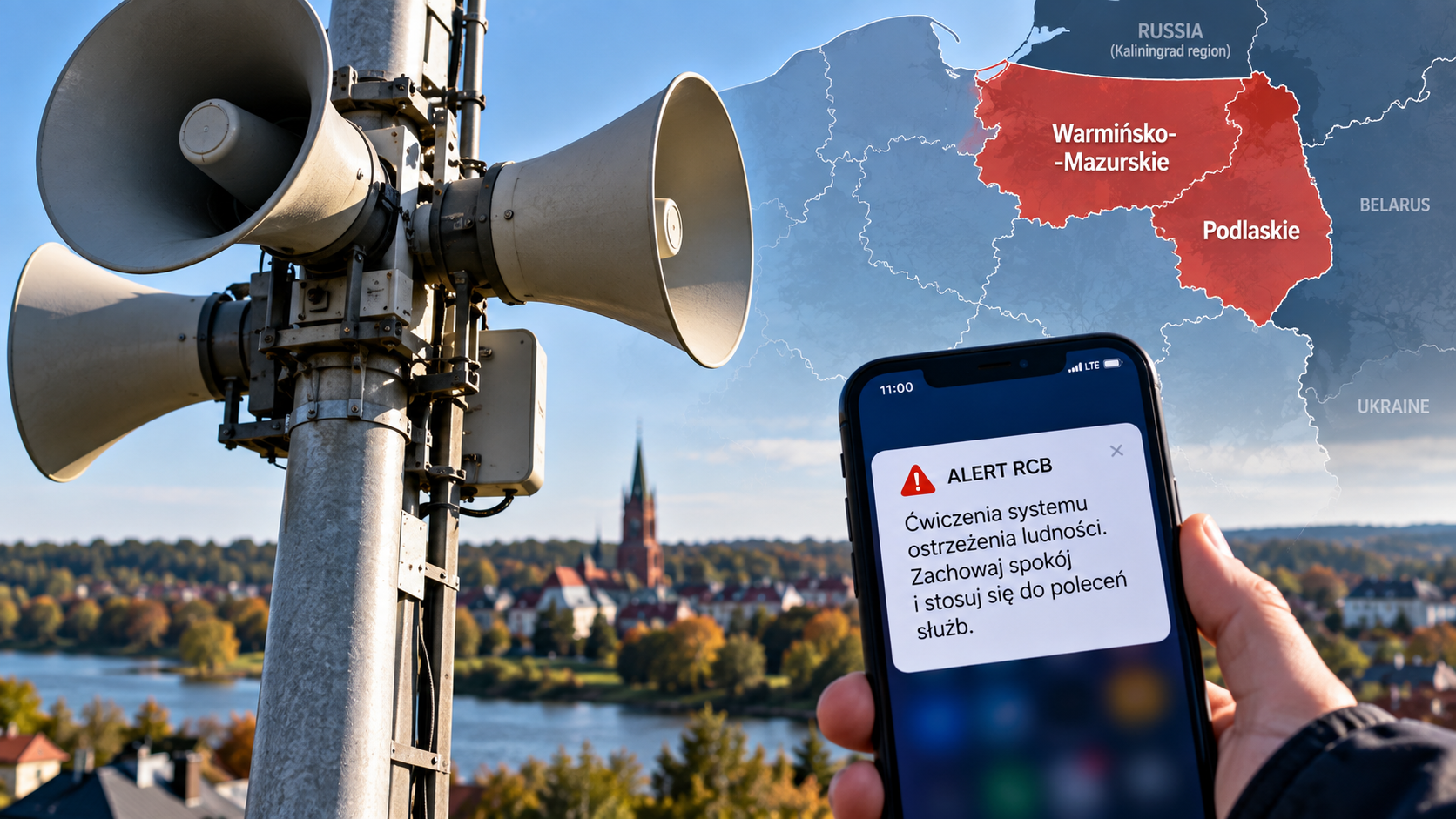
The Special Response Training (Specjalny Trening Reagowania) is taking place on 26 September across the Podlaskie and Warmińsko-Mazurskie regions, both of which lie on Poland’s strategically important north-eastern frontier.
The training is being organised by the Interior Ministry together with the State Fire Service (PSP) and Volunteer Fire Service (OSP) as part of Poland’s Civil Protection and Civil Defence Academy programme.
- Find more news from Poland on our Homepage .
Residents can participate between 11 a.m. and 2 p.m. at at least 260 fire and rescue units, fire stations and local educational points across the two regions.
The exercises are intended to familiarise civilians with the warning systems they could encounter during a real emergency.
Participants are being taught how to recognise alarm signals and official warning messages, including RCB emergency alerts, and what they should do after receiving them. Training also covers identifying suitable places to shelter and preparing households for a crisis.
The programme is specifically framed around responding to the threat of an air attack.
That gives Saturday’s training particular relevance in eastern Poland, where residents have experienced real emergency warnings connected with Russian attacks on neighbouring Ukraine.
Podlaskie borders Belarus and Lithuania, while Warmińsko-Mazurskie includes Poland’s border with Russia’s heavily militarised Kaliningrad region.
The exercise should not, however, be interpreted as a warning that authorities have identified a new or immediate military threat to the two regions. It is a scheduled public civil-protection training programme announced several days in advance.
Saturday’s event is also not Poland’s first exercise of this type.
Earlier this month, the same Civil Protection and Civil Defence Academy organised nationwide training in nearly 1,500 locations. More than 112,000 people participated, according to government figures, while almost 400,000 people had taken part in the academy’s activities since the beginning of 2026 by that point.
Special response training was also organised in the Lubelskie and Podkarpackie regions earlier in September.
The programme forms part of a much broader effort to rebuild Poland’s civilian preparedness.
Poland’s modern civil-protection framework was substantially reshaped by the 2024 Act on Civil Protection and Civil Defence, which established new responsibilities for public authorities, warning systems, shelters, training and preparation of the population for emergencies.
Recent events have put those systems under unusually close scrutiny.
On 17 September, residents in parts of eastern Poland received real RCB alerts and heard warning sirens as Polish authorities responded to a Russian air attack on western Ukraine. Schools and public institutions in Lublin and Rzeszów were among those that activated emergency procedures.
The warning system had already faced questions following a Russian missile incursion into Polish airspace on 30 July. Reporting on the incident found that an air-attack alarm was declared for 17 districts but sirens operated in only seven, while an RCB alert was not ultimately sent. The Interior Ministry subsequently worked on changes intended to improve how civilians are warned.
That recent experience helps explain why the government is placing increasing emphasis not only on the technology used to issue warnings, but also on whether people understand what those warnings actually mean.
The State Fire Service’s official information on civil-protection training says participants practise recognising alarm signals and warning messages and learn how to respond correctly after they are activated.


Local exercises go further.
In Nowa Wieś Ełcka, for example, residents are being taught how to distinguish population-warning sirens from ordinary Volunteer Fire Service signals, verify emergency information and prepare a family evacuation kit.
Elsewhere, training includes how to locate an appropriate place of shelter and how families can prepare their own emergency plans.
The programme therefore represents more than a test of sirens or mobile alerts. Its purpose is to train the people receiving those warnings to understand them and know what to do next.
For Poland’s eastern regions, that has become an increasingly practical part of civilian preparedness as the country adapts its emergency systems to the security environment created by Russia’s war against Ukraine.