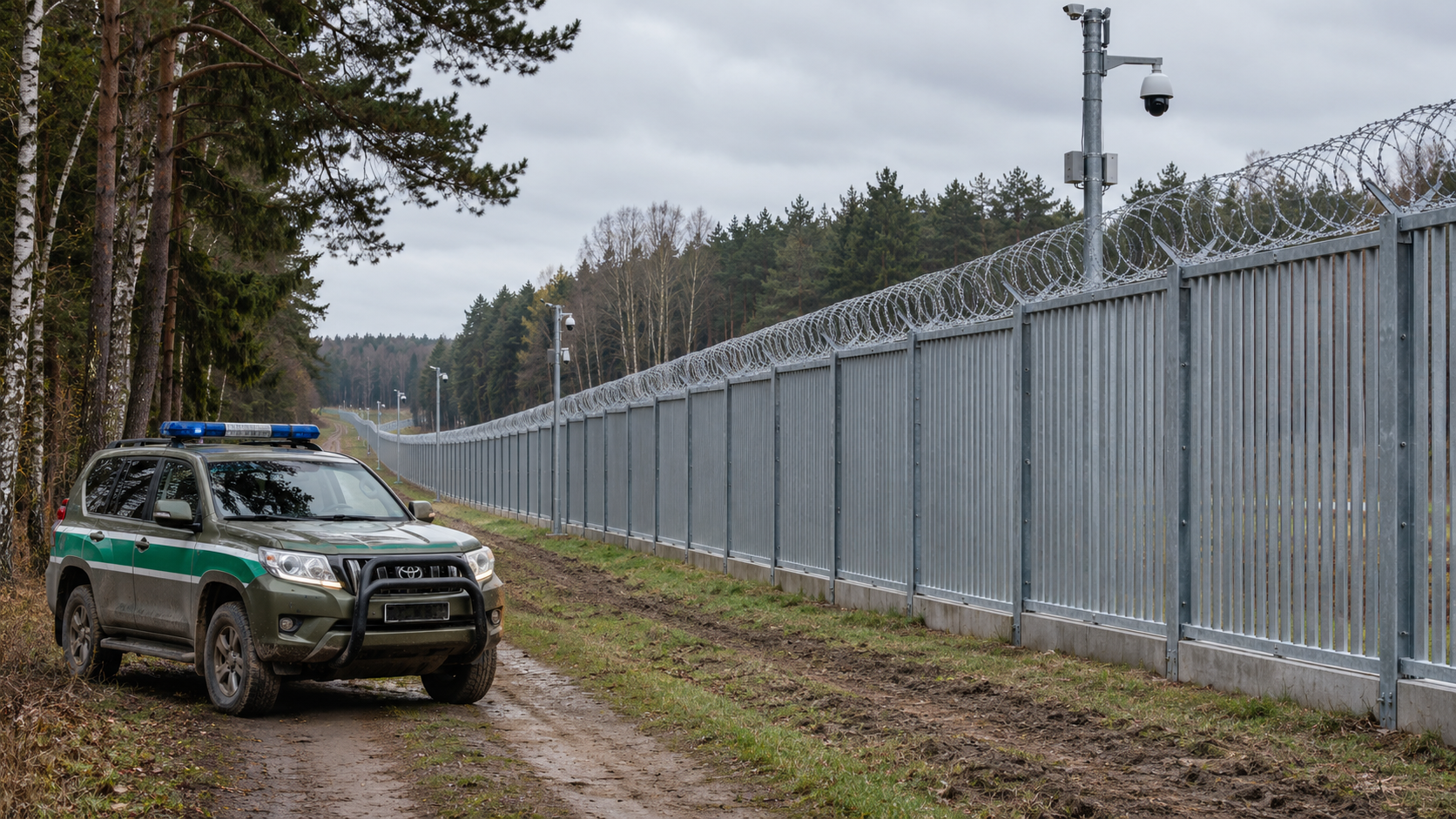
Poland’s government has approved proposals to introduce tougher criminal penalties for migrant smugglers and people who carry out dangerous attacks on police officers, border guards and other public officials. The legislation, approved by the Cabinet on 10 November, would introduce prison sentences of up to 20 years for organising illegal border crossings that result in a person’s death and increase the minimum fine for certain unlawful crossings from PLN 20 to PLN 500.
The amendments, prepared by the Ministry of Justice, are intended to strengthen protection for public officials and enable courts to impose more severe penalties on organisers of dangerous or profit-driven border crossings.
The government says the changes are necessary to address gaps in existing criminal legislation, particularly where smugglers expose people to serious danger or an attack on an officer involves a vehicle rather than a conventional weapon.
- Find more news from Poland on our Homepage .
However, the measures are not yet law. The Council of Ministers has approved the draft, which must still pass through Poland’s parliamentary legislative process.
Up to 20 years in prison for migrant smuggling resulting in death
One of the most significant proposed changes concerns Article 264 of Poland’s Criminal Code, which regulates offences involving the organisation of unlawful border crossings.
Under the existing provision, organising an illegal crossing for another person can carry a sentence of between six months and eight years’ imprisonment.
The government wants to introduce three additional aggravated forms of the offence, with higher penalties depending on the circumstances.
The proposed sentencing ranges are:
| Proposed offence | Prison sentence |
|---|---|
| Organising illegal crossings for financial or personal benefit | 1–10 years |
| Organising crossings that endanger the life or health of multiple people | 2–12 years |
| Organising crossings resulting in a person’s death | 3–20 years |
The sentencing ranges are set out in draft legislation UD425 and its accompanying legislative documentation.
The higher penalties are intended to distinguish particularly dangerous smuggling operations from less serious forms of unlawfully organising border crossings.
For example, a criminal organiser who transports migrants in conditions exposing several people to serious danger could face a substantially higher sentence under the proposed provisions.
The most severe penalty would apply when a person’s death results from the offence, subject to the legal requirements for establishing responsibility.
The government argues that these distinctions would give prosecutors and courts more appropriate tools to respond to the seriousness of individual cases.
Dangerous attacks on police officers and border guards
The legislation would also expand the circumstances covered by aggravated assault provisions protecting public officials.
Article 223 of the Criminal Code currently provides particularly serious penalties for certain assaults, including those involving firearms, knives or similarly dangerous objects.
However, questions have arisen over how the law should apply to other potentially lethal actions.
One example identified by the government is deliberately directing a moving vehicle towards a police officer or border guard.
Depending on the circumstances, courts may face difficulties determining whether a vehicle qualifies as an object sufficiently similar to the weapons expressly mentioned in existing legislation.
The proposed amendment would make clear that aggravated assault also covers conduct that directly threatens an official’s life through other means.
Government spokesman Adam Szłapka described this change during the post-Cabinet press conference on 10 November.


He identified the deliberate use of a car against a public official as an example of conduct the government wants to address more explicitly.
The relevant aggravated offence carries a potential prison sentence of one to ten years.
Importantly, the proposal would broaden the types of attack covered by that provision. It would not simply increase the maximum sentence for an offence already covered by the existing wording.
The government says the change is particularly relevant to police and Border Guard officers who may encounter dangerous confrontations while performing their duties.
Minimum fine for illegal border crossings could rise 25-fold
The draft legislation also proposes a significant increase in the minimum financial penalty for unlawful entry into Poland when the conduct constitutes a petty offence rather than a criminal offence.
Under Article 49a of the Code of Petty Offences, the minimum fine can currently be PLN 20.
The proposed new minimum would be PLN 500, an increase of 25 times.
According to the Justice Ministry’s explanation of the reforms, the increase is intended to make the financial penalty more significant and better reflect the nature of the offence.
The distinction between the two types of conduct is important.
Organising unlawful border crossings for others can constitute a criminal offence punishable by imprisonment.
An individual crossing a border unlawfully may instead face penalties under the Code of Petty Offences, depending on the circumstances.
The proposed increase would not mean that every migrant entering Poland irregularly automatically faces a PLN 500 fine.
Individual circumstances, the applicable legal provisions and any relevant protection or asylum procedures must still be considered.
Why the changes matter for Poland’s eastern border
The proposals have particular relevance to Poland’s continuing efforts to strengthen security along its eastern frontier.
Poland shares a border with Belarus, which also forms part of the European Union’s external border.
Since 2021, Warsaw has accused the Belarusian authorities of facilitating irregular migration towards the Polish border as a means of placing political pressure on Poland and the wider EU.
Belarus has disputed accusations concerning its role in the border crisis.
Poland has responded with additional border-security infrastructure, increased deployments of Border Guard personnel and soldiers, and changes to its migration and asylum policies.
The proposed criminal penalties form part of this broader security context, although the legislation would apply to offences involving Poland’s borders more generally.
Authorities are particularly concerned about organised smuggling networks that arrange unlawful crossings or transport people in dangerous conditions.
Such activities are distinct from the circumstances of every individual migrant or asylum seeker.
In an earlier case covered by Poland-24, Border Guard officers discovered 34 migrants hidden behind a false wall in a refrigerated lorry.
Cases involving concealed passengers and dangerous transport arrangements illustrate why authorities want stronger penalties for people who organise crossings that endanger lives.
Whether a particular incident would satisfy the new aggravated-offence provisions would remain a matter for prosecutors and courts.
Government withdraws controversial humanitarian-aid proposal
The legislative process has also involved disagreement over how far Poland should extend criminal liability in migration-related cases.
During consultations, the Ministry of the Interior and Administration proposed a separate amendment that could have criminalised certain assistance provided to people residing unlawfully in Poland even where the person offering assistance received no financial or personal benefit.
The suggested provision carried a potential prison sentence of up to three years.
Human rights organisations and legal experts warned that its broad wording could expose people providing charitable or humanitarian assistance to criminal prosecution.
Poland’s Commissioner for Human Rights raised concerns about proportionality and the possibility that activities intended to help vulnerable migrants could be treated as offences.
In an intervention dated 14 October 2026, the Commissioner’s office asked the Justice Ministry to clarify the proposal and whether additional consultation was necessary.
The Interior Ministry subsequently withdrew the controversial amendment.
As Rzeczpospolita reported following that decision, the ministry said border security measures must preserve protection for humanitarian assistance and efforts to save lives.
The withdrawn proposal is not part of the legislation approved by the Cabinet on 10 November.
The current bill nevertheless retains aggravated penalties for organising unlawful crossings for financial or personal benefit, making the precise interpretation of those provisions important during parliamentary scrutiny.
Questions raised over the severity of punishments
The proposed penalties have also attracted criticism from parts of Poland’s legal community.
Earlier in the legislative process, the Criminal Law Codification Commission and National Prosecutor Dariusz Korneluk questioned the severity of some proposed punishments for migrant smuggling.
Their concerns were reported by Dziennik Gazeta Prawna in September.
The debate concerns proportionality: whether the proposed sentencing ranges appropriately distinguish different forms of unlawful conduct and their consequences.
The government maintains that more severe punishments are justified where criminal organisers endanger multiple people or their actions result in deaths.
The issue may receive further attention when the bill reaches parliament.
What happens next?
The Council of Ministers approved the draft on 10 November 2026.
The legislation is formally titled Projekt ustawy o zmianie ustawy – Kodeks karny oraz ustawy – Kodeks wykroczeń and carries government legislative reference UD425.
The government’s official legislative register identifies the proposed amendments to Criminal Code Articles 223 and 264 and Code of Petty Offences Article 49a.
The draft must now proceed through the Sejm, Poland’s lower house of parliament.
If approved there, it would need to complete the remaining legislative process, including consideration by the Senate and the president.
The legislation would then require official publication before the new provisions could enter into force.
No effective date has yet been established.
Until the legislative process is completed, the existing criminal penalties and minimum fines remain in force.
The Cabinet’s decision therefore marks an important step towards tougher legislation, but does not itself change the legal penalties currently applicable in Poland.