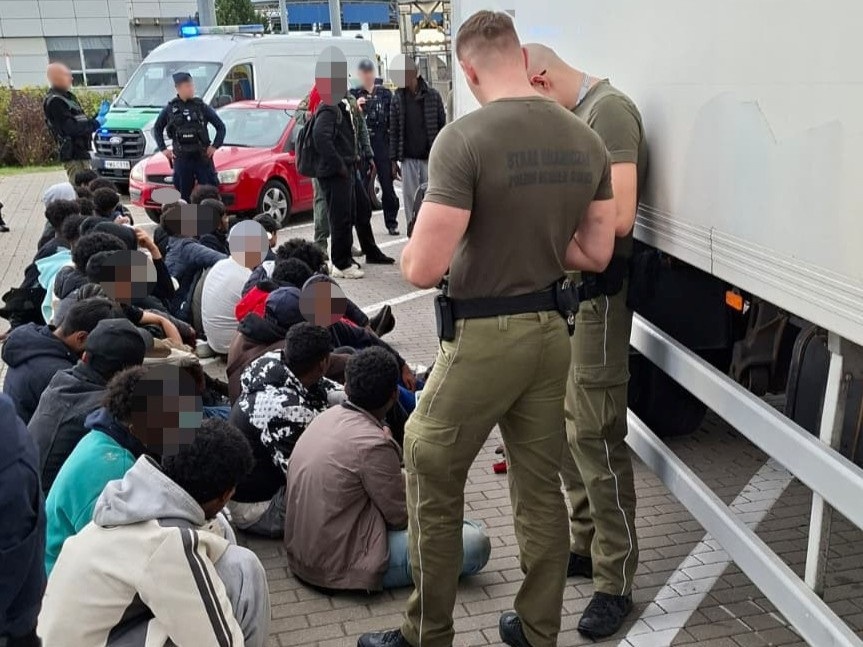
Polish border guards discovered 34 migrants hidden behind a specially constructed partition inside a refrigerated lorry on the A2 motorway near Poznań, in a suspected people-smuggling operation involving a route from Lithuania through Poland to Germany.
The interception took place on 14 September 2026. The Polish Border Guard initially announced the discovery the following day and confirmed on 23 September that two Serbian nationals had been charged and placed in pre-trial detention.
According to the Border Guard’s official account, the men are suspected of participating in an organised criminal group and helping foreign nationals cross the Lithuanian-Polish border unlawfully.
- Find more news from Poland on our Homepage .
A court ordered both suspects to be held in custody for three months while the criminal proceedings continued.
Migrants concealed behind a specially constructed wall
Officers from the Border Guard’s Poznań-Ławica unit intercepted two vehicles on the Poznań section of the A2 motorway: a Ford passenger car and a refrigerated Renault lorry.
Both vehicles were being driven by Serbian nationals.
The operation followed intelligence received from the Border Guard’s Podlasie division, which had alerted officers to a possible attempt to transport migrants through Poland.
When officers inspected the lorry’s cargo compartment, they discovered a false internal wall concealing 34 people.
The refrigerated vehicle had Lithuanian registration plates, according to the Border Guard’s initial report published on 15 September.
The people discovered inside were nationals of Pakistan, Egypt, Somalia, Sudan, Ethiopia, Tunisia and Eritrea.
Officials have not provided a complete public account of the conditions inside the concealed compartment, including whether refrigeration equipment was operating during the journey.
The operation highlights the potential dangers of transporting people in hidden compartments of commercial vehicles, where ventilation, emergency exits and access to assistance may be restricted.
Investigators identify suspected route to Germany
According to the Border Guard, investigators established that the intended journey would have taken the group from Lithuania through Poland and onwards to Germany.
The route is significant because Poland forms a major overland connection between the Baltic states and Western Europe.
The A2 motorway connects Poland’s central and western regions with Germany, making it an important international freight corridor.
The use of a refrigerated lorry with a specially constructed hiding place suggested an attempt to conceal the passengers from roadside inspection.
However, the authorities have not publicly established how long the people had been inside the vehicle, where they initially entered it or whether they had paid anyone to arrange the journey.
The alleged involvement of an organised criminal group remains subject to the criminal investigation.
Migrants had previously applied for international protection
The Border Guard said that all 34 people had documents confirming that they had submitted applications for international protection in Latvia or Lithuania.
Their possession of asylum-related documentation is an important distinction from the suggestion that they were simply undocumented migrants.

Having applied for international protection does not automatically authorise onward travel to another EU country.
The authorities said the group was transferred to Lithuania under readmission arrangements after the necessary procedures were completed.
Readmission refers to the process by which one country transfers a person to another country under applicable agreements and procedures. It does not, by itself, establish the final outcome of an individual’s asylum application.
The Border Guard has not provided individual decisions concerning the 34 people’s protection claims.
Serbian drivers charged and remanded in custody
Following the interception, the two Serbian drivers were detained and brought before prosecutors.
They were charged with participating in an organised criminal group and arranging unlawful border crossings for foreign nationals travelling from Lithuania into Poland, with Germany as the intended onward destination.
The investigation was handled by the District Prosecutor’s Office in Środa Wielkopolska, according to the Border Guard’s earlier announcement.
At the prosecution’s request, a court ordered three months of pre-trial detention for both men.
The alleged offences carry a potential prison sentence of up to eight years.
Pre-trial detention is a precautionary measure within criminal proceedings and does not constitute a finding of guilt. Both suspects retain the presumption of innocence.
The regional Border Guard’s statement of 23 September did not announce that an indictment had been filed or that the suspects had been convicted.
Another case on the A2 corridor
The September interception was not the only suspected people-smuggling case involving a Serbian driver on the A2 motorway in 2026.
On 9 July, Polish border guards reported intercepting a lorry near Stryków, west of Warsaw, carrying 13 foreign nationals.
Those passengers included nationals of Pakistan, Afghanistan and Bangladesh. The driver, a Serbian national, was placed under criminal investigation.
That was a separate incident, and the authorities have not established a connection between the two cases.
Nevertheless, both investigations involved suspected attempts to transport people westwards through Poland in commercial vehicles.
What remains unresolved
The Border Guard’s latest identified announcement concerning the September interception was published on 23 September.
It confirmed the charges, the court’s detention orders and the transfer of the 34 migrants to Lithuania.
No later public announcement establishing a conviction, a trial date or an extension of detention was identified during the review for this article.
The case illustrates how Polish authorities investigate suspected organised people-smuggling networks operating across several European borders, while leaving the eventual outcome of the criminal proceedings to the courts.