


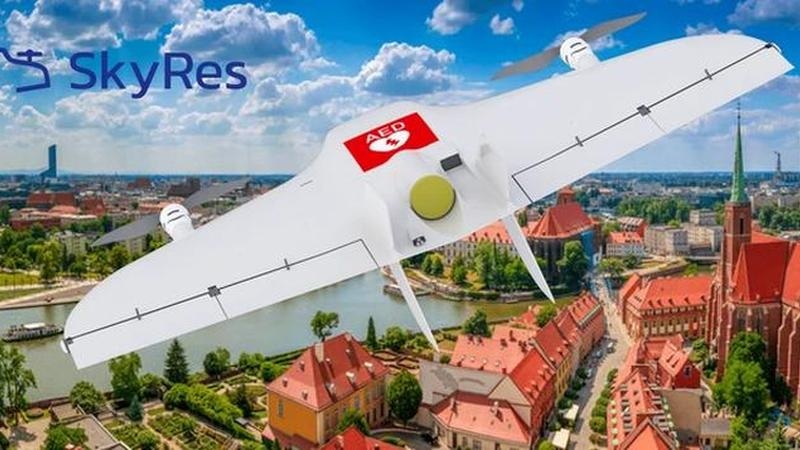
A life-saving drone developed by researchers at Wroclaw University of Science and Technology has won a gold medal and a special award at the Geneva Inventions Expo 2026, marking a significant achievement for Polish innovation on the international stage.
The unmanned aircraft system, called SkyRes, is designed to rapidly deliver automated external defibrillators (AEDs) to people suffering sudden cardiac arrest. The project was created by students and doctoral candidates in the Department of Technical Systems Operation at the university’s Faculty of Mechanical Engineering, with development supported through the Lider XIV program run by Poland’s National Centre for Research and Development.
How the Drone Works
SkyRes can carry up to 3.5 kilograms of medical equipment over a distance of up to 8 kilometers, according to its developers. The system combines vertical takeoff with fast horizontal flight, allowing it to operate effectively even in locations that are difficult for ground vehicles to reach.
- Find more news from Poland on our Homepage .
Developers say the drone can reach a person in cardiac arrest in approximately four minutes. That speed matters because survival odds and the risk of serious complications are largely determined in the first minutes after a person’s heart stops, well before most emergency medical crews can arrive on scene.
Recognition in Geneva
A team from the university presented SkyRes to an international jury at the Geneva Inventions Expo, one of the world’s most prestigious events dedicated to new inventions and technologies. The project received a gold medal from the expo itself, along with a special award from the National Research Council of Thailand.
“The invention was rated very highly by the international jury, which awarded us the exhibition’s gold medal as well as the special award from the National Research Council of Thailand,” said Bartlomiej Dziewonski, one of the project’s creators.
The university’s exhibition booth in Geneva drew a number of visitors, including Michal Broilo, Poland’s ambassador and permanent representative to the United Nations Office in Geneva, along with members of the diplomatic staff. “We presented them with the fundamentals of our project and the potential applications of the technology in emergency medical response systems,” Dziewonski said.
From Campus Project to Startup
The team behind SkyRes has moved beyond the research phase and is now working to commercialize the technology. The creators founded a startup called SkyRescue, which operates through the university’s Academic Business Incubator. University officials say the move demonstrates that innovations developed by students and doctoral candidates can carry genuine potential for real-world deployment in emergency medical systems.
Part of a Broader Delegation
The trip to Geneva was part of a larger program organized for winners of Poland’s national Student Inventor competition. The Wroclaw team showcased its project at the booth of the Association of Polish Inventors and Innovators during the expo.
University representatives also took part in a seminar at the World Intellectual Property Organization focused on current challenges in intellectual property protection. The visit’s itinerary additionally included a meeting at the United Nations Office in Geneva and a tour of the European Organization for Nuclear Research, known as CERN.
A Broader Signal for Polish Innovation
University officials described the Geneva win as more than a point of institutional pride, framing it as an example of how emerging technology can respond directly to urgent public health needs. Organizers of the Geneva expo present awards each year to inventions from around the world judged to be especially promising and practical, and SkyRes’s recognition places it among that group for 2026.
The achievement adds to a growing list of Polish university-led innovations gaining international attention in recent years, according to the university. Developers say they expect SkyRes and the broader SkyRescue venture to draw more attention in the coming years as the technology moves closer to practical deployment in emergency medical response networks